Working on a cover for a forthcoming children’s book:


A Notebook – Since 2007
 Count up 12 books from the bottom in the pic to the left (a stack of books mostly from the mid-60s) and you’ll find “The Fall of the House of Usher,” a book of short stories by Edgar Allan Poe. I spent a 9th grade weekend copying out longhand Poe’s tale “The Pit and the Pendulum.” Never mind why, but it was a punishment I rather enjoyed.
Six books from the bottom is “The Time Machine,” H. G. Wells’s forecast for long term care for the human race.
Eight books up you’ll find Jerzy Kosinski’s “The Painted Bird.” I was in 10th grade Home Room class sitting behind a friend who was reading furtively in a paperback I didn’t recognize. I asked him what he was reading. He gave me the book, but asked that if caught with it I would not tell where I got it. We didn’t know one another that well, though later we became good friends. He had substantially more stock with the authorities, was a genius. But he seemed concerned that I might be traumatized by the reading experience. Some critics now suspect that Kosinski was traumatized by the writing experience.
I wrote a paper in 10th grade arguing that Melville’s “Pierre, Or the Ambiguities” contained more social insight than “Moby Dick.” Unfortunately, I can’t fine my 10th grade copy of “Moby Dick”; fortunately, though, I can’t find the 10th grade paper I wrote, either. I still have the Rhinehart edition of “Moby Dick” we used at Dominguez Hills.
That Sherlock Holmes “Memoirs” used to have a partner, “The Adventures of Sherlock Holmes.” It’s a mystery what happened to it.
I remember first reading “The Spy Who Came in from the Cold” in high school, but I can’t remember what grade. But I remember wondering about a scene where Leamas is shaken by a near miss on the highway. Is he less shaken by the near miss than by the recognition that the near miss has shaken him?
I can’t find my 9th grade copy of “Two Years Before the Mast.” I can’t imagine anyone wanting to borrow it. In fact, a couple of weeks ago, we were moving some things around, sort of spring cleaning, impatient for spring, and we wound up with a couple of bags of used books we decided to take down to Powell’s. They took about half of them, but I was surprised they took as many as they did. Do literary influences wane over time? What else can’t I find? All the Steinbeck books gone, but I know where they went. All four original Salinger books not to be found, though three have been replaced. The early “Walden,” “On the Road,” but also replaced.
I don’t suppose anyone reads Asimov’s “The Human Body: Its Structure and Operation” anymore. If we want to know something about the human body, we google it. But who thinks of the body as an operating system? It’s like talking about books as physical objects, and as if their mere presence might have an effect on us, like a gravity, the experience of influence.
Related Posts: Reading influences and Henry Miller: more on reading influences.
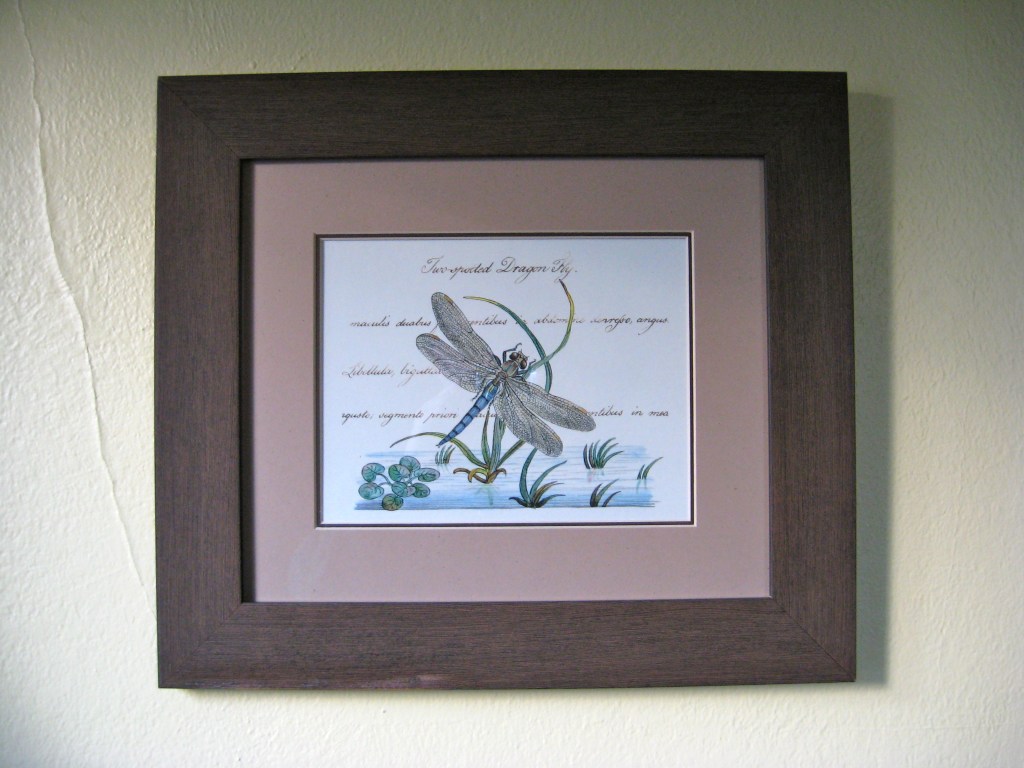
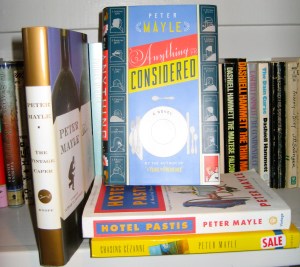 “Anything Considered” (1996) was purchased at an estate sale toward the end of last summer, along with a framed print of a dragonfly. I promptly found a place on the wall over the back room piano for the dragonfly, but I didn’t get around to reading my first Peter Mayle book (the author of, as the book covers repeat, “A Year in Provence,” which I’ve not read) until the holidays. I liked “Anything Considered,” and on a Powell’s run before Christmas found three more Mayle books in good used condition. The four read are what might be loosely described as mystery books, crime fiction, though the plots are not hard-boiled, not even soft-boiled, but over easy, poached, or sunny side up.
Indeed, the sun is a character in the southern French settings where Mayle’s mysteries are cooked, the plots as convoluted as French cuisine. Typically, the main character is a self-imposed outsider, disaffected with bourgeois standards, but not hostile to its spoils, inveigling his way in and out of capers involving an array of likable and despicable characters, though these labels don’t always identify the good and bad guys. Femmes arrive, though not of the fatale type, after a spell, and the plots are continually interrupted by structured meals with plenty of cheeses and wines. The writing is full of atmosphere created by descriptions of weather and water, food and drink, furniture and clothes, structures and landscapes. Much of the action takes place outdoors. The tone is often sarcastic, in places ribald. The plots move the characters out of Provence, to London or Paris, and the contrast has everyone, reader included, wanting to get back into the sun.
Of the four read, “Anything Considered” is the longest and most detailed, and contains the most sinister villain. I then read “Hotel Pastis” (1993), the funniest of the four, slapstick, even, with a primary dual running plot that weaves around and up and down like a bicycle ride through the countryside – actually, that is part of the plot. “Chasing Cezanne” (1997) adds art to the cheeses and wines, and “The Vintage Caper” (2009) adds a Hollywood flair to the mix.
But if I’ve not interested readers in the Mayle books, perhaps the dragonfly will satisfy:
 I asked Eric if for Christmas he might like a couple of books. It was a busy week, with the Christmas baby on her way, and so Susan and I found ourselves in Powell’s on Hawthorne two days before Christmas looking around for things we thought Eric might find interesting, not an easy chore, since we have trouble usually identifying things that even we might find interesting. It’s not easy finding the right book at the right time for someone. Choosing a book is like picking a campsite. But Susan’s a genius at this sort of thing, and found Nick Hornby’s 31 Songs, perfect, and Nickel and Dimed: Undercover in Low-wage USA, by Barbara Ehrenreich (the perspicacious reader will pick up on the perfect pairing these two books make).
Then, waiting in a long Powell’s last minute Christmas line with a hundred other Portlanders on Hawthorne, I spotted what appeared to be a little, homemade paperback, This is Portland: 13 Essays About the City You’ve Heard You Should Like, by Alexander Barrett. Three of the essays are only one sentence long (illustrated, to give them a bit more heft), and I liked that he still called them essays, and that you could read an entire essay standing in line at Powell’s on Hawthorne and that by the time you got to the counter, you could finish the book, and if you didn’t like it, you could just put it back. But I did like it, and I thought Eric would dig it, and the essay that cinched the deal (two pages long, still standing in line), was “Hawthorne V. Belmont,” about the supposed value clash between the two alt-commercial Portland East-side strips.
The author of This is Portland had only moved to Portland eight months before the writing of his book, but the book’s undated, which we find a bit weird, but Portlanders are supposed to value weird, so there you go, but a bit of Toads sleuthing and we came up with an on-line version of the book ($5 at Powell’s, but we’re more than ok with that, see below), and not only that, but we discovered (ok, this was actually pretty easy, the sleuthing part, since Alex the brief essayist included his website address at the end of his book) an amazing website devoted to himself, the Portland essayist, apparently hosted by his parents.
About being ok spending $5 for something available on-line for free: obviously, emailing somebody a link doesn’t make for much of a gift, but beyond that, we continue to support hard copy whenever we can, and Alex’s little hard copy book has already been shared and read by at least six others, folks dropping in on Christmas day to visit and share-alike. It’s a wonderful Portland.
Related: “Portlandia“; “Portlandia Portraits“

What would Benjamin Franklin, electrical experimenter and founder of our first public library, have thought of today’s electronic readers?
Of his first attempt at building a public library, he says, “…reading became fashionable; and our people, having no public amusements to divert their attention from study, became better acquainted with books…” (90), and he claims strangers noted the effects.
Having successfully completed the kite experiment, he invents the lightning rod (234-236), but he doesn’t seem to know when he’s having a good time: “Reading was the only amusement I allowed myself. I spent no time in taverns, games, or frolics of any kind” (91). Apparently, flying a kite in a lightning storm with one’s son is not frolicsome.
Early he had been turned into a practical person: “I now took a fancy to poetry and made some little pieces…They were wretched stuff, in street ballad style…,” but “the first sold prodigiously”; nevertheless, “my father discouraged me by ridiculing my performances and telling me verse-makers were generally beggars” (27).
The first library consisted of collective contributions – electronic books could not have been so shared. Nor printed, nor borrowed: “This bookish inclination at length determined my father to make me a printer…Often I sat up in my room reading the greatest part of the night, when the book was borrowed in the evening and to be returned early in the morning, lest it should be found missing or wanted” (26-27).
Franklin thought men most satisfied when employed, and best employed when able to handle their work independently from start to finish. He wrote of cleanliness, but lived, as we always do, in a time of muddiness. EBooks can’t be loaned or borrowed or returned. No foxing of the pages, no crimping, no dog-eared dirty garage sale wet basement copies. EBooks can’t be gifted, dedicated to someone we love, later to be second-handed at the local book sale, the dedication a fiction within a fiction. EBooks are to print books as cars are to walking, as the transistor radio is to live music, as a televised game is to the loose frapping of the ballpark.
We’re not sure what Franklin the scientist and printer would have preferred: book or electronic reader. “A book, indeed, sometimes debauched me from my work” (79). But for such debauchery, acoustic or electric should work.
 The Coming of the Toads