Tag: Biography

  • A Sane and Ordinary Blog Post: Paula Byrne’s “The Adventures of Miss Barbara Pym”

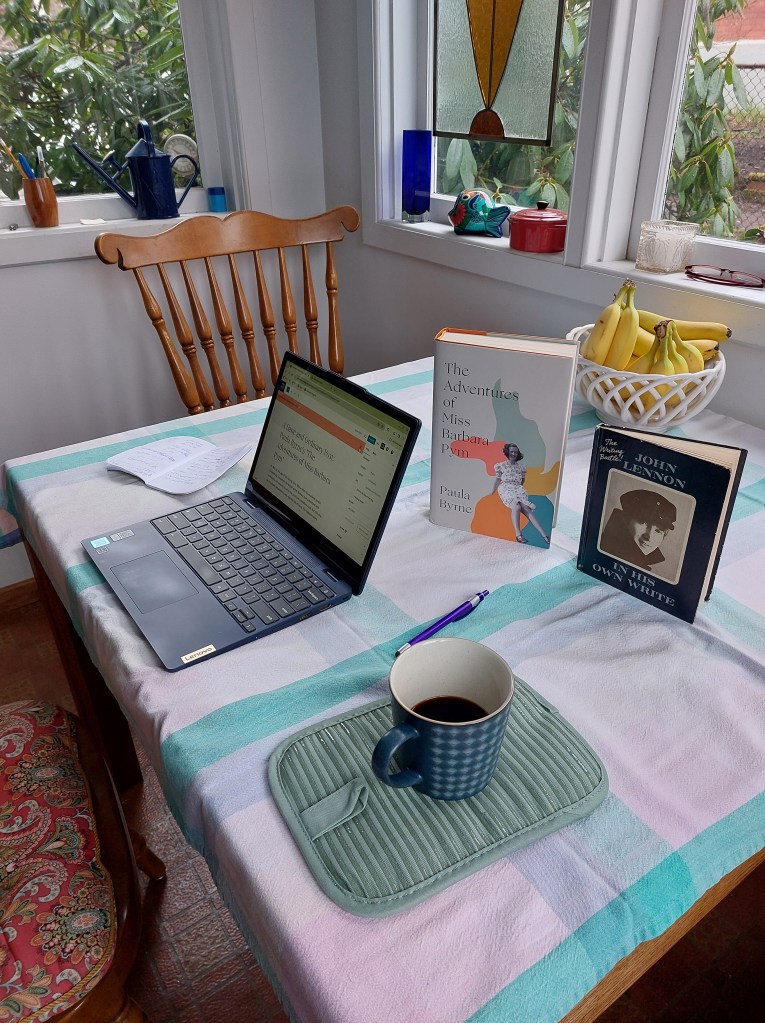
    In 1963, at the age of 50, having since 1950 written six excellent novels successfully published, the British writer Barbara Pym submitted with confidence her seventh novel to her publisher, Jonathan Cape. But this one, An Unsuitable Attachment, was rejected out of hand. The rejection story comes as a plot twist in Paula Byrne’s biography, The Adventures of Miss Barbara Pym (2021, William Collins).

    Then, as now, publishers were trying to respond to changes in their operating environment. After being rejected by her publisher Cape, Pym sent her new novel off, on a long successive round of submissions, to publisher after publisher, where it met with the same rejection fate, as if she were a writing newbie lost in the slush pile.

    Publishers are expected to make a profit. New books have always been expensive. Books are, after all, not a necessary. Yet few novelists, and even fewer, if any, poets, can survive financially off the royalties from their book sales. The occasional blockbuster book followed by a movie is the rare exception that has often helped support a publisher’s efforts to produce less popular works with literary merit. Detailed numbers of what might have been necessary to recoup publishing costs and turn a profit in 1963 are a small but important part of Byrne’s Pym biography, and because Pym continued to write without publishing, then over a decade later did publish anew and with even greater positive critical reception (including a Booker Prize nomination in 1977 for Quartet in Autumn), an interesting theme is suggested where we might find some insight into what gets published (and unpublished) and when and why.

    How many prospective sales were necessary in 1963 to get a publisher’s attention? Pym’s good friend British poet Philip Larkin suggested 4,000 as a break-even point: “I’m told that the economic figure for novels is 4,000 – and has risen a lot recently. The circulating libraries are diminishing, too – Smith’s gone, Boots going” (Byrne, 533). Larkin’s own book, The Whitsun Weddings (a collection of 32 poems published in February 1964), sold 4,000 copies in the first two months, an unusual poetry bestseller (504). Pym mentions to Larkin that “she heard Cape were about to publish a book by one of the Beatles: John Lennon? I think?” (497). The book in question was Lennon’s In His Own Write, which sold, according to Wikipedia, 300,000 copies in Britain, and was also a best seller in the US market. Wiki shows, citing Hazel Holt, that Barbara Pym’s book Excellent Women, published by Cape in 1952, had sold 6,577 copies by 1960. Writers decide what will be written, publishers decide what might be read, critics decide what’s good, and readers decide what to purchase. And then there’s the remaindered, not remembered.

    How do books get into the hands of readers? Public libraries, generally assumed to be in the public interest and of great cultural benefit, arrived at a cost to publishing. In England, since the mid 1700s, prior to public libraries, books were made available to the reading public through the use of “Circulating Libraries.” These were not free public libraries. They rented books for a fee. Nor were they housed in buildings. They traveled, by rail and wagon. Still, the rental fees were affordable only down to a middle class clientele. Later, stores carried books for rent, but usually as part of a store’s variable lines of business. Renting or selling books wasn’t enough to keep a stand-alone book business afloat. But the effect of renting books on publishing was simply this: readers could rent far more books than they could afford to purchase. It was therefore in the interest of the circulating library business for publishers to keep prices of new books high. If readers could not afford to buy new books, they would have to rent them.1

    All of that of course before the Internet, ebook, etc. Still, paper books persist. Past changes like the mass market, cheaply produced paperback brought book prices down, but still the book market is supply and demand driven, and it’s not easy determining what drives demand. Dime novels in the US and the Penny Dreadful in England were relatively cheap and brought literature to working class readers. I was a working class reader, started with comic books, graduated to Classics Illustrated at the suggestion of my Confirmation sponsor, who also encouraged me to read novels and to start my own library, six paperback books sitting on a window ledge of my bedroom. I still have a few of them. That books are a commodity, no more no less, may seem like a paradox to some readers:

    “One could make an argument that the book’s own history mitigates against seeing it as a commodity. For centuries, after all, the book’s primary place was at the center of religious practice. It is historically associated, as a result, with the evanescent, spiritual, not-for-profit world. But printed books, as Elizabeth Eisenstein and Raymond Williams have shown, have always had as much of a secular as a spiritual existence. Their history in the modern west is synonymous with the development of industrial production and the rise of consumer culture that went with it. If the book has maintained some sort of transcendent identity, it has done so despite its position at the center of the world of goods, not because of some privileged position outside it.” 2

    After the Cape rejection, Pym kept writing, kept submitting, and kept getting rejected. She reached a point where she told a friend, “All I want now is peace to write my unpublishable novels” (Byrne, 530). And, Byrne says, “Her friend Hazel Holt even suggested that she should think about publishing her novels privately for her loyal following of readers” (524). Today, of course, Pym could easily self-publish her novels. But would she? In any case, all of her books are today still in print, with many used copies of Pym books available for sale via sites like Alibris. And a quick check at Multnomah County Library shows ten Pym books available, but only one copy each, and six copies of the Byrne biography in stock.

    As critic, Larkin described what he liked to read, and he did not find fault with work devoted to a narrow alley of life, provided ample detail was given to bring that life into profound focus:

    “‘I like to read about people who have done nothing spectacular, who aren’t beautiful or lucky.’ He wanted to read about people who can see ‘in little autumnal moments of vision, that the so called big experiences of life are going to miss them.’ That such things are ‘presented not with self-pity or despair or romanticism, but with realistic firmness & even humour’” (521).

    Larkin, with connections in publishing, and as England’s popular poet, gave Pym emotional support and advocated on her behalf. Still, it took time to convince the publishers to reconsider. In a letter to Charles Monteith, editor at Faber, Larkin wrote:

    “Turn it down if you think it’s a bad book of its kind, but please don’t turn it down because it’s the kind of book it is…I feel it is a great shame if ordinary sane novels about ordinary sane people doing ordinary sane things can’t find a publisher these days. This is in the traditions of Jane Austen & Trollope and I refuse to believe that no one wants its successors today” (521).

    What kind of books were being published in 1963? John le Carre’s The Spy Who Came in from the Cold (which a couple of years later would be assigned reading in one of my high school English classes); Thomas Pynchon’s V.; John Rechy’s City of Night; Kurt Vonnegut’s Cat’s Cradle. And when the publisher Little, Brown republished in book form The New Yorker stories of 1955 and 1959, Raise High the Roof Beam, Carpenters and Seymour: An Introduction, by J. D. Salinger, it was the third best-selling novel in the US in 1963 (Wiki). (I remember seeing Mr. Abney, my 9th grade Language Arts teacher, reading it at his desk at the front corner of the room, stage right, next to our ground floor windows, which looked into the Breezeway, where the girls were at lunch recess.) While there were of course many other kinds of books published in 1963, those just mentioned probably would not qualify as the kind of book favored by Philip Larkin.

    There’s no critical advantage gained in trying to put down the 1963 books mentioned above, that’s not the point, they’re already classics, or of pooh-poohing John Lennon’s book as silly. The point is, what’s good is what achieves its purpose, even if that purpose might be considered bad, or if it’s not the purpose you want. Lennon’s book is successful on its own terms. It’s good because it achieves what Lennon wanted. It’s also good because it’s entertaining and clever and also gives a nod to James Joyce and his technique in Finnegans Wake. Few would have thought Lennon at the time might have been a Joycean. No amount of marketing could have achieved for a Pym book the kind of sales Lennon’s In His Own Write racked up. But Pym’s books also are good because they achieve what she wanted, are entertaining and clever, and her style, while original, gives a nod to Jane Austen, master novelist of them all.

    There is much more to Paula Byrne’s biography “The Adventures of Miss Barbara Pym” than the discussion above regarding what gets published. Byrne’s biography of Pym is 20th Century history as viewed from a specific writer who lived according to detail. Pym kept copious notebooks, always writing. She rethought, reconsidered, reconnoitered her every conversation, meal or tea, dress and dance, kiss or hug, relationship, experience. No detail was too small, the smallest maybe the most important. Bryne’s Pym biography might inspire any would-be writer, for we see Pym at work and play, see the ups and downs, the approvals and dismissals, the potential loneliness of life sitting at a typewriter, the rewards of completion and the hopes for a bite of recognition. We see where ideas for fiction come from and how life experience might be formed into fiction. In the end, the ordinary life, realistically rendered, given due attention, is exceptional and impressive and universally shared.
    1. Circulating Libraries,” Oxford Reference, The Oxford Encyclopedia of British Literature. ↩︎
    2. Ideas and Commodities: The Image of the Book.” Trish Davis. MIT Communications Forum. Undated. ↩︎
  • About Nora

    Most of us carry about a particular picture of ourselves, seldom the same picture others have of us. Some carry a portfolio of pictures about, anxious to show all they meet all about themselves – their family, schools, jobs, homes, accomplishments, disappointments, hobbies, books read, movies liked, places visited, lived, abandoned. Friends. Others don’t like having their picture taken, the only photo about them on their driver’s license, and that they don’t like either. Acquaintances may be more interested in your market value than in your face value.

    Taken at face value, that is, legal value, net worth at birth, which may or may not bear any resemblance to one’s market value at the end of a life of living, of struggle, of getting by, of adapting to, or avoiding where possible, the more absurd cultural mores, steering as clear of the wildly ridiculous ones met on the street as one possibly can, Nora Barnacle’s life story is nominal, average, without great distinction. Most of us share a similar story. But, as the lifelong partner of the famous writer James Joyce, Nora’s life story far exceeds its salvage value – it’s a life worth a ticket-scalping.

    But how should Nora’s story be told? Nora never read her husband James’s books, though he often read aloud to her from them, and she put no stock in literary values other than as a means to put food on the table, and which, as a means to make a living, for most of their lives proved woefully inadequate. They were never, until later in life and only then to satisfy the legal issues of the passing on of debts and assets and to protect their children, married, though they remained devoted to one another, having two children they were almost never separated from, living literally on top of one another in a seemingly endless succession of rented rooms, flats, shared spaces, hotel stays, sustained by gifts from sacrificing siblings and wealthy benefactors, until at long last Joyce’s reputation and writings began to produce earned royalties, distinction, and then the trappings of fame.

    Joyce was always, and in all ways, a difficult man to live with. He was impractical, stubborn, inattentive, wasteful, and drank to excess. They fight and argue, Nora threatens to take the kids and leave, but of course she’s nowhere to go, but more importantly nowhere she wants to go – she wants her life with Jim to settle in with the peace and love of its original promise, which was to take her away from a life and family and place of destitution, beggary, and abuse. At the same time, they love and celebrate – their family, birthdays and holidays, their marginal achievements and successes, their apartments, the air and freedom of life away from dreary and unfair Ireland. They celebrate food and drink, family and friends, music and poetry, dance and lovemaking. Meantime, they’ve the bad luck of having to live through two World Wars and the Great Depression.

    But how is the life just described, at face value, any different than most? Why do we want to know Nora’s story, particularly when, as we probably already know, she’s destroyed Jim’s letters to her and requested him to destroy her letters to him to keep private their private lives? They both remain victims, or feel victimized, to attempts to shame to control – attempts by the state, the church, society, friends and acquaintances, critics. Their attempt to live an existential life, defined by free choice, true to one another and to Jim’s belief in himself and his ability to make a difference with his writing (a difference to art, literature, and to all of the above), is a messy affair.

    Readers familiar with the James Joyce story, whether fan or foe of his writing, may feel differently about the Nora Joyce story. In Nuala O’Connor’s “Nora: A Love Story of Nora and James Joyce,” we experience the James Joyce story through the eyes and ears – the sentiments and temperament – of Nora, who tells the story in her own voice. And we get the Nora Joyce story. Nuala’s book is neither straight biography nor straight fiction. Readers may choose to focus on one or the other, but the blend is a perfect mix, and you can’t have the one without the other. The Nora here is Nuala’s Nora, not Joyce’s Nora nor even Nora’s own selfie. But you come to see that you can’t have James Joyce without Nora Joyce, nor can we have Nora without James. What a glorious and perfect union.

    Nora: A Love Story of Nora and James Joyce, by Nuala O’Connor, 2021, Harper Perennial.

  • Charlatan Beckett

    Charlatan Beckett

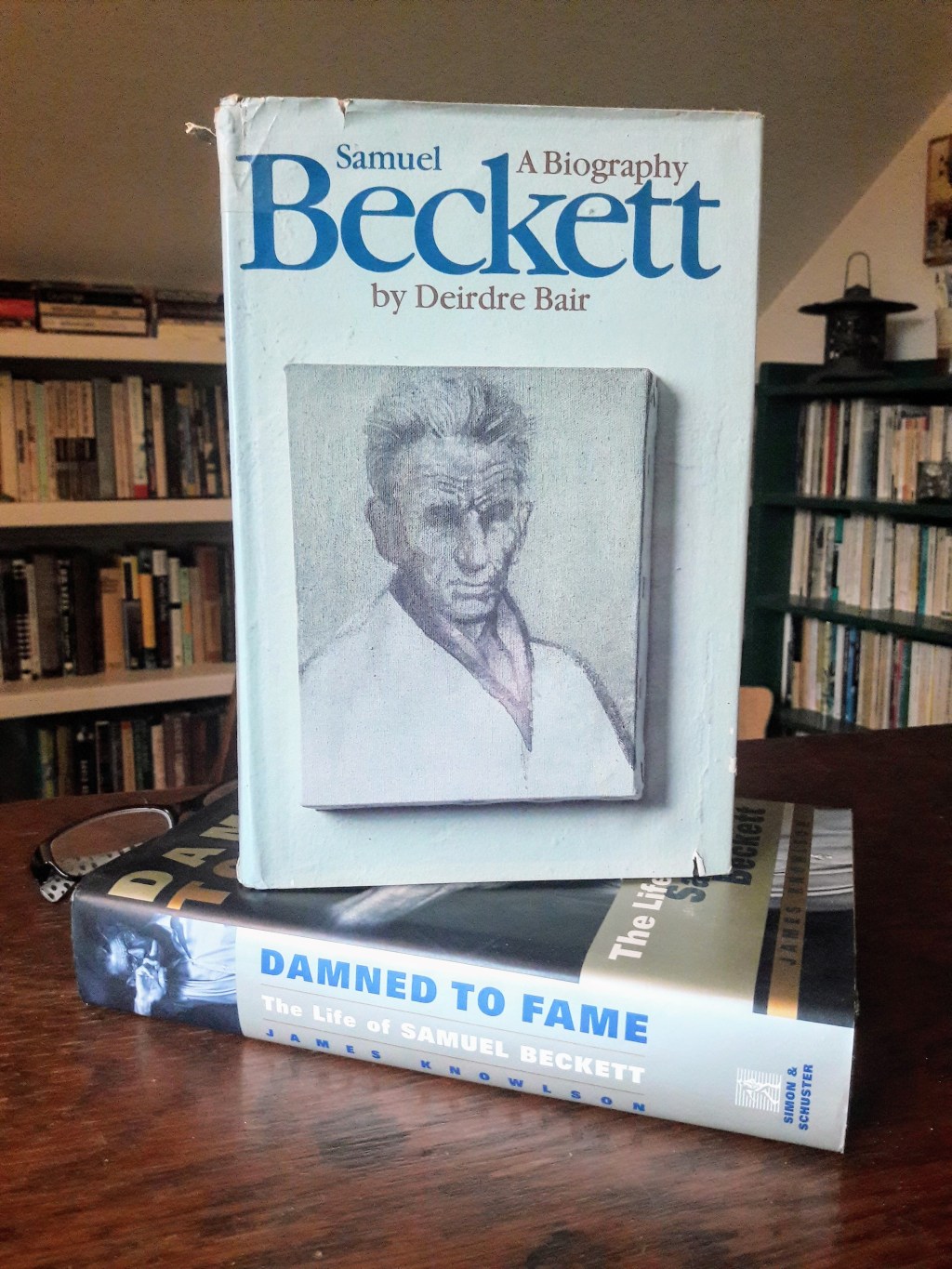
    The biographer Deirdre Bair, Samuel Beckett’s first official biographer, has passed away, the Times reports: ‘His first words to her, she wrote in “Parisian Lives,” were, “So you are the one who is going to reveal me for the charlatan that I am.”’

    Beckett may have hoped so. He certainly gave her that start, for he just gave away two key insights to his work. The etymology of charlatan includes “to prattle,” and “I talk nonsense.” And Charlie Chaplin’s work was fully enjoyed by Beckett. Chaplin was popular in France, and was colloquially called “Charlot.” Many (if not all) of Beckett’s characters seem inspired by the clown, the tramp, the outsider, the vaudevillian villain, whose humor reveals deep suffering truths of the human condition. We could die laughing.

    “You might say I had a happy childhood,” Deirdre Bair’s biography of Beckett begins. But the 1978 Times review frowns on the biographer’s focus on what appeared to be Beckett’s lifelong condition of anhedonia. For Bair, Beckett seemed the kind of person who had fun once, but didn’t enjoy it. Of course, Beckett himself fueled this kind of confusion, what he called tragicomedy.

  • Penelope Fitzgerald

    Susan, post El Porto
    Susan, post El Porto

    Hermione Lee’s recent Penelope Fitzgerald: A Life occasioned a number of reviews in the usual places. Most touched on the questions of how did Penelope do it (the uncanny way she cleans up the mess by throwing out the novelistic clutter extraneous to her enriched needs, leaving almost every sentient sentence embering in its own mystery), and when did Penelope do it (she did not write and publish her first novel until around age 60). Writing and publishing a novel are two different activities. Writing one at any age seems unremarkable; publishing one, at any age, may be. Readers often gawk and might wonder if Penelope was a so-called “late bloomer.” But the flower seduced into blooming too early may come to regret a late frost. In any case, there is little evidence that Penelope was a late bloomer. Her writing seems set in her past. The novels are reflections, reconsiderations of experience, of a life rooted in the mutation and gestation of failure. Failure, like slapstick, can be funny in a way success can never be, but only a writer bloomed wise (rather than, say, embittered) from omission will get this. Slapstick, too, is found where the waves of success (swells that break in a timely manner) dissipate on the strand of a listless audience.

    The narrator of a Penelope novel, always in third person, tells only what she wants to when she’s good and ready, often slipping very close to first person in what James Wood calls “free indirect style,” but might pull back and mention a year, not all that useful a piece of information, actually, considering 1960 aboard a barge on the Thames hardly suggests an environment the same as 1960 up from the Strand at El Porto, except that later it might help explain a question of whether or not television was invented yet or were the characters too poor or too bohemian to own one, and one begins to see the ship of one’s own home going down in a domestic storm just as easily on 44th in El Porto as on the Thames in London. Domestic themes are at once both universal and local; what matters is both what is said and how it is said. One doesn’t navigate one’s way through domestic turmoil following some staid rubric or outline; one lives through the hullabaloo and just maybe survives alone to tell the tale. And you must tell it as it happened, full of confusion and doubt about what might come next, wind always full in the sails, or might have happened, if someone, anyone, had their hand, even once in a while, on the tiller.

    Of the reviews of Lee’s Life I reviewed, I’ll only mention a few: Caleb Crain in Harpers, “Her Struggle: The reticence of Penelope Fitzgerald” (which I saw note of on his blog but had to renew my lapsed subscription to Harpers to see, only to be thwarted by a six week delay before my first issue arrived, which by then was the next month’s; no matter, by then, impatient, I was able to read Caleb’s review on-line, having gained re-admittance via subscription to go behind the Harper’s pay wall – you need a hand stamp); James Wood in The New Yorker, “Late Bloom”; Alexander Chee in Slate, “The Lady Vanished”; and Levi Stahl, on I’ve Been Reading Lately, “Penelope Fitzgerald’s notebooks.” I mention Caleb’s review because he waited until 46 to write and publish his first novel (following a novella published in n+1 and a number of non-fiction works, including articles, book, and blog); is Caleb a late bloomer? Of course not, but it’s interesting that the setting of Caleb’s Necessary Errors, like most of Penelope’s, occurs decades ahead of its writing and publication. Doesn’t wine aged twenty years taste different from the day it was bottled? Some writers are everblooming. Alexander Chee mentions not just the idea of the late bloomer but recounts the actual critical reaction to Penelope’s success that at the time combined skepticism with derision, as if to have arrived late and wearing a housedress provided adequate support for the claim unprolific oldster can’t write or she would have by now. And Levi Stahl’s review is interesting because it references an earlier review he wrote of Penelope’s The Afterlife, a collection of her non-fiction articles, and on the strength of his review, I picked up a copy and quickly saw that this whole late blooming explanation of anything is a dodge. The clue to understanding Penelope might have something to do with knowledge of patience, as this comment, from Bridget Read’s Paris Review “How She Knows,” explains:

    “It is vital to emphasize that Fitzgerald’s novels were not achieved in spite of her domestic life; they were borne directly out of it. Her work is radical in that it suggests that, in fact, a feminine experience, a liminal experience, might be better equipped than a male one to address the contradictions of human existence taken up by the greatest literature.”

    Levi Stahl’s review was of Penelope’s notebooks, and he quotes Penelope saying:

    “I am drawn to people who seem to have been born defeated or, even, profoundly lost.”

    It’s possible that Penelope’s testimony, expressed in her novels, belies even her most perceptive reviewers: did she not feel herself, during all those years of veritable single motherhood and low rung jobs thanks in large part to the miscreant missing husband – did she never feel neither beat nor no direction home?

    I am reminded here of Daisy from Penelope’s The Gate of Angels. Maybe Daisy wasn’t born defeated, but loss came nevertheless, which perhaps makes things even worse, for if one is not born defeated, one may not have the skills necessary for sane survival (wit and sense of humor, irony, empathy, honesty, ability to pack quickly and travel light) yet Daisy, in so many ways, never seems either defeated or lost. Even when she is actually lost, as in without a map, she manages to find a way out of that lostness. And of course the lone woman going astray into the for-males-only cloistered arena of Fred’s college is hilarious with irony. Daisy, for her obvious suffering, is existentially happy, the most telling characteristic of her personality, upon her like a birthmark, that she finds it easier to give than to take, to provide for than to ask from.

    This sense of being born lost, though, surely is gender neutral, but to find oneself lost with children in tow is a condition most often reserved for women. Reading Penelope, I am reminded of both Stevie Smith and Clarice Lispector, Stevie for humor, Clarice for a style of omission, and both for a hold on the occult. While I was reading The Bookshop, which employs a poltergeist, coincidentally Susan informed me a squirrel had taken up residence in an eve recently slightly opened by ice damage to a fascia board of our old house. I argued, since we had not actually seen the squirrel, that it could be a poltergeist. But Susan said, no, because the squirrel only made noise in the early morning, just before dawn, whereas a poltergeist prefers the hour just after you’ve fallen asleep.

    What else characterizes the style of Penelope’s short novels? The narrator often comments on the behavior of characters as if there are three parties at play at once: the character, the narrator, and the author. While to some readers, this may seem like a loose grip on point of view, it’s actually a way of condensing and rotating observation, like with a kaleidoscope. The action is close in, the distant details of world news obviously irrelevant. The focus is on detail – if things seem vague, it’s not for lack of detail, description, or dialog that reveals character. Character as Chaplinesque cog, subject to naturalistic randomness. Free indirect style, with the narrator making evaluative, reflective, and analytical comments, as if claims made may indeed be challenged, though of course there will be no reply. Still, almost everything continually on the go, or on the move, coming, as it were, as surprise. But isn’t that the nature of the domestic, which cannot be domesticated?

    So, I’ve read so far, of Penelope novels, in this order, as they came up in library queue: Offshore, my favorite I suppose for its setting of water and boats and mix of characters major and minor as well as the unexpected turns; At Freddie’s, again, a mix of young and old characters, age sometimes having little to do with maturity, and Freddie’s is how all schools should work; The Bookshop, atmosphere so strong you can smell the water and the books and hear the poltergeist and the cash machine; The Golden Child, bit of a mystery this one, though they all contain something of that genre; The Gate of Angels, again, while the plot is dated in a specific time zone, it hardly seems relevant in the sense the characters and their predicaments could be playing out even as we read. And I’m opened now to Human Voices. Now, in the interest of full disclosure, I started Innocence, but did not finish it. I had read about a third of it when I nonetheless had to admit that I couldn’t get my ear around it. I think something of the “historical novel” angle and too much of the fairy tale got in my way. Maybe I’ll go back to it some day. It’s often I pick up an old favorite book and wonder, how did I ever find this enjoyable? Likewise, I might pick up a book I long ago was unable to get into, and wonder, how could I not have appreciated this? Maybe I’ll have to wait until I turn 60, a late blooming reader. Meantime, I’ve also put Hermione Lee’s biography of Penelope Fitzgerald in the queue.