Finishing Barbara Pym’s “Excellent Women,” read aloud evenings recently with Susan, wondering in an aside what we’ll read next, as Pym’s first person narrator, Mildred Lathbury, says this:
“I had finished my library book, and thought how odd it was that although I had the great novelists and poets well represented on my shelves, none of their works seemed to attract me” (195).
Reading, at the time, just after World War II, in London, where food and shelter shortages continued, was a main source of resourcefulness for solving the difficulties of one’s free but empty time. But why Mildred’s pause in interest in the classics? What is she wanting to read?
“It would be a good opportunity to read some of the things I was always meaning to read, like In Memoriam or The Brothers Karamazov, but in the end I was reduced to reading the serial in the parish magazine” (195).
What follows is Mildred’s summary of that serial entry, which sounds very much like something from the book we have in hand by Barbara Pym, “Excellent Women.” Saying she was “reduced” is characteristically Mildred, too hard on herself, always questioning her own motives and chastising herself whenever she feels she’s been impolite, unkind, or unfair, or otherwise failing some obscure or fancied expectation that no one else would give a first thought to, let alone a second.
“The caption under the picture said, ‘I’m sure Mrs. Goodrich didn’t mean to hurt your feelings about the jumble sale.’ I finished the episode with a feeling of dissatisfaction. There was some just cause or impediment which prevented the clergyman from marrying the girl, some mysterious reason why Mrs. Goodrich should have snubbed her at the jumble sale, but we should have to wait until next month before we could know any more about it” (195).
The whole passage quoted in parts above can be read as Barbara Pym’s explanation or description of the type of writing she herself is attempting, or to include, but without setting the reader up for, in the end, a “dissatisfaction,” even if we have to wait for subsequent chapters to discover some “mysterious reason” behind things said or acted out. In as much as she might be seen to turn away from “the great novelists” (whoever they might have included, apart from Dostoevsky, in post war Europe, or in Mildred’s entering her 30s in late 1940s estimation), Barbara Pym actually engages many of their lofty themes, which turn out to be easily accessible to what the lowest of characters is capable of transmitting. The passage is a literary critical comment of her own writing, which is not “classic,” but an extension to the church newsletter, weekly bulletin, full of jumble sales and bazaar conversations about relationships, motivations, disassembling.
Humor and grace, alongside satire and wit and subtlety, abound in Pym’s work. So too in Penelope Fitzgerald’s, and I think our next book for reading aloud will be Penelope’s great “Offshore” (1979), which takes place around 1961, also in London, a decade after the setting of “Excellent Women.” Though Penelope was much older when she wrote “Offshore” (or any of her other novels) than Barbara Pym was when she wrote “Excellent Women,” she might well have been a character in a Barbara Pym novel. These are domestic novels, but unsentimental, and to qualify as such, the writing must be suited to being read aloud, and not overly dense. “Excellent Women” was some kind of fun reading aloud. We’ll see how “Offshore” goes.
I’ve been reading aloud evenings to Susan, “Excellent Women,” by Penelope Pym. First published in 1952, the setting is London after the war. Soldiers are coming home, rentals are hard to find, some foods are still being rationed. The narrator is the understated, astute Mildred Lathbury, a bit over 30, who has a flat of her own, but must share a bathroom with the lodgers downstairs. She attends church regularly, helps with the jumble sales and flowers for the altar, and is drawn into relationships involving a cast of characters requiring her free and easy to come by assistance. Every character’s name seems effectively thought out. Not my favorite character, but certainly my favorite name, is Everard Bone, an anthropologist:
“I crept quietly up to my flat and began to prepare supper. The house seemed to be empty. Saturday night . . . perhaps it was right that it should be and I sitting alone eating a very small chop. After I had washed up I would listen to Saturday Night Theatre and do my knitting. I wondered where the Napiers were, if they were out together, or if Helena was with Everard Bone” (57).
It’s my third time reading “Excellent Women,” but just the first time reading it aloud. A few nights ago, a chapter began with this:
“A list of furniture is not a good beginning to a letter, though I dare say a clever person with a fantastic turn of mind could transform even a laundry list into a poem.
I sat for a long time at my desk, unable to put pen to paper, idly turning the pages of a notebook in which I kept accounts and made shopping lists. How fascinating they would have been, had they been mediaeval shopping lists! I thought. But perhaps there was matter for poetry in them, with their many uncertainties and question marks” (164).
And I have been sitting this morning at my writing table wondering if I have time for some writing that might make for a good post for this here Hear ye blog. The electric folks are on the block this week replacing utility poles, and we’ve been told they will shut our power off for most of the day today, likely around 8 to 3, though it’s now 9 and the coffee is still hot and the temperature inside stable. The big inconvenience, once the power goes off, comes from it being only around 40 degrees out, and our old place does not hold heat any longer than a tee shirt and swim trunks in a dunk at Refugio.
A few weeks ago, I bought a digital subscription to the New York Times for $4.00 a month. Little did I know at the time that I would spend as much time on their Games page as on their news. Like most things pocket phone related, the games are addictive. My favorite is Spelling Bee. Every day, a new circle of 7 letters is posted for you to type as many words over 3 letters long as you can find – all using the center letter. Today’s letters amount to a difficult episode: b c d y t e o. So far, I’ve found only 8 words: Body, Booty, Byte, Dotty, Eddy, Teddy, Toddy, and Toyed. My score at this point is “Nice,” the rankings ranging from Beginner to Good Start, Moving Up, Good, Solid, Nice, Great, Amazing, and Genius. A four letter word is worth only 1 point, longer words worth more, a pangram scores high. The longest word I’ve logged so far is Ineffective. Statistics are maintained in the game file. I’ve worked 35 puzzles, finding 755 words, including 16 pangrams, but only 4 times have I scored Genius.
I doubt Barbara Pym succumbing to digital games, but maybe Mildred Lathbury would play along. Here’s a short poem I made using the words from the Spelling Bee mentioned above:
Waiting for a Cold Spell Teddy swimming in the spilling morning waves Dotty over having this morning scored Amazing In the New York Times oft ToyedToddy in hand Testing word Bytes but Eddy and Bill stay away For the Booty is holy Body alone and cold here Unlike marbles in a warm dust of green Spring.
“Excellent Women,” by Barbara Pym, was first published in Great Britain by Jonathan Cape in 1952, in the US by E. P. Dutton in 1978, and my edition by Penguin Books in 2006.
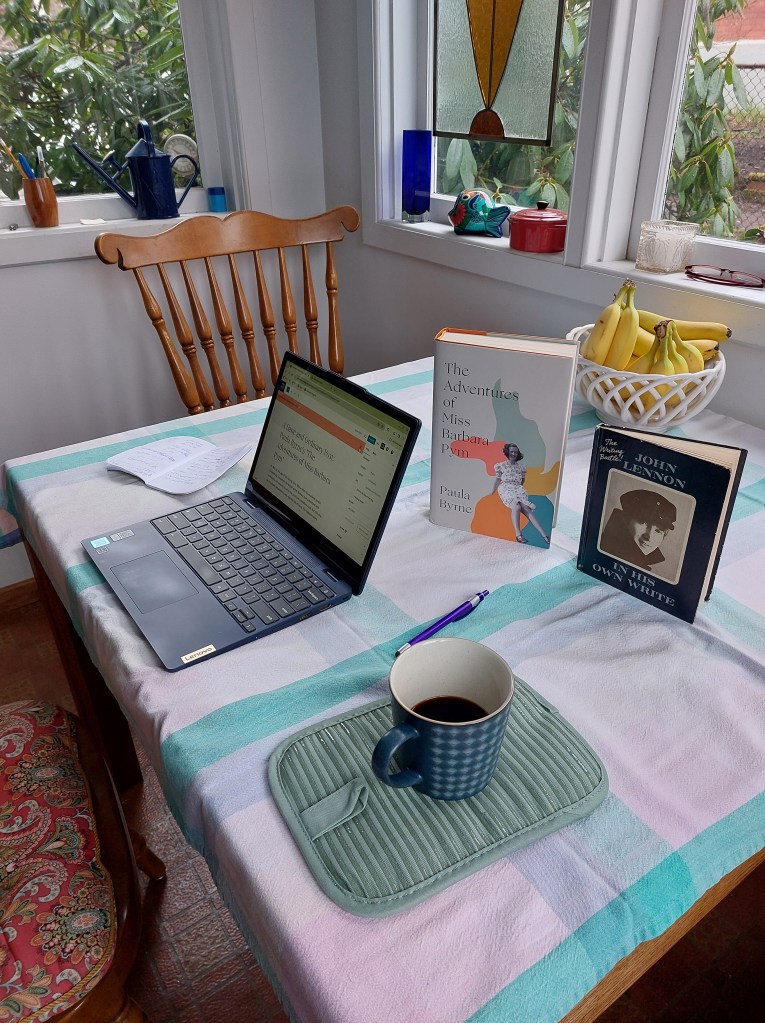
In 1963, at the age of 50, having since 1950 written six excellent novels successfully published, the British writer Barbara Pym submitted with confidence her seventh novel to her publisher, Jonathan Cape. But this one, An Unsuitable Attachment, was rejected out of hand. The rejection story comes as a plot twist in Paula Byrne’s biography, The Adventures of Miss Barbara Pym (2021, William Collins).
Then, as now, publishers were trying to respond to changes in their operating environment. After being rejected by her publisher Cape, Pym sent her new novel off, on a long successive round of submissions, to publisher after publisher, where it met with the same rejection fate, as if she were a writing newbie lost in the slush pile.
Publishers are expected to make a profit. New books have always been expensive. Books are, after all, not a necessary. Yet few novelists, and even fewer, if any, poets, can survive financially off the royalties from their book sales. The occasional blockbuster book followed by a movie is the rare exception that has often helped support a publisher’s efforts to produce less popular works with literary merit. Detailed numbers of what might have been necessary to recoup publishing costs and turn a profit in 1963 are a small but important part of Byrne’s Pym biography, and because Pym continued to write without publishing, then over a decade later did publish anew and with even greater positive critical reception (including a Booker Prize nomination in 1977 for Quartet in Autumn), an interesting theme is suggested where we might find some insight into what gets published (and unpublished) and when and why.
How many prospective sales were necessary in 1963 to get a publisher’s attention? Pym’s good friend British poet Philip Larkin suggested 4,000 as a break-even point: “I’m told that the economic figure for novels is 4,000 – and has risen a lot recently. The circulating libraries are diminishing, too – Smith’s gone, Boots going” (Byrne, 533). Larkin’s own book, The Whitsun Weddings (a collection of 32 poems published in February 1964), sold 4,000 copies in the first two months, an unusual poetry bestseller (504). Pym mentions to Larkin that “she heard Cape were about to publish a book by one of the Beatles: John Lennon? I think?” (497). The book in question was Lennon’s In His Own Write, which sold, according to Wikipedia, 300,000 copies in Britain, and was also a best seller in the US market. Wiki shows, citing Hazel Holt, that Barbara Pym’s book Excellent Women, published by Cape in 1952, had sold 6,577 copies by 1960. Writers decide what will be written, publishers decide what might be read, critics decide what’s good, and readers decide what to purchase. And then there’s the remaindered, not remembered.
How do books get into the hands of readers? Public libraries, generally assumed to be in the public interest and of great cultural benefit, arrived at a cost to publishing. In England, since the mid 1700s, prior to public libraries, books were made available to the reading public through the use of “Circulating Libraries.” These were not free public libraries. They rented books for a fee. Nor were they housed in buildings. They traveled, by rail and wagon. Still, the rental fees were affordable only down to a middle class clientele. Later, stores carried books for rent, but usually as part of a store’s variable lines of business. Renting or selling books wasn’t enough to keep a stand-alone book business afloat. But the effect of renting books on publishing was simply this: readers could rent far more books than they could afford to purchase. It was therefore in the interest of the circulating library business for publishers to keep prices of new books high. If readers could not afford to buy new books, they would have to rent them.1
All of that of course before the Internet, ebook, etc. Still, paper books persist. Past changes like the mass market, cheaply produced paperback brought book prices down, but still the book market is supply and demand driven, and it’s not easy determining what drives demand. Dime novels in the US and the Penny Dreadful in England were relatively cheap and brought literature to working class readers. I was a working class reader, started with comic books, graduated to Classics Illustrated at the suggestion of my Confirmation sponsor, who also encouraged me to read novels and to start my own library, six paperback books sitting on a window ledge of my bedroom. I still have a few of them. That books are a commodity, no more no less, may seem like a paradox to some readers:
“One could make an argument that the book’s own history mitigates against seeing it as a commodity. For centuries, after all, the book’s primary place was at the center of religious practice. It is historically associated, as a result, with the evanescent, spiritual, not-for-profit world. But printed books, as Elizabeth Eisenstein and Raymond Williams have shown, have always had as much of a secular as a spiritual existence. Their history in the modern west is synonymous with the development of industrial production and the rise of consumer culture that went with it. If the book has maintained some sort of transcendent identity, it has done so despite its position at the center of the world of goods, not because of some privileged position outside it.” 2
After the Cape rejection, Pym kept writing, kept submitting, and kept getting rejected. She reached a point where she told a friend, “All I want now is peace to write my unpublishable novels” (Byrne, 530). And, Byrne says, “Her friend Hazel Holt even suggested that she should think about publishing her novels privately for her loyal following of readers” (524). Today, of course, Pym could easily self-publish her novels. But would she? In any case, all of her books are today still in print, with many used copies of Pym books available for sale via sites like Alibris. And a quick check at Multnomah County Library shows ten Pym books available, but only one copy each, and six copies of the Byrne biography in stock.
As critic, Larkin described what he liked to read, and he did not find fault with work devoted to a narrow alley of life, provided ample detail was given to bring that life into profound focus:
“‘I like to read about people who have done nothing spectacular, who aren’t beautiful or lucky.’ He wanted to read about people who can see ‘in little autumnal moments of vision, that the so called big experiences of life are going to miss them.’ That such things are ‘presented not with self-pity or despair or romanticism, but with realistic firmness & even humour’” (521).
Larkin, with connections in publishing, and as England’s popular poet, gave Pym emotional support and advocated on her behalf. Still, it took time to convince the publishers to reconsider. In a letter to Charles Monteith, editor at Faber, Larkin wrote:
“Turn it down if you think it’s a bad book of its kind, but please don’t turn it down because it’s the kind of book it is…I feel it is a great shame if ordinary sane novels about ordinary sane people doing ordinary sane things can’t find a publisher these days. This is in the traditions of Jane Austen & Trollope and I refuse to believe that no one wants its successors today” (521).
What kind of books were being published in 1963? John le Carre’s The Spy Who Came in from the Cold (which a couple of years later would be assigned reading in one of my high school English classes); Thomas Pynchon’s V.; John Rechy’s City of Night; Kurt Vonnegut’s Cat’s Cradle. And when the publisher Little, Brown republished in book form The New Yorker stories of 1955 and 1959, Raise High the Roof Beam, Carpenters and Seymour: An Introduction, by J. D. Salinger, it was the third best-selling novel in the US in 1963 (Wiki). (I remember seeing Mr. Abney, my 9th grade Language Arts teacher, reading it at his desk at the front corner of the room, stage right, next to our ground floor windows, which looked into the Breezeway, where the girls were at lunch recess.) While there were of course many other kinds of books published in 1963, those just mentioned probably would not qualify as the kind of book favored by Philip Larkin.
There’s no critical advantage gained in trying to put down the 1963 books mentioned above, that’s not the point, they’re already classics, or of pooh-poohing John Lennon’s book as silly. The point is, what’s good is what achieves its purpose, even if that purpose might be considered bad, or if it’s not the purpose you want. Lennon’s book is successful on its own terms. It’s good because it achieves what Lennon wanted. It’s also good because it’s entertaining and clever and also gives a nod to James Joyce and his technique in Finnegans Wake. Few would have thought Lennon at the time might have been a Joycean. No amount of marketing could have achieved for a Pym book the kind of sales Lennon’s In His Own Write racked up. But Pym’s books also are good because they achieve what she wanted, are entertaining and clever, and her style, while original, gives a nod to Jane Austen, master novelist of them all.
There is much more to Paula Byrne’s biography “The Adventures of Miss Barbara Pym” than the discussion above regarding what gets published. Byrne’s biography of Pym is 20th Century history as viewed from a specific writer who lived according to detail. Pym kept copious notebooks, always writing. She rethought, reconsidered, reconnoitered her every conversation, meal or tea, dress and dance, kiss or hug, relationship, experience. No detail was too small, the smallest maybe the most important. Bryne’s Pym biography might inspire any would-be writer, for we see Pym at work and play, see the ups and downs, the approvals and dismissals, the potential loneliness of life sitting at a typewriter, the rewards of completion and the hopes for a bite of recognition. We see where ideas for fiction come from and how life experience might be formed into fiction. In the end, the ordinary life, realistically rendered, given due attention, is exceptional and impressive and universally shared.
“Circulating Libraries,” Oxford Reference, The Oxford Encyclopedia of British Literature. ↩︎
Barbara Pym’s novels are relaxing reads. I found her while reading and following Penelope Fitzgerald, Elizabeth Taylor, Elizabeth Bowen – other 20th-century British female writers I’ve been reading and have grown to appreciate and like and want to share. I finished the Hermione Lee biography of Penelope some time ago. Writers, like the rest of us, don’t always lead exceptional or excellent lives. And a biographer needs tools and supplies to work with. I recently read Susan Cheever’s biography of e. e. cummings – much material for a biographer to work with there: Harvard and its takes and mistakes; both World Wars and post-war worlds; the Great Depression; the eccentric poet at work and play; the effects of criticism and changing popular and academic tastes on a writer’s occasions for work; notes and diaries; interviews; and correspondence. But readers interested in 20th Century British history and literature will find good reference and enjoyable works among these women writers: Bowen was born in 1899, Taylor in 1912, Pym in 1913, and Fitzgerald in 1916. They are not modernists in the sense of James Joyce or Samuel Beckett or Virginia Woolf or Gertrude Stein, even if they constitute a newer generation. Their novels are characterized by realistic prose and dialog, and as for history, the settings are often domestic, about family and relationships, work, church as social community place (think jumble sale, what here we call rummage sale), not so much about historical events as about the effects of the great tides on individuals in society, but of the person in an outlier sense. Consider Nenna in “Offshore,” living on the barge Grace on Battersea Reach on the Thames with her two young girls, estranged from her strange husband who in a final desperate argument-ending-blow, yells at her, “You’re not a woman!”
I ordered a copy of Paula Byrne’s Pym biography, “The Adventures of Miss Barbara Pym” (2021, William Collins, London). I’m on page 179 of the close to 700 page tome. I started out reading the inside cover blurb on the author, Paula Byrne, which mentions, “She is founder and lead practitioner of ReLit, the charity for literature and mental health.” Having never heard of ReLit, I looked it up and found a site illustrating a small organization’s devotion to using literature to assist those struggling to handle the slings and arrows of daily life, whether king, knight, or knave. From ReLit’s About page:
“ReLit is the Foundation for bibliotherapy: the complementary treatment of stress, anxiety and other conditions through slow reading of great literature, especially poetry. We believe in the power of words to restore and relight the human mind.”
Apt words have power to assuage / The tumors of a troubled mind / And are as balm to festered wounds (John Milton, Samson Agonistes)
I discovered on the ReLit site, and ordered from Alibris a used copy, a book titled “Stressed, Unstressed: classic poems to ease the mind” (2016, William Collins, London). The poems are indeed for the most part classic, the youngest poet included born in 1952, Linton Kwesi Johnson. The book is divided into 12 chapters devoted to themes related to dealing with stress, for example, “meditating,” “feeling alone,” “living with uncertainty,” “positive thinking.” (Stressed, unstressed also of course about the forms of poetic syllabication and lines.) Each chapter is introduced by a short explanatory essay on the given theme. The book is not an escape portal, though. The poems may or may not help the afflicted in a time of need. But as Jonathan Bate says in his introduction: “If words can do the work of drugs, what is to lose by putting them in our mental health first aid kit? There is nothing to lose and everything to gain.” Of course there are many different kinds of poetry and poetic definitions. The book “Stressed, Unstressed” uses the Wordsworth definitions: “the spontaneous overflow of powerful feelings” or “emotion recollected in tranquility.” Further into the book, we find mindfulness strategies discussed, and I was reminded of the Thich Nhat Hanh “how to books” (e.g. “How to Relax”), which focus on calm breathing and attentiveness to the moment.
I think I might prefer, to the poetry as a means toward relaxation, the novels of Barbara Pym as well as Penelope Fitzgerald, Elizabeth Taylor, and Elizabeth Bowen. Too often, for me, poetry, like the classic country western song, often plays upon the emotions in the way of pathos, stirring the emotions rather than calming them. In any case, all of the subject of this post has me wondering if readers here at The Coming of the Toads find for the most part relaxing reads or stuff that gets the dander up. My hope is for the former, the relaxed, the three breaths you take while waiting for the page to change.
Speaking of nothing, Henry Green wrote a novel titled “Nothing” (1950). “Nothing” shares some of the characteristics of the early radio and television soap operas. It’s nearly all dialog; one can’t see the narrator, but the storyteller sees the reader. “Nothing” is about the nothing that is the something at the center of human activity. One forgets the narrator is watching one’s every move. From dialog only the characters are drawn, succinctly and diversely, such is the clarity of their voices – that they talk mostly of nothing is nothing. It only matters what one says. By nothing is not meant something insignificant; on the contrary – it is only through the direct encounter of nothing, where the characters are stripped of all their lies and workarounds, diversions and investments, that the essence of true life is revealed.
Yet it’s 1948, and these “Nothing” characters don’t seem as affected by the recent war as Barbara Pym’s characters in similar settings. “Nothing’s” John, knowing his daughter Mary “was to be out of London the next forty-eight hours on some trip in connection with her Government job” (133) – but we find out little to nothing about that job or what the connection is. The war of course was an unpleasant affair, its results mostly visible in the everyday details of work-a-day life: the difficulty of finding a suitable flat or flatmate, parsing wardrobes, the reopening of restaurants as places of interest, the local church the center of social, cultural, familial life (think jumble sales, lectures, and clubs of all sorts), and the shortage of marriageable men or men with the proper attitude toward marriage. Thus stripped of diversion and meaningful advertisement these folks on the edge of nothing seem a peculiar precursor to our time when commercialism and popular culture, and the adulation of the famous for being famous and nothing more, seem to reckon yet another coming.

 The Coming of the Toads