Tag: Apples

  • Apple’s Tale

    I could have been applesauce. Or a French apple tart. Or a Viennese strudel, dessert following an outdoor Oktoberfest Mozart concert. Something fit for a queen. Instead, some two-bit squirrel is eyeing me for a quick bite of fodder. I could have been a hard cider. I suppose I still might be.

    They say we don’t fall far from our tree, but if your tree is on a steep hill and you get squeezed out early by self-thinning siblings and you hit the ground bouncing and spinning, you might end up, as I did, in a patch of dry grass on the edge of a grade school playground.

    We live to be eaten. And it’s what we want. It’s complicated, and I don’t pretend to understand it all, but ever since I was awoken by the bees, those giant furry honey bees, and the little masons, the breeze also stirring my imagination – anything seemed possible on that early Spring morning when we got our first taste of sunshine and our petals felt like wings and we thought we might fly with the bees through the trees.

    My tree was planted as part of an orchard up on the hillside sometime in the late 1800’s. There are not too many of those early trees still around. They watched the city grow slowly from across the river and up the Eastside slope – growth that took out a lot of trees.

    Funny how things grow and move around and live off one another. It takes cooperation for life to thrive.

    I was hoping to be part of a bushel full of my siblings that might make its way to some outdoor market. That was fantasy. My old tree is lucky to produce a single peck these days. And it’s been a hard go since that day awhile back the temperature reached 117 degrees. We prefer the chill side, but still, we’re not all that picky. We start off cold, slumber in the warm shade of summer, and finish cool. Life is not bad being an apple. And there are, contrary to idiom, no bad apples, just poor storage.

    But a crop of boys one decade used the apples for their backyard baseball games. Wooden hardball bats. Talk about applesauce. The old tree was happy to see the boys grow up and move on. Another family took exceptional care of the tree. Every year careful pruning, watering, thinning, picking – and storage in their cool, dry basement. They made applesauces, cobblers and crisps, and prize ribbon-winning pies. But that family also moved on. An older couple that spent most of their time travelling abroad moved in and let my tree grow wild, apples falling and rotting, fermenting, covered with wasps in the fall. Those years the yard was full of birds. One year there were skunks. Raccoons were common. And a family of possums took up residence under the back porch, though they mainly fed off the slugs and bugs and tiny rodents attracted by the fallen apples.

    All this and more my tree passes on to its apples, how to open to the coming of the bees, the loss of petals, the June drops, our capricious caretakers – the humans who covet us. We know our past, and fancy we know something of the present, but guessing our future is tricky.

    One day, hidden in the schoolyard grass, I was found by a dog chasing a ball, and I was picked up by a boy and put in his jacket pocket, and I went for a walk with the boy and his dog around the playground. Over a fence I was tossed, into the back of a nursery, in among the rose bushes potted for sale.

    I got picked up again, looked at closely and felt all over, and put in a paper sack with an assortment of other apples. We were weighed and paid for and carried out of the nursery and walked off, winding our way up the side streets of the hillside.

    An old woman received us at the door and carried us through the house, out a kitchen door, and onto a back porch where she took us out of the bag and placed us one by one upon a table. A murmur of softening filled the air. 

    And there I saw my tree, out in the yard, looking as old, no – much older – than the old woman standing on the porch next to us, picking us up one by one, smelling, feeling, softly rubbing, looking closely. I don’t know what she’s going to do with us. She looks like she could be a fritter type. I’m hoping for a good old-fashioned apple pie. A la mode.
  • Field Notes 28 Aug 23

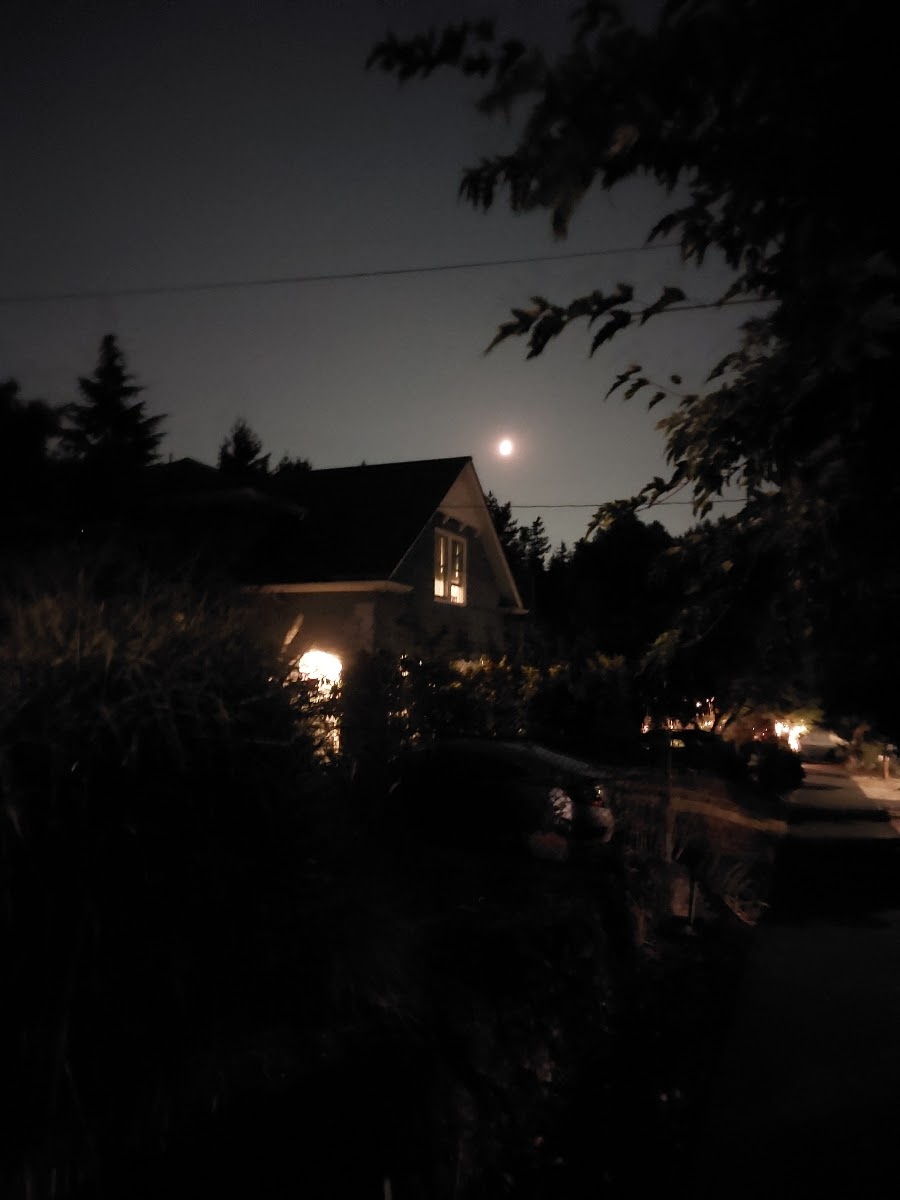
    Walked a mile last night with Eric, curlycue around the neighborhood streets late in the evening, the blue moon rising over the houses and over the firs up on the dark volcano, first cool evening in awhile, feeling the ocean air arrive like an old steamship foreshadowed by tugboats pushing and pulling against a tide. Earlier had sat out in the drive with the guitar, disturbing the universe, though no one seemed to mind, a few passersby walking dogs giving me a nod, the International Play Music on the Porch Day passing locally like any other day.

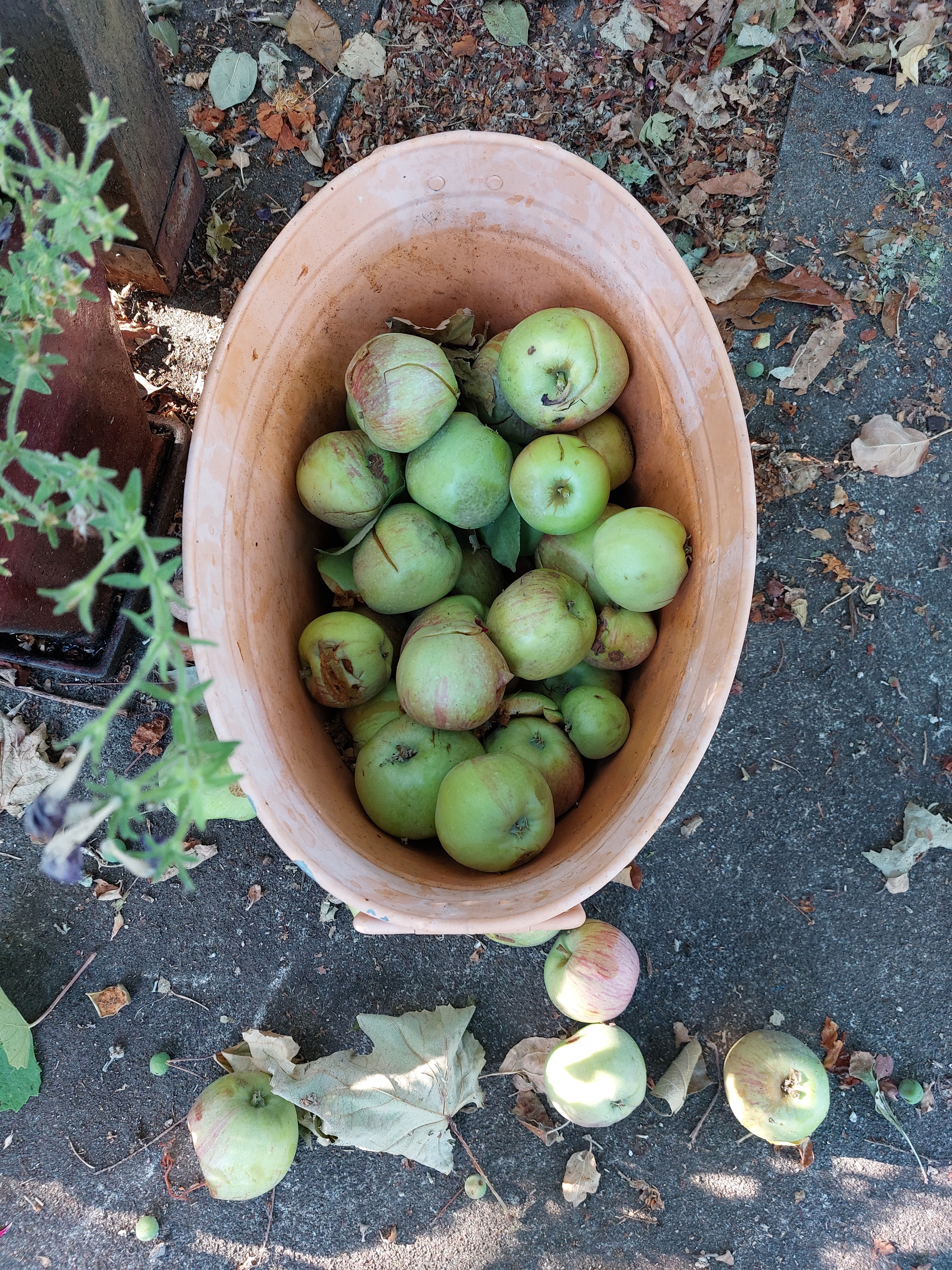
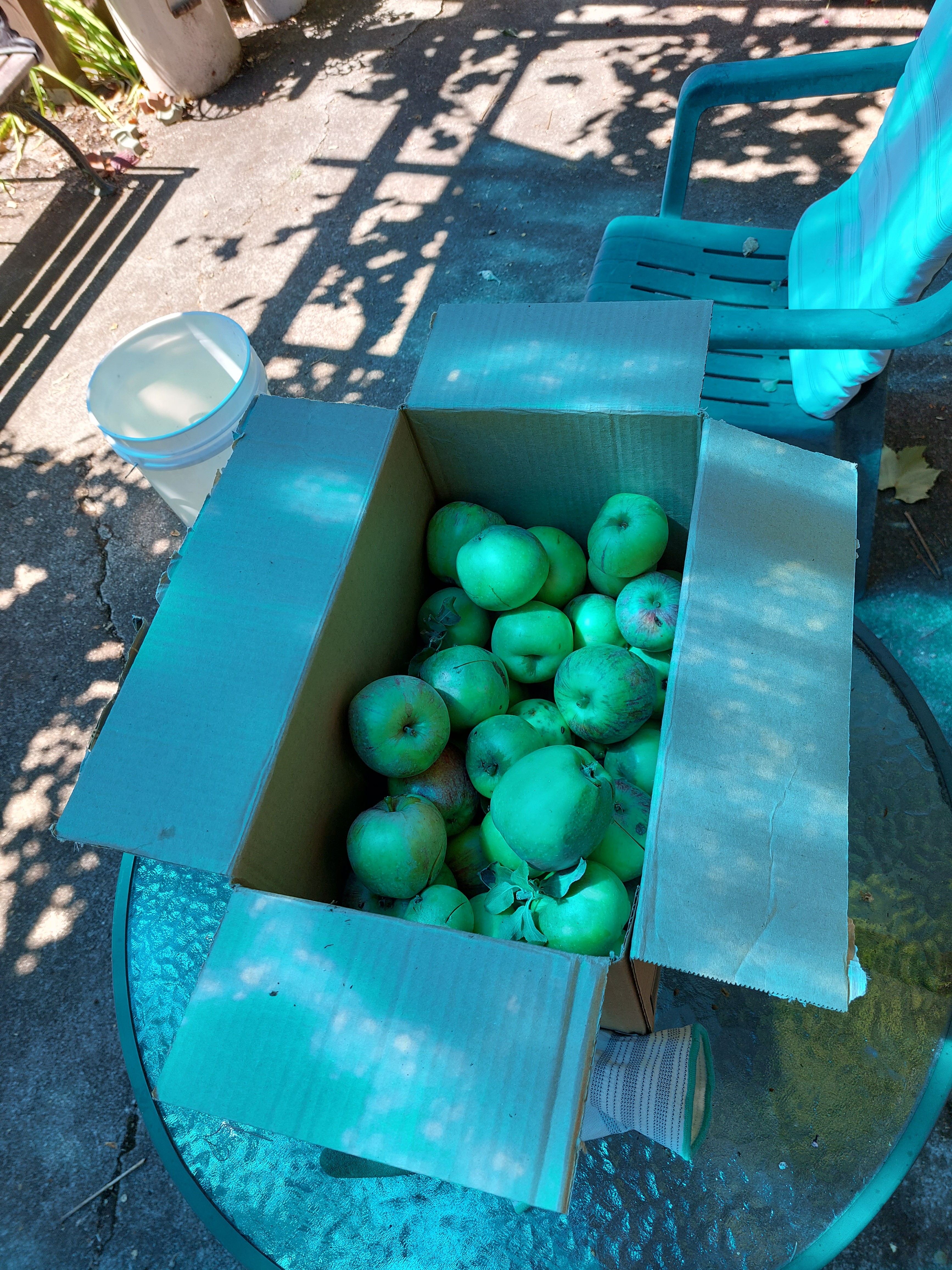
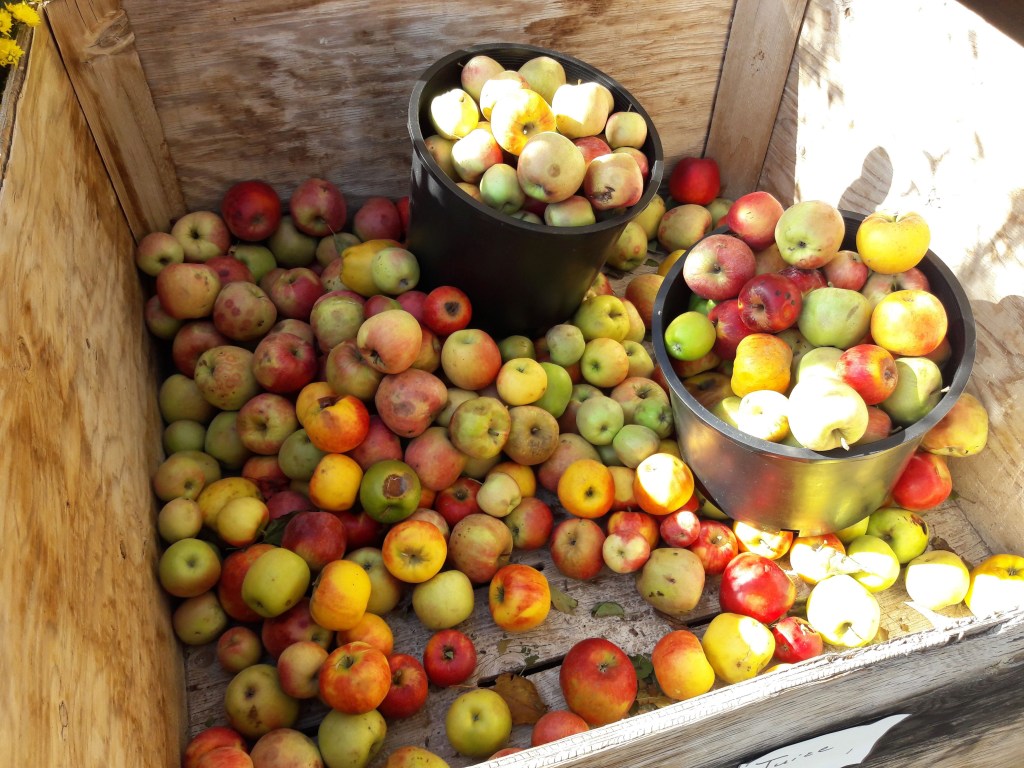
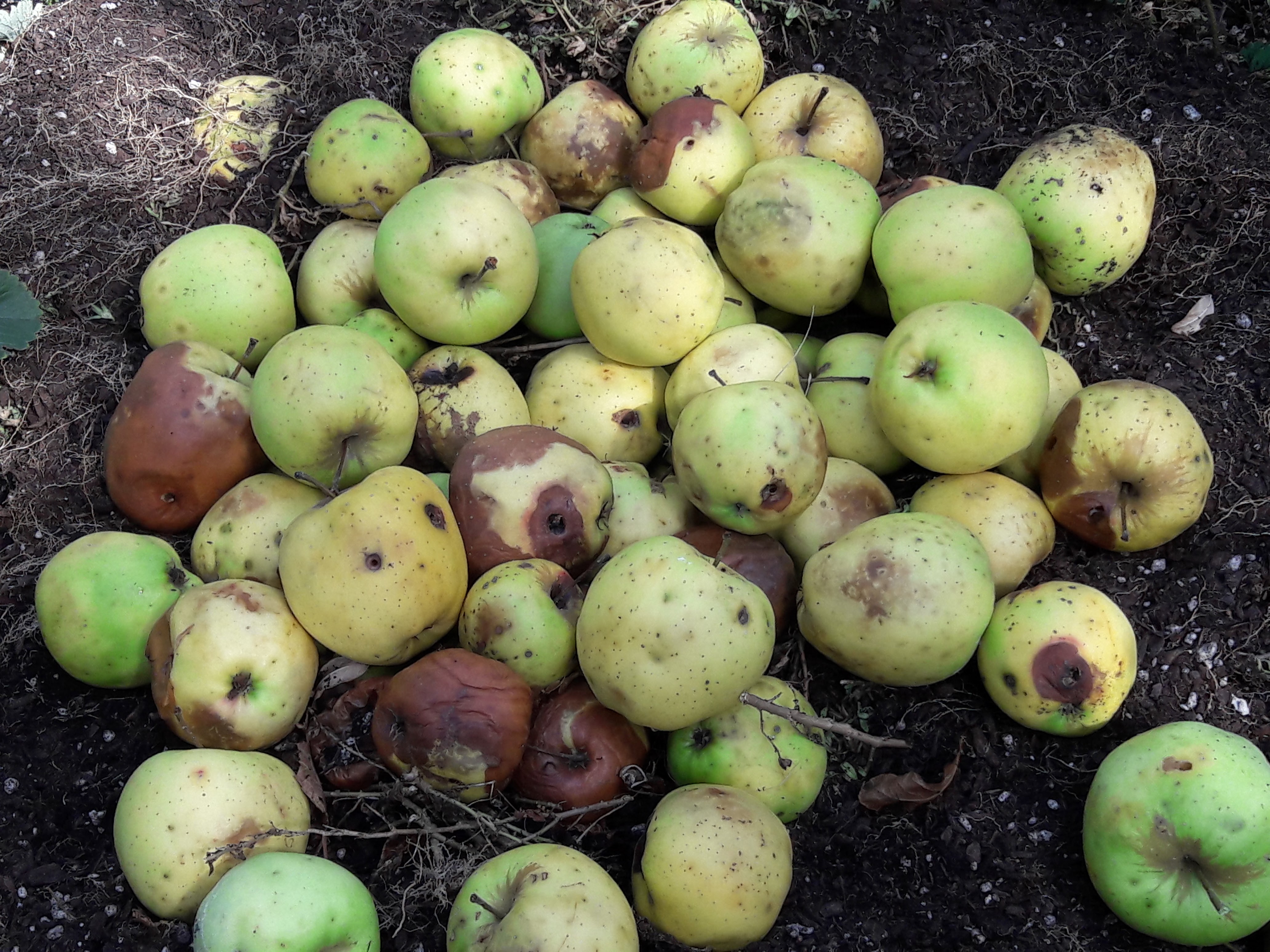
    The neighbor’s Brobdingnagian apple tree, high up above the border wall, half of which hangs out and over our grape pergola, too high to pick, seems to have come close to finishing its self-harvest drop, around a dozen or more bushels falling on our side of the wall this year, a bumper crop, peck after peck after peck we’ve picked up and bagged.

    Meanwhile, peaches are in season. Fresh peaches, juicy and tender, slightly fuzzy, plump, pink and red and yellow and orange. Nectarines are also peaches, but without the fuzz, smooth, and the pit of the peach is akin to an almond. This is what comes from looking things up, a new pastime. Of the numerous poets who have tried to get their hands around a peach, perhaps none have squeezed as close yet stayed afar as Andrew Marvel, in his poem titled simply “The Garden” (circa 1650), where he seems to prefer the actual peach to any metaphor that might point elsewhere for one’s fuzzy orbs:

    “What wond’rous life in this I lead!
    Ripe apples drop about my head;
    The luscious clusters of the vine
    Upon my mouth do crush their wine;
    The nectarine and curious peach
    Into my hands themselves do reach;
    Stumbling on melons as I pass,
    Ensnar’d with flow’rs, I fall on grass.”

    Andrew Marvel

    Why “curious”?

    “I grow old … I grow old …
    I shall wear the bottoms of my trousers rolled.

    Shall I part my hair behind? Do I dare to eat a peach?
    I shall wear white flannel trousers, and walk upon the beach.
    I have heard the mermaids singing, each to each.

    I do not think that they will sing to me.”

    from “The Love Song of J. Alfred Prufrock,” T. S. Eliot, 1911

    One of these days, I’ll compose my own poem to the peach, maybe “Portrait of a Peach,” which is to say, one you cannot eat, dare or not. Lately, Susan’s been offering ripe peaches on a plate to nibble through the slow afternoon, so soft, so cool, so sweet, so refreshing. Love peaches, love to see two, side by side, each to each, within easy reach.

    Speaking of growing old and wearing trousers rolled, yesterday, lightly working outside, I came close to falling twice. The first time, I caught my pant cuff on a hook under the outdoor couch. I nearly fell into a cluster of flower pots. The second time, the foot whose turn it was to move forward on the porch somehow stuck in place, and the pot I was carrying was tossed so I could stop my fall with the arm that was holding it. The pot fell and broke in two, splattering the walk with potting soil. And somehow I found myself sitting on the porch step. Not quite a fall, then, a sit?

  • Of an Old Style

    When you need to get close to each season,
    to know which direction our vast Earth spins,
    come sit under the apple tree and reason,
    pink blossoms now against winter winning.
    Life is not much of a competition;
    most creatures make the best of and endure.
    And then there’s this endless repetition
    of flowers come-hither with alarming
    allure. Such is the plan it would appear,
    since the same thing happens every year.


  • Argument in the Time of Apples

    Torqued antipathy apparels dimple Args
    dented funny car, idling gear limbed,
    oiled, greased, and garbed
    wardrobe red, beaming barbs,
    wavy hair flames bursting
    from the fat winged fenders
    of his 1950 hot rod roadster,
    and the countdown lights
    go green, and the ground springs,
    and the asphalt melts to sap;

    meanwhile, in lane next whole daddy,

    apples in juicy life dangle,
    from form below pending,
    suspended, the quick nap of a bee,
    moistly sloping sap up elegant boughs,
    up, wake up, give us blush
    pale pink blossoms,
    not the false fruit of an inapt poem.
    Leaf springs, cracks the bark
    of the dormant pome tree
    pruned for Verve & Vigor.

    Explication:

    What is called a season is the mapping of sap
    around a wound,
    and a poem is a funny car.
    After the burled cuts, twisted,
    elbow pruned shifting of gears
    and squealing of red wheelbarrows,
    the melting tongue wanders away,
    talking to the bees from a standing start,
    showing the pink slip core of reason
    dash and flash in a sap sluice.

  • Spring Waltz

    IMG_1128The local nurseries and flower markets are loaded with starts, but I can feel the pink of the hard orange rose hips still sleeping, snoring in thorns, and hear the tiny golden broach just touching the iridescent crimson of the humming-bird’s throat.

    Spring came yellowing in a green coach, wavy red-orange hair billowing out the open windows, the coarse driver spitting and spurring the horses to spirit, but the horses needed a rest already, apparently, and Spring slowed to a walk, not even a trot. Slug, slug, slug. One evening, a few weeks ago, we ate dinner outdoors – a false spring. I had lugged out the wooden table from the basement into the backyard, and we lit candles – it’s been covered with a vinyl table cloth since, to protect it from the rains.

    IMG_1129And still the going is slow, the soil too wet to work, but I work it anyway, and the only birds following the hampered whirlicote, and a few Mew Gulls (never saw them before this far inland), sensing a lost trawler on restless water. Still, the apple tree is in fine form, drenched with blossoms and besotted with a few skittish bees. A little early for besotted bees, but there it is, Spring.