Never mind why, but so you have a notebook, or a blog, what do you write, and when? You begin to ignore other interests and responsibilities. You quickly become preoccupied with the possibilities of writing, and don’t see, or ignore, consequences. In “Forbidden Notebook,”1 Valeria begins to obsess over her writing and her notebook, which for Valeria are one and the same:
“Michele wanted to keep me company and I said, ‘No, thanks, you go ahead, go to bed.’ But it was because, afterward, I intended to write. Now, under everything I do and say, there’s the presence of this notebook. I never would have believed that everything that happens to me in the course of a day would be worth writing down. My life always appeared rather insignificant, without remarkable events, apart from my marriage and the birth of my children. Instead, ever since I happened to start keeping a diary, I seem to have discovered that a word or an intonation can be just as important, or even more, than the facts we’re accustomed to consider important. If we can learn to understand the smallest things that happen every day, then maybe we can learn to truly understand the secret meaning of life” (35).
Valeria writes mostly about what she can see and hear and reactions within reach. It’s 1950, and she’s aware there’s talk of the possibility of a new war. But she stays focused on her household and family, and on her job and friends and acquaintances. I keep reminding myself it’s a novel, not a real notebook. But that effect is part of Alba’s, the author’s, intent.
Reading along, I began to think the unfolding household dramas amounted to a kind of soap opera. But Italian television in the 1950s did not include serial shows like those originating in New York City, fueled and sustained by TV advertising, akin to today’s social media set-up, where the audience easily confuses the real with the make believe. Nevertheless, I looked forward to each new installment-like chapter with a soap opera addiction.
It wasn’t until I finished the book and went back to read the Introduction, followed by a Note from the Translator, that I discovered that “Forbidden Notebook” was indeed first produced as a serial, in an Italian weekly magazine, in real time, from December 1950 through June 1951.
Coming to terms with the smallest things that happen every day can be difficult. We would probably have to let go of the fortunate distractions of the news, the media, radio, and television, reels and reels and reels of distraction – fortunate because without them we are forced to stare at an empty screen:
“If we can learn to understand the smallest things that happen every day, then maybe we can learn to truly understand the secret meaning of life. But I don’t know if it’s a good thing. I’m afraid not” (35).
Having decided its worth as a bad thing, how do you get rid of it? Valeria writes for herself, but in constant fear someone in her family will find her notebook, and, since she’s writing about them, and what’s outside their purview, the intimate details of her family interactions and her work life, her criticisms and disappointments, her thoughts and wishes, resentments and humiliations, her contradictions and doubts, to be discovered would jeopardize her standing as “mamma,” a name so full of assumptions and presuppositions it’s smothering, but to be rid of it is something she both wants and doesn’t want.
“But maybe everything I’ve been thinking I see around me lately isn’t true. Maybe it’s the notebook’s fault. I should destroy it, I will certainly destroy it: I’ve decided” (39).
She continues to debate with herself the value of her notebook, why she continues with it, worrying about it being discovered, where to hide it from her family, what and how to write:
“Sometimes I think I’m wrong to write down everything that happens; fixed in writing, even what is, in essence, not bad seems bad. I was wrong to write about the conversation I had with Mirella when she came home late and, after talking for a long time, we separated not as mother and daughter but as two hostile women. If I hadn’t written it, I would have forgotten about it. We’re always inclined to forget what we’ve said or done in the past, partly in order not to have the tremendous obligation to remain faithful to it. Otherwise, it seems to me, we would all discover that we’re full of mistakes and, above all, contradictions, between what we intended to do and what we have done, between what we would desire to be and what we are content to be” (47).
The writing in “Forbidden Notebook” is epistolary, as if each short chapter is a letter Valeria is writing to you, the reader, her audience, or, more to the point, letters to herself that you, the reader, have discovered. You have found her notebook, and are reading about her fears that someone might find her notebook.
Later in the book, she reads through a collection of old letters Michele wrote to her when he was stationed across the sea, in World War II, and she confides she doesn’t recognize him or herself. But are not the letters a kind of notebook? Maybe, but letters are edited. The letter you write to your mother sounds very different indeed from the letter you write to your wife or mistress, boss or senator, different if written in times of happiness and safety versus times of stress and bombardment. Indeed, you are a different person as your circumstances undergo upheaval or fall to sleep.
“Every time I open this notebook the anxieties I felt when I began to write in it return to mind. I was assailed by regrets that poisoned my day. I was always afraid that the notebook would be discovered, even if at the time it contained nothing that could be considered shameful. But now it’s different. In it I’ve recorded the chronicle of these last days, the way in which I’ve gradually let myself be drawn into acts that I condemn and yet which, like this notebook, I seem unable to do without. Now I’ve got into the habit of lying; the gesture of hiding the notebook is familiar to me, I’ve become very good at finding the time to write; I’ve ended up by getting used to things that, at first, I judged unacceptable” (189).
She considers taking her notebook to the office, and finding time to write and a place to hide it there, but she still fears it being found and her being laughed at and losing prestige.
“It’s strange: our inner life is what counts most for each of us and yet we have to pretend to live it as if we paid no attention to it, with inhuman security. Also, if I took the notebook to the office, I’d find nothing of my own when I came home” (199).
And what if she dies, the notebook’s secrets revealed; but she thinks Mirella, if she finds it, would not read it. She thinks the notebook is the reason her life seems to be changing, her self-image evolving, and the fact she’s hiding something so important from her husband has her feeling she’s living in sin. Is to know one’s self a sin?
“I know that my reactions to the facts I write down in detail lead me to know myself more intimately every day. Maybe there are people who, knowing themselves, are able to improve; but the better I know myself, the more lost I become” (233).
She’s in the middle of her life, in the middle of her family, in the muddle of her thoughts, feeling alienated, even if being alone with her notebook is what she wants:
“It began in wartime, because of the housing crisis. Or maybe because suddenly you could die and things had no importance compared with the lives of human persons, all equal, all threatened. The past no longer served to protect us, and we had no certainty about the future. Everything in me is confused, and I can’t talk about it with my mother or my daughter because neither would understand. They belong to two different worlds: the one that ended with that time, the other that it gave birth to” (247).
She remembers a reason why she wanted the notebook to begin with:
“I hoped that in it I would be able to fulfill without guilt my secret desire to still be Valeria” (252).
In the end, Valeria’s notebook is out of place. What she imagined her family would think of her writing is probably right. She’s wasting her time and writing is causing herself grief and gaining her nothing. There are those who should not write, even if they can, even if they happen to be good at it, but what is good is also of course debatable. Her husband has written a screenplay, ironically his secret from Valeria. He reveals it when Valeria meets up with her old friend, Clara, now a filmmaker, and Clara agrees to look at Michele’s screenplay, but later she tells Valeria it’s not going to work out:
“He’d like to change his life, leave the bank to devote himself to the movies. But you have to persuade him not to, Valeria….They wouldn’t have any faith in a man like Michele, who has spent all his life in a bank. They’d always judge him a dilettante; and in fact he would be, it couldn’t be otherwise” (196).
Clara claims the script is too risque for producers to risk, but that might be hard for some readers to accept as true given the history of Italian cinema. In any case, we don’t get any of the script in Valeria’s notebook because she hasn’t read it, but we do get snatches in passing from her talks with Clara so we have some idea, but it remains vague, while Valeria’s concerns are modeled on the conservative, class, and religious values she has come of age in, even if her behavior flirts at times with betrayal of those values. When a rule is violated, is the offender blamed or the order behind the rule?
If there are writers of secret notebooks today, of course we don’t know them. We assume they are there, working away, learning about themselves, maybe with productive results, maybe not, but either way, filling notebooks then throwing them out with the trash, or, maybe worse, saving them – for what? And of those who for various reasons try to share their writing, we find many forms of occasions of writing, of simple to outlandish claims with and without backing, full of personal details or no mention or sign of the author whatsoever, an anonymous blogger. But readers seldom have the same picture of the writers the writers have of themselves. Like flowers, some writing is perennial, some annual; some take root and in a friendly environment thrive, some wilt. Or writing is not a flower at all, more like a weed, an invasive, non-native weed, growing prolifically out of a crack in a street.
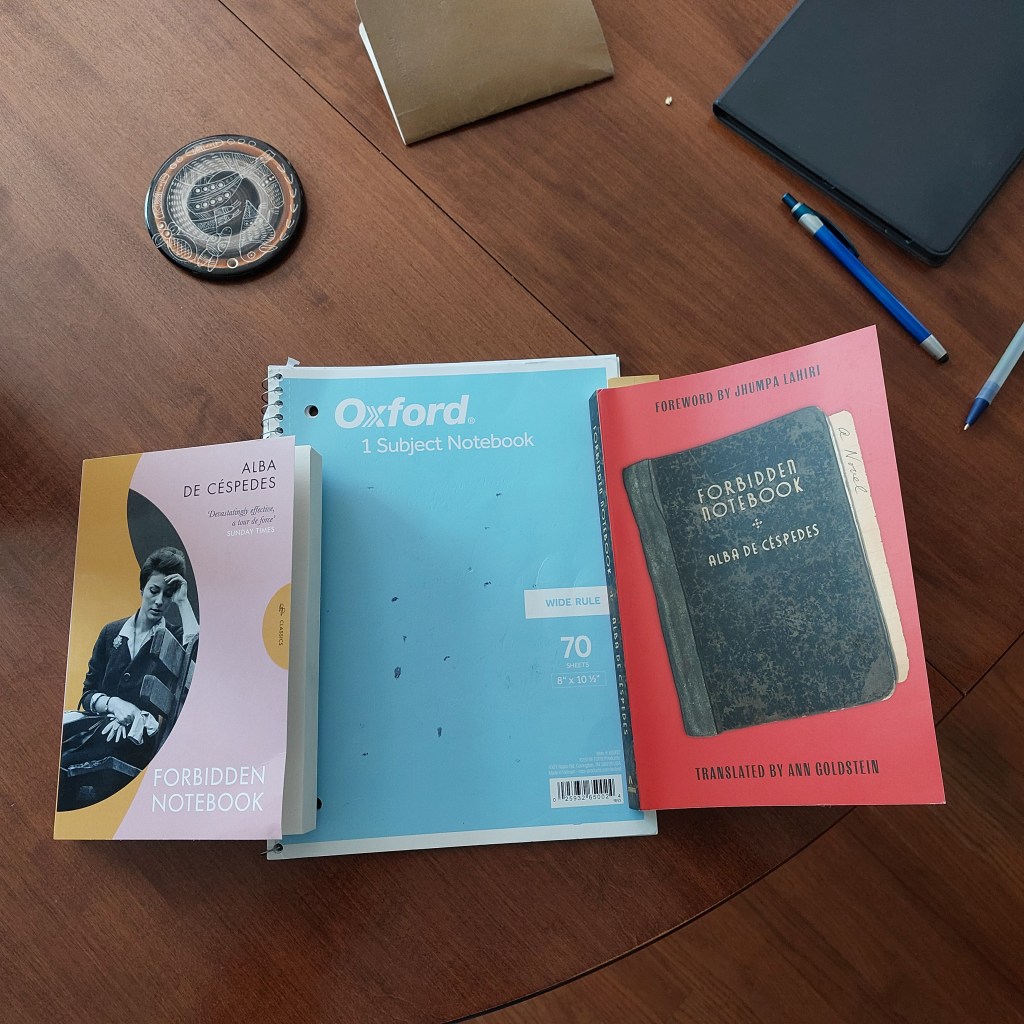
- “Forbidden Notebook,” by Alba De Cespedes. Originally published in book form in Italian as Quaderno Proibito in 1952 by Mondadori. I read the first paperback edition 2024 from Astra House, Translation by Ann Goldstein and Forward by Jhumpa Lahiri. ↩︎
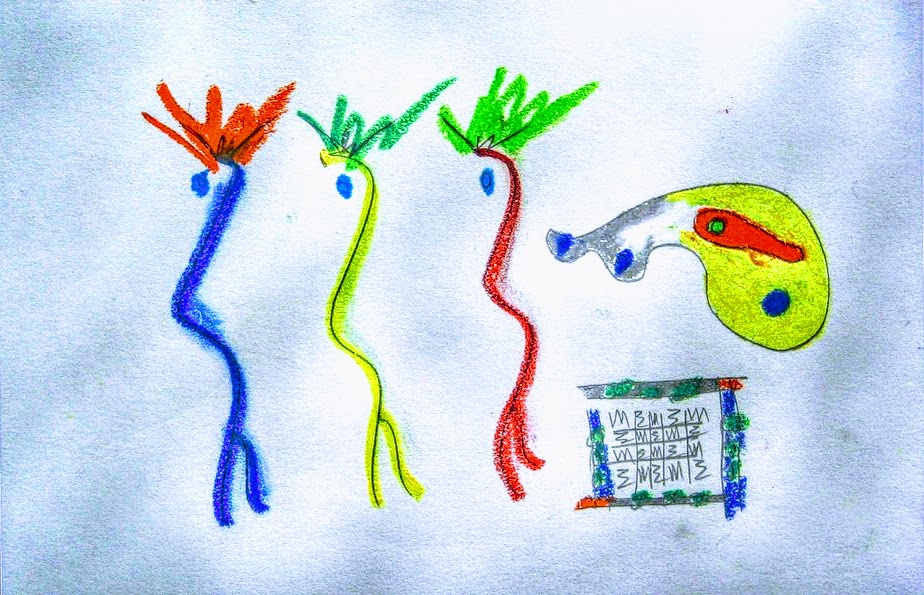
 The Coming of the Toads