For some time, I followed physics in the news. My casual observations started with Lisi’s “An Exceptionally Simple Theory of Everything,” and gained momentum with a Robert B. Laughlin lecture I attended.
String theory and physics in general no longer attract me like they did back in the early days of this blog. There’s a fundamental difference between asking questions you don’t know the answer to from asking questions there are no answers to, and it doesn’t seem to help to fabricate questions that can’t be measured and answered experimentally – questions considered non-empirical or unfalsifiable. And when we might be able to answer such questions, the answers are probably going to be, Laughlin still seems to suggest, far more far out than we have ever imagined. Though William Blake may have come close. Anyway, today, I’m more interested in guitar strings.
CB was back and we broke a string. I had been playing a set of Chromes, flatwound electric guitar strings, experimentally on the acoustic Gitane Gypsy Jazz guitar, 11’s, so fat strings that boom like distant hollow wave tunnels rather than 9’s and 10’s that sprinkle rushing white water into your ears. Of course, Rock style players then experiment with pedals and amps to achieve a data sonification of a nova, regardless of string size – a universe of tinnitus.
The Chromes were invented by D’Addario in collaboration with guitarist Pat Metheny, where Chrome suggests chromatic, using notes in and out of key. The string surface wrap is smooth rather than coiled. The Chromes sound on an acoustic is muted, and I had decided to go back to a set of Savarez Augustine Gypsy Jazz strings. But I didn’t have a set, so I went back to a D’Addario set, also 11’s, which I had on hand. And for the restringing, CB introduced me to a new, exceptionally simple method. You pull the string through the tuning peg, pull it back the same distance between pegs, wrap outside over and around the peg, bend up the excess end, and wind. Presto, job done.
All strings stretch a bit, some more than others, when they are new, so tuning new strings can be problematic. You think they’re in tune, then they stretch and quickly need retuning. To counter this effect, I’ve always overtightened them a bit while stringing. So when CB took the restrung guitar and sat down to give it a final tuning, the G string snapped, unravelling at the ball end, probably the result of tuning an octave too high, as I had already wound it pretty tight, or maybe the string was faulty from the factory. In any case, we had no more strings on hand, so there the guitar sat, missing its 3rd string.
That led me on a new string search, online and through the local universe of guitar shops. I found an interesting Martin string, silk and steel, with a total tension of only 122.2, in spite of a full size 6th string of 11.5. Very interesting. I got a set and put them on the 1970 Yamaha Red Label FG180, which has a crack in its headstock that makes me leery of using too heavy a gauge on it. The Martin silk and steel strings are soft and loose, easy on the fingers and guitar, but sound full, like old folk. For the Gitane, I settled on another set of D’Addario, but 10’s instead of the heavy 11’s.
All that said, guitars restrung and ready to play, we must now remind ourselves of John Cage’s manifesto on music (1952): “}instantaneous and unpredictable nothing is accomplished by writing, hearing, playing a piece of music} our ears are now in excellent condition.”
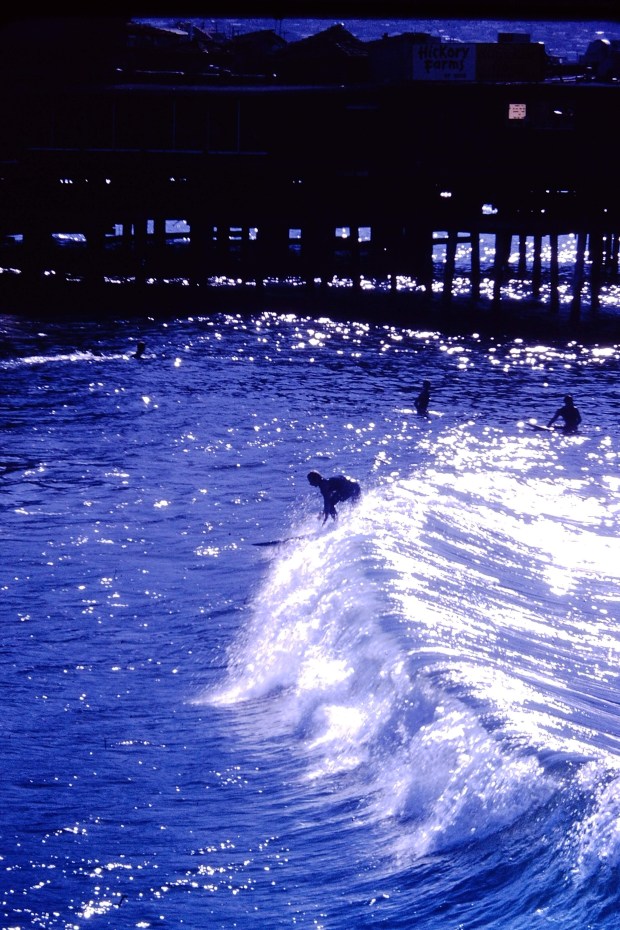
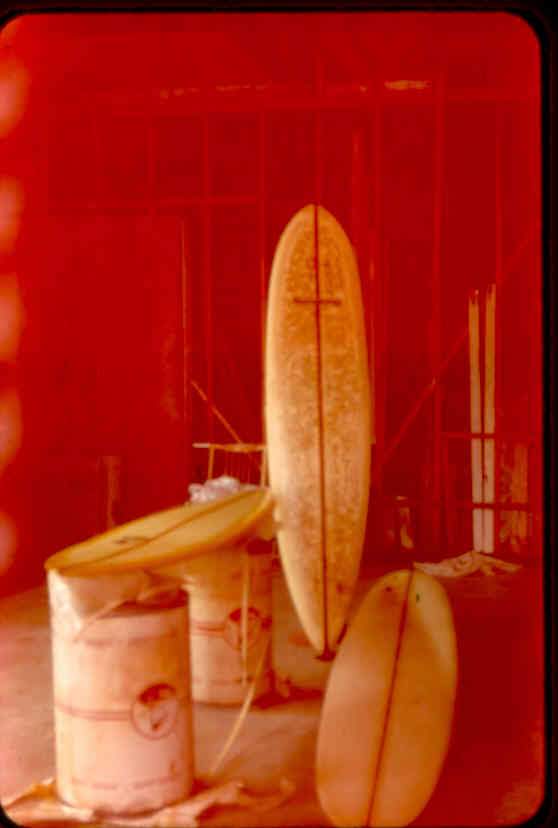
Surfing at Horseshoe Pier in Redondo Beach CA, 1971. 35 mm Ektachrome slide taken with an Exakta 500.
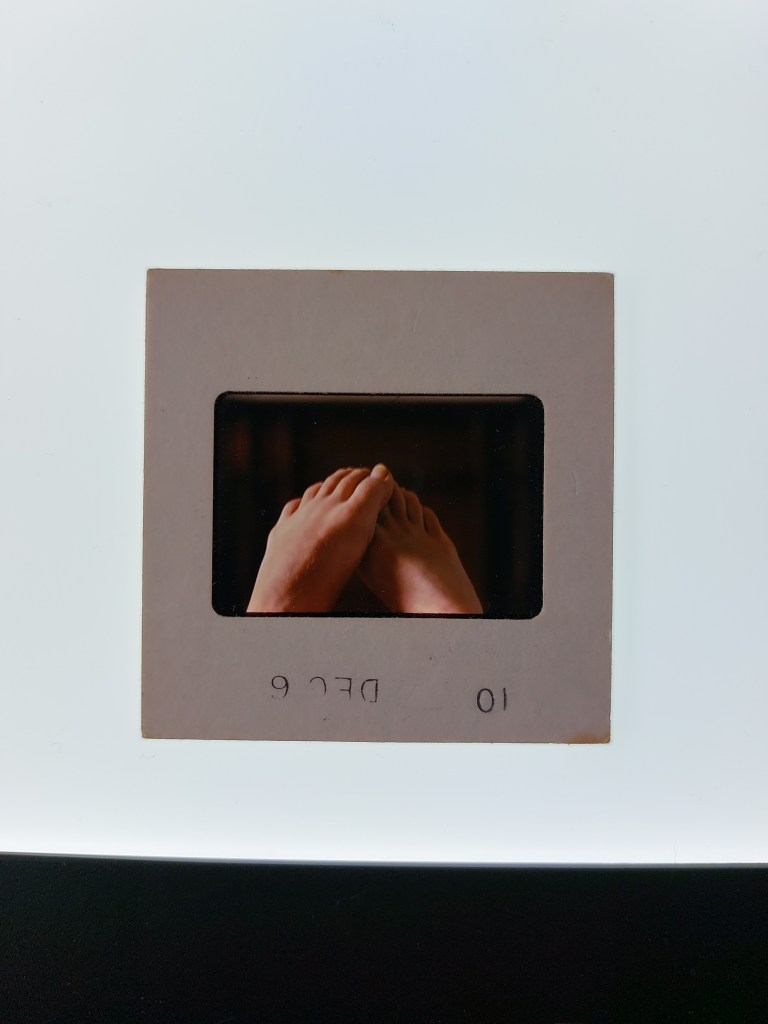
“Sliding into Saturday” is a blog meme, a day-themed prompt for posting electronic copies of old slide transparencies, usually 35 mm slides, but also 120 and 110 formats.
To turn the heater on would signal the surrender of summer, so I put on a coat. A bit damp out, Fall oozing in the offing, low 60s inside, open the Chromebook with a cup of bleak coffee.
In the email, from The Library of America, “A Cartoon Universe: Celebrating 75 Years of Charles Schulz’s Peanuts.” Schulz apparently didn’t like the title. In his opinion, it lacked “dignity and it’s not descriptive.” Not only that, but when asked if he had a newspaper with “Peanuts” in it, a local news stand fellow replied he did not, nor did he “have any with popcorn either,” thus confirming Schulz’s concern over the given title. “Peanuts” worked out, of course, but these days “Good Grief!” might make a good title, both dignified and descriptive.
Which reminds me of my blog title, “The Coming of the Toads,” borrowed from a short, obscure poem. While the poem itself remains dignified and descriptive, the title as allusively used for this blog has grown over time to lack connection to the daily posts – or maybe that’s the case from the beginning. The title, for a blog, is distinctive and memorable, but what does it mean in the absence of the About page? And might it not be a bit much asking readers to figure it out, and might they not wonder, to what end? If readers don’t recognize where a borrowed title comes from, the allusive effect is lost. To complicate matters further, the poem itself borrows or alludes to other works.
But isn’t all that the words of the absent parents in the Charley Brown TV specials? We hear their voices but can’t make out what they’re saying. The form says it all, no content necessary.
Anyway, it was Fall of 2007 when I discovered blogging and decided I’d try my hand at a WordPress blog, for which I needed a title. It’s not that I’ve come to dislike the title, but I wish somehow, like MTV creatively and against the commercial tide did with its logo branding in the early 80s, I could change it with every post, but to what, and to what end, and what confusion?
A Blog Universe: Celebrating 18 years of Joe Linker’s The Coming of the Toads
Old pond
frog jumps
sound of water

Old toad
flops in
blogs about

Where the toad
plops into a pond
echoes of Basho

Splish splash splosh
splushes an old toad
in the same pond
Going about without making any noise is perhaps the most difficult task of our day. If we try to make sense of the noise, we discover music.
I was thinking the blog was a silent activity, but then I began hearing my fingers striking the keyboard, padded notes, which, if given time, could be organized into a piece of music.
The quieter we try to be, the more noise we hear.
We might think of silent noise, tinnitus, for example, an apparent oxymoron, a noise but silent because it’s not really a sound, but simply the perception of sound, hearing a sound that has no outside source. Others can’t hear it, no matter how hard they listen. But they have their own silent noise playlists.
The keyboard went quiet as I reread the above paragraphs. I’m in real time for the moment, but my reader, if there is one, will not be in the same time. Thus the blog is like a recording, but the reader will not be able to hear the keyboard as I type, or as I typed, unless I made a recording.
There are 24 time zones around the globe. They allow for music to occur internationally. But not everyone pays strict attention to the time zones. In China, for example, everyone uses the same time, all the time, regardless of which of the five geographically separated time zones they might be in. What time is it becomes an interesting question, since sunrises and sunsets can occur hours apart, depending on where you are at the time. In other words, to awake at sunrise for one person, could be sleeping in for another, not getting up until noon! For some reason, we try to match our time with the position of the sun. But most people work inside, unlike our ancestors, so what does the sun have to do with it? Circadian rhythms. We can’t hide from the sun.
I’m making a recording now of the keyboard, using my cell phone. Note the pauses, as I try to figure out what to say. The spaces between the notes create music, because they are separated in time (duration). But is there rhythm? The recording has now gone on for just over one minute.
A default has given the keyboard recording the title “Voice 0061.” I’ve tried to upload the recording to this blog post, so readers can follow along, hearing the typing as they are reading the paragraph, but I received a message saying I’m unable to upload the file, to wit: “Sorry, you are not allowed to upload this file type.” Thus we discover that learning to play an instrument is harder than we might think. Undaunted, I’ll now try a video, using the keyboard and my cell phone.
I’ve set the phone against the screen, and I can’t see what I’m typing now, feeling much like the player in a jazz band. But I type on, being video-recorded. I don’t feel much like continuing the experiment, but having pushed on this far, I keep typing. As Cage said, “What we re-quire is silence; but what silence requires is that I go on talking.”1 Similarly, what music requires is that I go on typing. Many mistakes in this typed paragraph, like playing the worong [sic] notes on the guitar or piano, but I’ve gone back and corrected the text, but the mistakes, as recorded, sound just like all the other notes, no problem.
Now I have the video recording on my phone. Because I set the phone so close to my screen, the video is a white grey cloud, but the viewer can hear the keyboard. Now I have to figure out how to get the video from my phone into this blog post, so readers can listen to it as they read along. Alas, I try to email it to myself, but get a Gmail message saying it’s too big a file. Yet it’s only 1:33 minutes.
But you can perform your own keyboard music. All you have to do is type and listen. You don’t even have to type real words, but that should probably be the subject of a different blog post.
John Cage, “Lecture on Nothing” (1959), from “Silence” (First printing 1961. Wesleyan Paperback, 1973). ↩︎
My Heavy Metal brother was here: “… It’s a long, long road, from which there is no return, while we’re on the way to there, why not share?” (Lyrics from “He Ain’t Heavy, He’s My Brother,” by Scott and Russell, and a 1969 soft rock hit by The Hollies). And share we do, for example the “Live at 5” pandemic concerts we played weekly on Instagram Live; by the way, Instagram now limits “live” streaming to Instagramers who have at least 1,000 followers, creating a perceived scarcity – as if anyone watches anything to its end anyway, attention spans diminished as they are these days. So now we record short videos and post them as pre-recorded videos to Insta but also to our YouTube channels.
Anyway, while CB was here, he wanted to do a cover of “Stray Cat Strut,” the 1981 hit by the rockabilly group “Stray Cats.” Mainly, he wanted to try out my Gretsch1, which is good for playing in the rockabilly guitar style. It’s interesting that once again the British brought back a defunct American song style. Rockabilly was a 1950s sound originating in the South by players like Carl Perkins (“Blue Suede Shoes, 1956), Gene Vincent (“Be-Bop-A-Lula,” 1956), Buddy Holly (“Midnight Shift,” 1956), and Eddie Cochran (“Summertime Blues,” 1958). Rockabilly, the word, comes from a combination of the rock in rock ‘n’ roll, and the billy in hillbilly music, a description of mountain folk music, which evolved into country western, but which is still played in its original forms where it’s usually called old-time music.
Though his preferred guitar sound is heavy metal, CB is more of a perfectionist than I am on the guitar or with vocals. He also knows more than I ever will about guitar electronics, pedals, influences, and songs and players of the Metal sound. But I do like a raw sound, and a simple format. The original Buddy Holly and the Crickets, for example, was a simple trio of electric guitar, drums, and a stand up bass, and in those early recordings, you can hear the instruments individually, and it’s not a wall of sound coming at you like an electronic tsunami. Even when the rhythm guitar was added, the sound was still clear and concise. Meantime, volume has reached a reducio ad absurdum in some musical venues and recordings. Ironically, that loudness is often subdued by streaming platforms using loudness normalization.
After CB left, I decided to give “Stray Cat Strut” a go, but after a short while gave up on it, but as I studied it, I found both its lyrics and chord progressions interesting. The cat is a cool cat indeed, and I ended up taking the idea a couple of steps further, into the arena of the absurd, with an anthropomorphic pickup truck the main character. I satisfied myself with a short imperfect recording in a kind of country style, though others may of course have a different view of it. I made two recordings, one with vocal (with the 1970 Yamaha Red Label FG180), the other instrumental (with the Gretsch). Song chords and lyrics below, and link to YouTube instrumental recording at bottom.
Pickup Truck Strut

G7                                      E7
Sitting in a lot watching the lights go by
A7                                   D7
Gas tank on empty, tires pretty much flat
G7                                  E7
Surfboard sticking fin up out of my bed
       A7                     D7     G
I'm an old pickup truck and I got no strut

C7                  B7
Stray cats climbing into my cab
E7                      A7
Kids stealing all of my mooncaps
C7                      B7
I don't take off chasing Chevys in town
E7                     D7
I rumble away from the big city crowd

G7                        E7
Surf guitar playing on my radio
A7                          D7
Stand up bass, high hat and snare
G7                   E7
No red Corvette candy apple chic
      A7                          D7
I got tools and a surfboard in my bed

G7                            E7
Sitting in a lot watching the lights tonight
      A7                D7           G
I'm a used pickup and I ain't got no strut
The Gretsch is a G2420 Streamliner Hollowbody Electric Guitar with Chromatic II Tailpiece – “Village Amber” finish. Year 2021: with Maple Top, Back, and Sides, Nato Neck, Laurel Fingerboard, and 2 Humbucking Pickups. ↩︎
Since quitting a traditional 9 to 5 Monday thru Friday job some time ago, my sense of Saturday has changed. While working through the week, one looked forward to Saturday, sleeping in, hanging out, taking it easy – none of which happened, since one was forced to squeeze into that single day a week’s worth of chores and outside commitments. And it’s almost impossible to sleep very late when you’ve been getting up at 5 every morning all week. And I usually had work to take home. Have laptop, will travel, and work through the weekend.
So I begin this blog post on a Saturday, thinking of those Monday through Friday working readers today sleeping in, sliding into their Saturday, or having walked down to the corner cafe, opening their laptop looking for a brief and casual post that gives Saturday its day off due.
I finished reading Satoshi Yagisawa’s “Days at the Morisaki Bookshop.” By way of review, I remember this passage, from page 90:
Wada picked up the book and showed it to me. I secretly breathed a sigh of relief that we’d moved on from the last topic. “Oh? I don’t know. Is it a good book?” “It’s hard to say, actually. It’s kind of one of those tragic love stories. The author is a guy who had this one book and ended up dying in obscurity. When you read it, the writing can be clumsy, and there are a lot of places where it feels like it’s missing something. But there’s something about it that fascinates me. I’ve read it around five times already.” As he talked, he was staring at the oil painting of a road in the hills on the book jacket. There was something tender in the loving way he looked at the book that ended up making me want to read it. “Really? Five times? Maybe I should check it out.” “I’m not sure I can really recommend it. What are you reading, Takako?”
That’s sort of the way I felt about the book itself, that I was reading (I just finished it last night), “Days at the Morisaki Bookshop.” I mean, the writing did seem clumsy in parts, but the story and the lonely narrator and the neighborhood of bookshops in Tokyo were at the same time, if not fascinating, charming and diverting, inviting repeat visits, though I probably won’t read it again, let alone five times. And I do recommend it, for what that’s worth, to someone awake too early on a Saturday with nothing to do.
I’ve noticed that naming blog posts after a day of the week seems to have found followings, like “Wordless Wednesday,” or doors on a Thursday, or flowers on Friday. So I thought I’d put up an old photo slide on a Saturday, and call it “Sliding into Saturday.” This one’s from December, 1969.
I’ve been enjoying the New York Times game called “Connections,” even if it’s usually as stacked as a one armed bandit in a Western saloon. And I noticed they’ve created a sports version called “Connections: Sports Edition,” which I’ve not tried. I’ve enough sports watching my home team Dodgers falter down the stretch. But it occurred to me to try my hand at a poetry puzzle version.
How to Play: Find the solution that ties all the words in the puzzle table together. Click the footnote number in the bottom right hand corner of each table to view that table’s solution. Or feel free to post your own solution in a comment to the post.
From Disney’s Mary Poppins, here changed to an adverb, a multi-compound word.
A musical term: “As Slow As Possible” (notable example, John Cage’s organ composition ORGAN²/ASLSP).
A person who uses long words, from Latin for a foot and a half long.
Making connections.
Making an essay out of it.
To be unable to move forward for fear of “ifs.”
The correct spelling of irresistably.
1953 Samuel Beckett novel: The Unnameable.
Once considered the longest word in English. Refers to a 19th-century political movement in Britain opposing proposals to disestablish (separate) the Church of England from the state. It’s a turnaround word.
Last night around midnight I finished my nightstand book “All the Lovers in the Night,” the second of three Japanese fiction books I recently picked up. I read it after “Convenience Store Woman.” Next I’ll read “Days at the Morisaki Bookshop.” Meantime coincidentally I heard about “The Second Chance Convenience Store,” by the Korean writer Kim Ho-Yeon, so I added it to the stack on the nightstand.
I had been about to begin reading again Penelope Fitzgerald or Barbara Pym or Elizabeth Taylor, after “Seascraper” and “In the Cafe of Lost Youth,” both of which followed “The Dissenters.” The last Elizabeth Bowen I read was “Eva Trout.” My reading of course is a tale neither here nor there nor anywhere, but I try not to write book reviews, ever since Jessica commented, “It’s not a book review,” about something I’d written about one of her books, a simple reflection, drawing unexpected connections. But I was happy with that, with her comment. Too many book reviews seem template formatted and start to sound too similar. But blurbs, blurbs are the worst, exaggerated cartoons of reviews. Before “Eva Trout” I’d read “Spring Garden” and “Forbidden Notebook.” I also read, back in May, a book of short stories one of my brothers wrote, titled “Roxy, Reincarnated.”
But the last book I read, just before deciding on the Japanese trio, was “The Invention of Morel,” by Adolfo Bioy Casares, influential Borges friend and collaborator. I found the Casares book interesting but not suitable for midnight reading, though some may find it precisely written for the middle of the night. Still, I find it’s still with me, its strangeness. And it too is a kind of cartoon, exaggerated, comic book matter. It deals with metaphysics and light and predicts television and movie popularity. Think of the characters as all movie stars, among which you walk, but they don’t see or hear you. Indeed, one should approach such books with a keen reliance on circumspection:
“The case of the inventor who is duped by his own invention emphasizes our need for circumspection. But I may be generalizing about the peculiarities of one man, moralizing about a characteristic that applies only to Morel” (80).
Yet here I am duped by my own book reviews, if you can call them that, and Jessica said you cannot call them that, and she is right. Earlier this year I read “All Our Yesterdays” by Natalia Ginzburg, thick blocks of prose, this one, as if she were trying to save paper. And I read Hemingway’s “Across the River and Into the Trees,” which is not as bad as everyone has ever said, but there seems to be fewer sympathetic readers of Hemingway these days, but which I enjoyed nevertheless. Adam Gopnik had revisited back in a February New Yorker the controversial 1950 takedown profile of Hemingway in The New Yorker by Lillian Ross. Gopnik’s article was a piling on. He claims to have uncovered in recently revealed letters the true nature of the Ross and Hemingway relationship and why Hemingway postured he was not offended by the offensive profile. Something like that. Anyway. Gopnik quotes from Ross the section where Hemingway is buying a belt. Really? I first read the Ross piece in the book format that followed the article. It’s a classic, on that I agree with Gopnik, but for different reasons, but I won’t continue to bore you with Gopnik on Hemingway via Ross any further.
Nick Hornby used to write a short column for the monthly “Believer” magazine called “Stuff I’ve Been Reading.” I subscribed in its early days and saved all the issues, like deluxe paperbacks, the thick paper, the cartoon-like covers, until I’d had enough, after a few years, and carted them down to the corner book box where they went like Pokemon cards at a garage sale. Hornby’s articles contained two sets of books for the month: books he had bought, and books he had read, seldom exactly the same lists. Two books on my night shelf I’ve not read and they’ve shifted to the bottom: “The Colony” and “Ten Thousand Miles of Clouds and Moons.” “The Heart in Winter” was a gift, but I couldn’t get into it. I’m waiting for the heart in spring to come out. Eileen Chang’s “Written on Water” I’m still reading, slowly, slowly. And “The Uncollected Essays of Elizabeth Hardwick,” also slowly, on page 76, the next essay titled “Things,” following short, magazine like pieces on Faye Dunaway, Susan Sontag, and Katherine Anne Porter. Slowly, of necessity. I might have mentioned in some previous post I read Salinger’s “Nine Stories” aloud to Susan, except I skipped “A Perfect Day for Bananafish.”
But I started off here wanting to say something about “Convenience Store Woman.” It’s one of the more original books I’ve read this year. But its form is a novella length cartoon, but without drawings. It’s anime without comics. It’s not anti-literary, though it might appear so to some. It’s a first person narrative of a protagonist who must have a manual to live by, and the manual she finds suitable to her needs is the manual of the convenience store where she works. “All the Lovers in the Night” is more literary formally, but it also involves a single woman at odds with family, social expectations, being different, and aging. And where and what and how to work and establish and nurture relations, and who and what to trust as one navigates the busy streets of a lonely life looking for light in the middle of night, a night light.
One summer, I worked for one of my Dad’s friends in the body and fender shop at a Ford dealership in Culver City. He entertained the idea of getting a race car and I would be his driver. He foreshadowed the advent of the short surfboard. “Why are the boards so big?” he asked. “You could ride a two-by-four if you could get up the momentum.” Another summer my Confirmation sponsor hired me to work as a lab assistant at UCLA, where he was working on a graduate degree, the chalkboards in the lab covered with formulas and equations that looked like hieroglyphs left by sanderlings bicycling around the wavelets at El Porto.
The first thing my Dad taught me about plumbing was to name the tools, so I could hand them to him when needed. And I learned to dig a trench with the correct slope, for “shit falls downhill.” I worked odd plumbing jobs with him and knew enough of plumbing to know a plumber by trade was not what I wanted to be. Today, though, I feel some affinity for the plumber’s craft, even if my Dad would not now recognize it as the same trade, the new plastic pipe, the special tools, the glues that have replaced the lead and oakum joint jobs. Boiling the molten pig of lead in a lead pot then working the cooling lead sealing the oakum with a cold chisel around the lip of the cast-iron pipe. Yarned and roped, poured and caulked.
One day, my Dad, a plumber by trade, he would say if asked, asked me what I wanted to do, to be: a carpenter, an electrician, a plumber. I wanted to surf, which he knew, his garage a surfboard shop, but while I was a good surfer, I wasn’t an excellent swimmer, like my two best friends who were county lifeguards, but we all knew we weren’t going to surf our lives away. And I played guitar, but as an ambition as aimless as walking on a surfboard, for while I was a good guitarist, I wasn’t an exceptional musician, and had no taste for the business. And cars, beginning with the 1956 Chevy I bought for $75 from Gary, who was headed for Vietnam. I became a wheeled and track vehicle mechanic, MOS63BC20, which helped see me through school, that talk with my Dad over and out.
What’s all this got to do with Benjamin Wood and his novel “Seascraper,” recently longlisted for the 2025 Book Prize?
“The horse needs feeding up and harnessing. He gets into his boots on the back doorstep, rolls a ciggie underneath the rusty canopy his grandpa built from corrugated iron – it’s hanging by loose screws, and one more heavy rain could bring it down. He’s not repaired it yet, as mending stuff like that requires an aptitude he doesn’t have. His talent is for something else – his grandpa would decry it as a waste of time if he were still alive to hear him sing a tune, and if his ma knew anything about the pocket watch he gave to Harry Wyeth in trade for his guitar, then she would make a bonfire of it in their own backyard” (5).1
That talk with my Dad I replay like old vinyl, now full of scratches of course. I might pick an electrician to be, and maybe I’d specialize in electrical musical instruments. Or I might have moved from carpentry to lutherie. Those are indoor jobs. Do you want to work indoors or out was not a key question for a kid growing up in Southern California, where the weather was taken for granted. There were a dozen guys I knew having conversations with their Dads similar to the one I described above. Families just scraping by, recovering from one war and beginning another, and then another, or couples with a cache of war bonds that would see their two kids through USC or Stanford.
“It never used to foul his mood this much, the cold, the loneliness, the graft, but that was long before he harboured any aspirations for himself besides what he was raised to want. He used to think it was enough to fill the whiskers up with shrimp each morning and accept the cash for them by afternoon. Providing is surviving – that’s what Pop would tell him, and what else should any man desire? Perhaps a wife, if he could find one that’d have him” (12).
He has more than a job, an occupation, he’s a seascraper by trade. He both loves and hates it. For love, the culture and tradition, the brawn and brack, the freedom. For hate, the cold and wet and muddiness, the poverty, and not enough time to devote to his true calling:
“He was thirteen when he first went out to sea with Pop and, in those days, few adaptations to the old equipment had been made – the cart still had two wagon wheels with metal rims, and he felt queasy after half an hour of riding in the seat with him. It was supposed to be a weekend job, that’s all, and it was something he would beg his ma to let him do, believing it to be a rite of passage. Every other Flett had been a shrimper, going back to his great-grandpa who had putted barefoot on the beach alone with just a push-net and a basket on his back” (34).
Scraping for money, too. There’s the rub. And he learns and loves to read, fatal flaw. And comes under the spell, though he’s naturally wary, of an outsider who sees just some kind of romance in the beach and sea and fishing for a living, and who wants to make some kind of movie about it, with him the star, and the promise of some big bucks. He’s not sure.
“The folk club at the Fisher’s Rest begins at eight, and if he wants to play tonight he’s got to put his name down on the list by quarter to. Perhaps it wouldn’t be so bad to wait a week, rehearse his songs a few more times before subjecting people’s ears to them. He’s not in a position to refuse that kind of money. ‘I dunno,’ he says” (32).
What’s the catch? The empty promise of a false calling. And who is calling? You’ll meet all kinds of charlatans wanting to hear your story and help you to tell it. How could you tell? He’ll make a tourist scene of your livelihood. Tom Flett is the only seascraper around who still works with a horse and wagon. The others use motorized carts. He’s like a plumber who might still be using lead and oakum. Idealized and sentimental. The tourist view doesn’t see behind the facade. There’s no money in the songs. There’s no money in the seascraping. What’s he waiting for? To know his song well before he starts singing?2 What’s he going to sing about? Seascraping. Dangerous work, and just scraping by.
“He’s committed now and has to see it through. ‘Bear with me, then. I’ve got to work the nerve up.’ The guitar of Harry’s is much bigger at the body than he’s used to and its neck seems thicker when he takes hold of it. At least it’s strung the right way up. The frets are old and blackened, but it sounds in tune. ‘I need to warn you, I’ve not sung this more than twice from start to finish. It’ll come out ragged, but you’ll get the gist’” (161).
Mariposa Surfboards
“Seascraper,” Benjamin Wood, recently longlisted for the 2025 Booker Prize. Penguin Random House UK. ↩︎
“A Hard Rain’s a-Gonna Fall,” released in 1963 on the album The Freewheelin’ Bob Dylan. ↩︎
Susan came down to say it’s raining and did I want to bring in the cushions. I hadn’t heard the rain, though I’ve got the doors and windows wide open, but I knew it wouldn’t last long, a trace only had been predicted, but I also knew she’d be disappointed in me if I didn’t hop up and go grab the cushions, and in the moment she waited to see if I was going to go out or continue thinking at my laptop for how I wanted to say something about Benjamin Wood’s novel “Seascraper,” I pictured her dashing out and snatching the cushions herself from the rain in her nightgown and slippers.
I stood at the edge of the porch, cushions safely secured from getting wet, watching and listening to the rain, falling harder now than I had expected. Yesterday morning I was in the yard watering when I felt the drops hitting my hat and hands, but it lasted not even one minute, a trace, and I continued with the yard work, and the sun melted another day. But today as I stood at the opening of the porch and began to smell the dry ground oils stirred by the new rain I suddenly felt almost like an epiphany the end of summer.
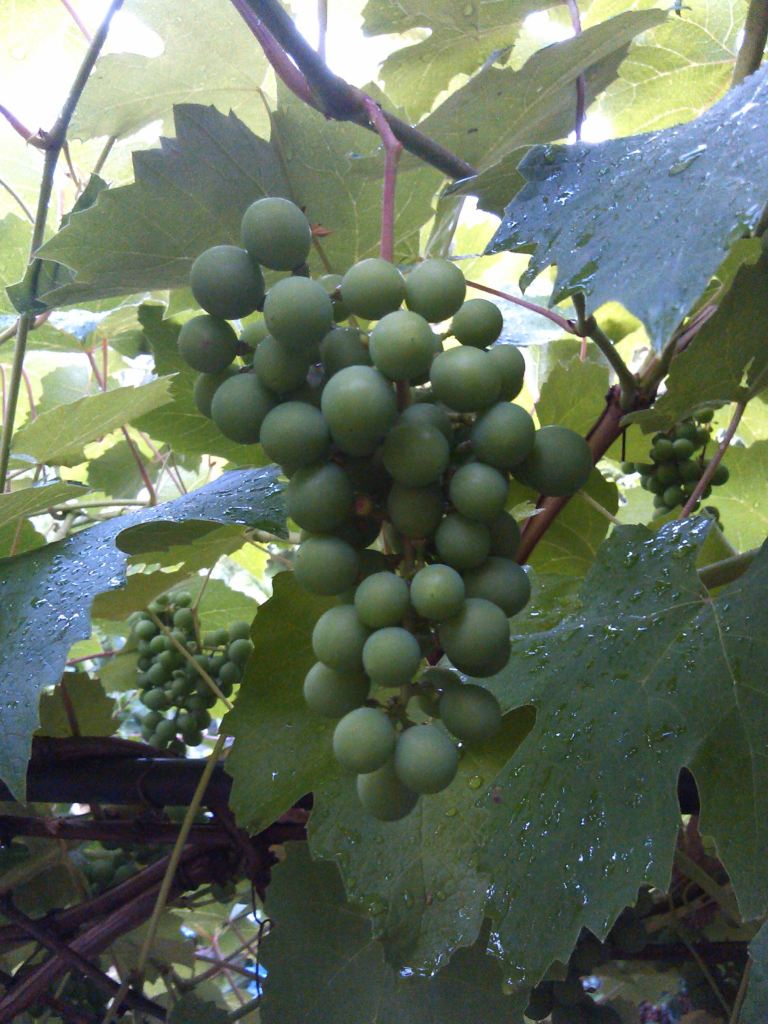
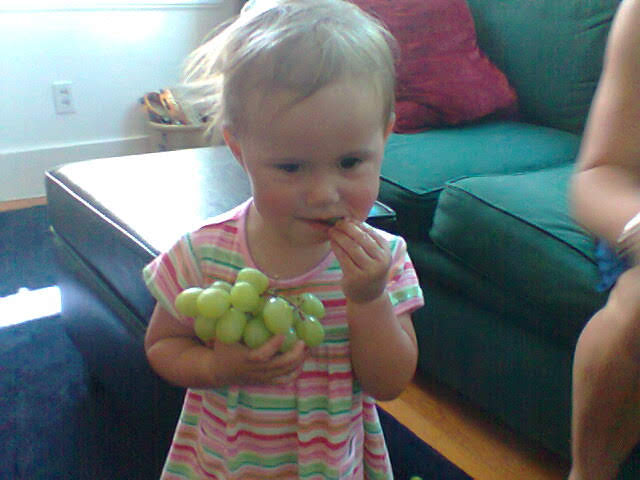
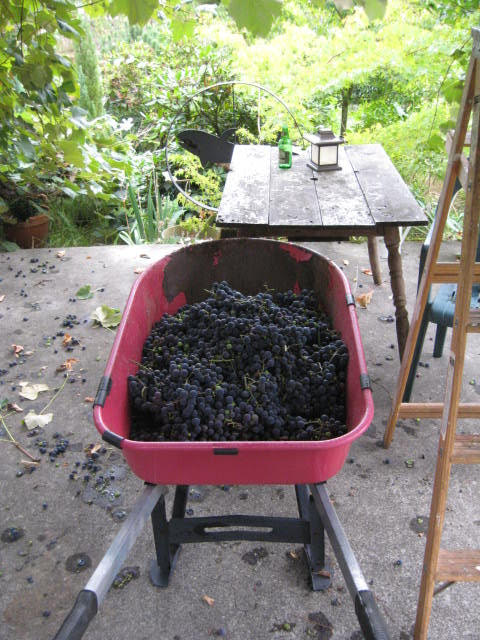
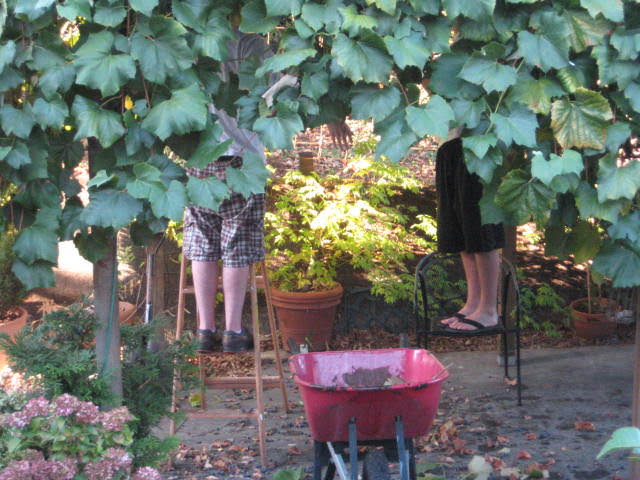
Yesterday I harvested the grapes from the pergola I built 35 years ago, the oil of the cedar boards dry and the wood crackling and splitting and fraying like an old T-shirt. I’ve been thinking for a few years of taking it down. By August the grapes are heavy. Scuttling the pergola will be a hard task. Meantime, the dwarf apple tree has overgrown the grape trunk and the Blaze Climbing Rose has reached the stratosphere, entangling its barbed links through the grape vines and the apple branches, a beastly hairdo that winds its way through the aged cedar board barrettes.
As I had predicted the rain stopped after a minute or two, my epiphany manifesting the end of summer yet another illusion of insight, a pseudo-epiphany, as too often happens. The rain was but a trace. And while I’ve got my copy of “Seascraper” sitting here by my side waiting for me to say something about it, I’ve lost the gumption. I’m going back out to take another look at the pergola; might even have a go at the Blaze.
 The Coming of the Toads