• Heat Wave

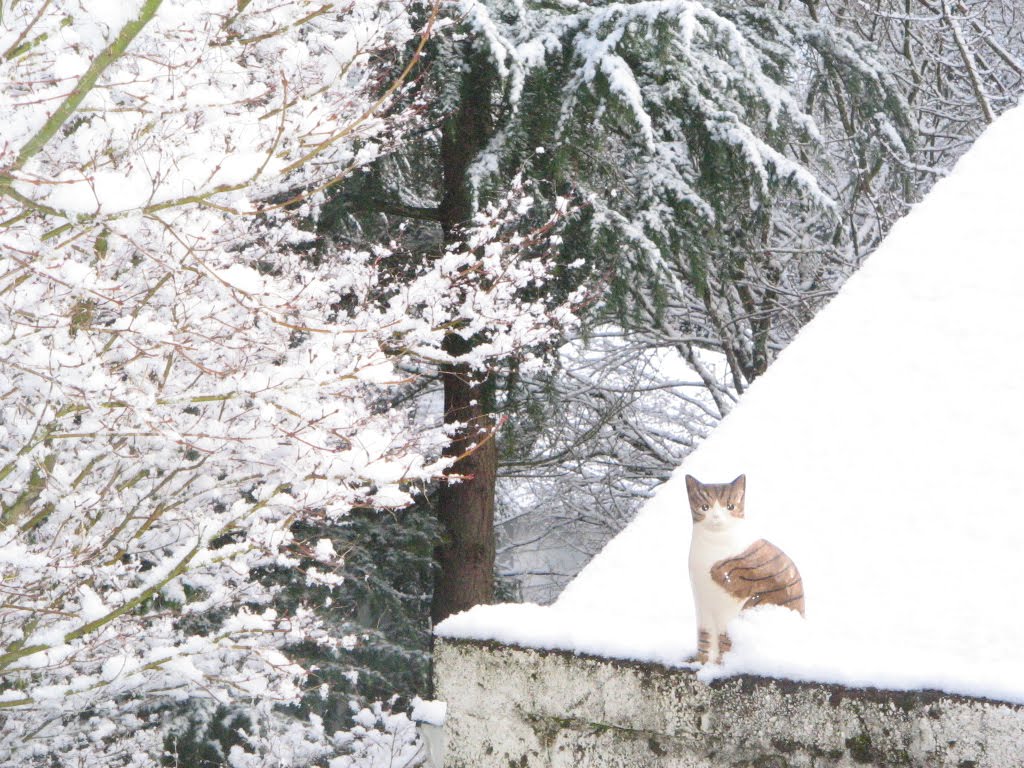
    Reading Darwin’s The Origin of Species (1859) this week, three days of 100 degree plus heat wave, we find many of his claims now absorbed as common sense and not controversial: when conditions of life change (flood, drought, extreme heat or cold, virus), plants and animals move, adapt, or perish. But Darwin may have underestimated the speed with which human intervention might disrupt nature’s pace:

    “How fleeting are the wishes and efforts of man! How short his time! And consequently how poor will be his results, compared with those accumulated by Nature during whole geological periods. Can we wonder, then, that Nature’s productions should be far ‘truer’ in character than man’s productions; that they should be infinitely better adapted to the most complex conditions of life, and should plainly bear the stamp of far higher workmanship?”

    What can we learn from the case of the demise of Florida’s orange groves? We might forget that orange trees are not native to Florida, or not think that 500 years is the wink of an eye in nature time. In any event, Florida’s orange trees, in the relative space of a few years, having been decimated by citrus greening, are being replaced with a new import, the pongamia tree, native to India. But what is said to be native to any given place is subject to constantly changing borders of nature. And natural partnerships are ever being created, renewed, broken, refreshed.

    Darwin made prolific use of metaphor, seemingly to his own chagrin, at times almost apologizing for using it.

    It has been said that I speak of natural selection as an active power or Deity; but who objects to an author speaking of the attraction of gravity as ruling the movements of the planets? Every one knows what is meant and is implied by such metaphorical expressions; and they are almost necessary for brevity. So again it is difficult to avoid personifying the word Nature; but I mean by Nature, only the aggregate action and product of many natural laws, and by laws the sequence of events as ascertained by us. With a little familiarity such superficial objections will be forgotten.

    So what are we to do with that “stamp of far higher workmanship” quoted in paragraph two above? And why would what Nature produces be any more true than what man produces when man is simply a part of nature?

    But the question blistering the headlines today is about the high tide of these heat waves, tsunamis of heat, every day breaking a new record somewhere, temperatures rising, plants wilting, animals dizzy from heat stress. Is the cause inscrutable Nature on some new unfathomable course, or “truer in character” yet, the stamp of human activity? And what’s to be done?

    Man can act only on external and visible characters: Nature, if I may be allowed to personify the natural preservation or survival of the fittest, cares nothing for appearances, except in so far as they are useful to any being.

    Where we see “survival of the fittest,” we may read survival of the best at adaptation, and the quicker to adapt, the more successful at continued comfortable living. Learning to live indoors at 70 AC degrees while the temperature outside is 103 degrees is not to adapt, and is not sustainable. Likewise, being able to navigate Death Valley as a tourist by virtue of AC in your Auto is not the same as slow adaptation to climate change. And we’re probably making matters worse. Yet Darwin remained optimistic, that Nature will continue to provide and sustain through change and adaptations, something like Matthew’s “Consider the lilies of the field, how they grow; they neither toil nor spin.” But to describe how something works does not explain why, and Darwin can’t seem to escape either metaphor or reference to “an active power or deity.”

    Authors of the highest eminence seem to be fully satisfied with the view that each species has been independently created. To my mind it accords better with what we know of the laws impressed on matter by the Creator, that the production and extinction of the past and present inhabitants of the world should have been due to secondary causes, like those determining the birth and death of the individual. When I view all beings not as special creations, but as the lineal descendants of some few beings which lived long before the first bed of the Cambrian system was deposited, they seem to me to become ennobled.

    But what does it mean or signify to become ennobled if you’re unable to enjoy the status of the moment? But the lily is Nature in all its so-called glory enjoying the sunny field. So is nature not at all anhedonic but hedonic in its random dance toward – toward what? But by definition hedonic pays not much heed to direction or purpose other than the pursuit and sustain of its own pleasure, which is to continue to procreate the game. The answer to that Darwin also suggests optimistically, is simply not to worry:

    It is interesting to contemplate a tangled bank, clothed
    with many plants of many kinds, with birds singing on the
    bushes, with various insects flitting about, and with worms
    crawling through the damp earth, and to reflect that these
    elaborately constructed forms, so different from each other,
    and dependent upon each other in so complex a manner, have
    all been produced by laws acting around us. These laws,
    taken in the largest sense, being Growth with Reproduction;
    Inheritance which is almost implied by reproduction ; Varia-
    bility from the indirect and direct action of the conditions of
    life, and from use and disuse : a Ratio of Increase so high as
    to lead to a Struggle for Life, and as a consequence to
    Natural Selection, entailing Divergence of Character and the
    Extinction of less-improved forms. Thus, from the war of
    nature, from famine and death, the most exalted object
    which we are capable of conceiving, namely, the production
    of the higher animals, directly follows. There is grandeur in
    this view of life, with its several powers, having been origi-
    nally breathed by the Creator into a few forms or into one;
    and that, whilst this planet has gone cycling on according
    to the fixed law of gravity, from so simple a beginning end-
    less forms most beautiful and most wonderful have been, and
    are being evolved.

    Reading Darwin’s The Origin of Species is an enjoyable way to spend a heat wave, if you have AC. He can be funny, too, though here probably not intentionally so:

    “Now the number of mice is largely dependent, as everyone knows, on the number of cats.”

    And on what is the number of cats dependent? The temperature outside today is coming down. We’re done with Darwin for now. So it goes.

    The Origin of Species, 1859.
  • Independence Day Eyeglasses

    We got a new pair of eyeglasses. Things look different now. Epiphanic frames. There’s seldom a guarantee others will see things the same way we do. Was he safe or out sliding into second base? Nine replays from nine different angles in slow motion and still the umpires are not certain. And we don’t see things the way we used to. The way we were. The light ever changing, en plein air an open challenge. Take away the mirrors!

    We were using non-prescription readers. Look over the top rim to see distance. The readers are inexpensive, and we had several pairs, easy to grab here or there, easily lost, broken, discarded, get a new pair, be found using someone else’s pair. The new eyeglasses are prescription, bifocal, a bit spendy, not to be lost, scratched, misplaced, stepped on.

    We used the readers for close up work: Chromebook, phone life, ingredients, books and magazines and sheet music, pics, shaving, mail call, is that a bug? Habit forming, may have used them when we didn’t really have to. Convenient.

    The new spectacles will take some getting used to. Evolution. Natural selection. We once tried to argue the impressionists painted what they saw – their vision blurred, eyesight not so good; someone said they painted from a well worked out theory. We still think theory comes later, what keeps the academics employed, the art appreciationists. Artists paint what they see. They don’t all see the same thing in the same way, and even if they do, are not trying to paint a photograph, but what they see feels like, the experience of the changing light. If you look closely at a Monet, you might see a slide show in progress. Might need a special pair of glasses.

    So we are now dependent on glasses. They won’t change the way we dream:

    “And I dreamed I was flying
    and high above my eyes
    could clearly see
    the Statue of Liberty
    sailing away to sea”

    Paul Simon, “American Tune,” 1973

  • Post on Nothing

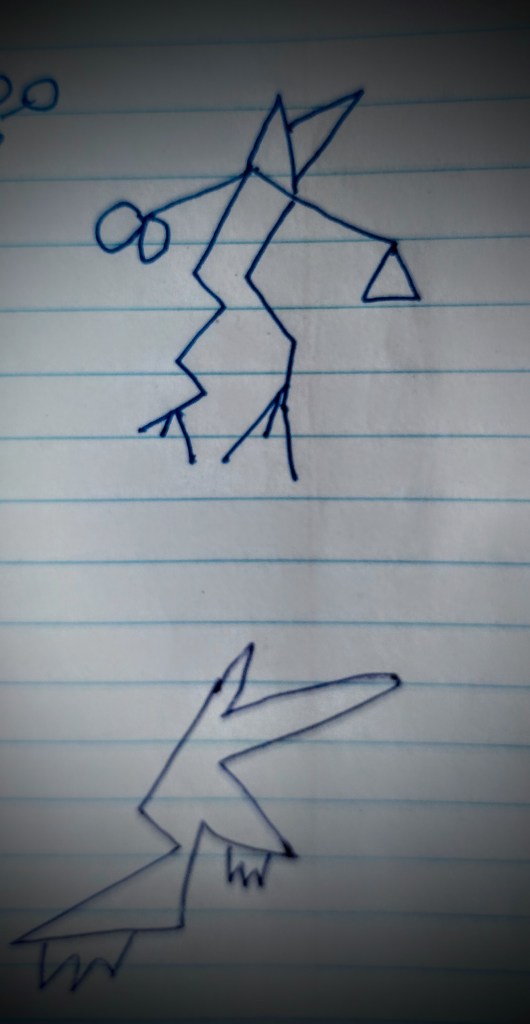
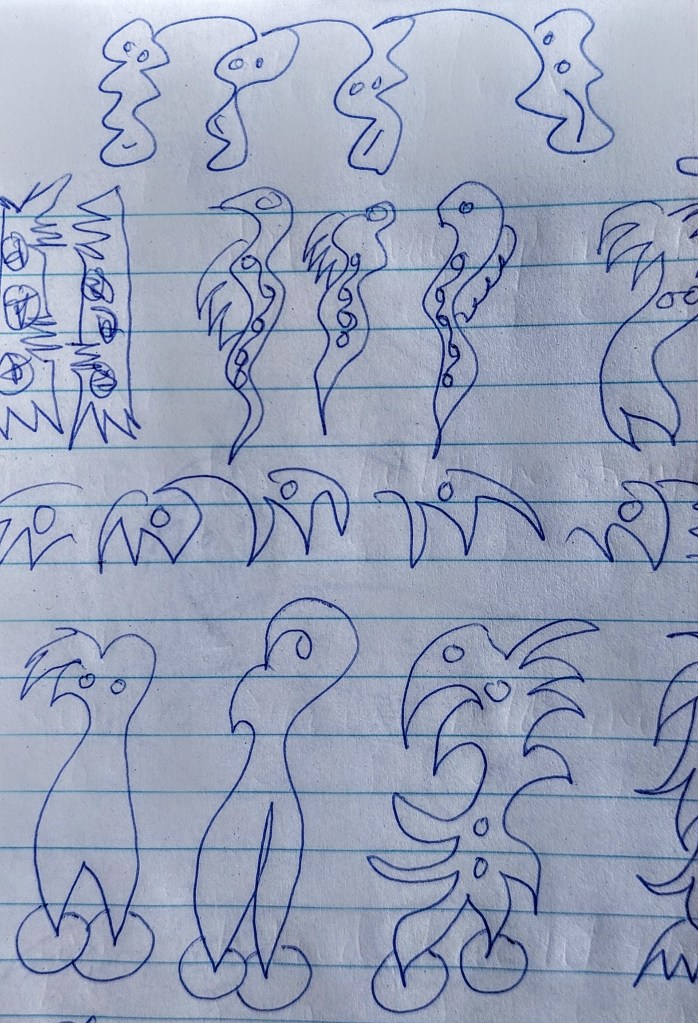
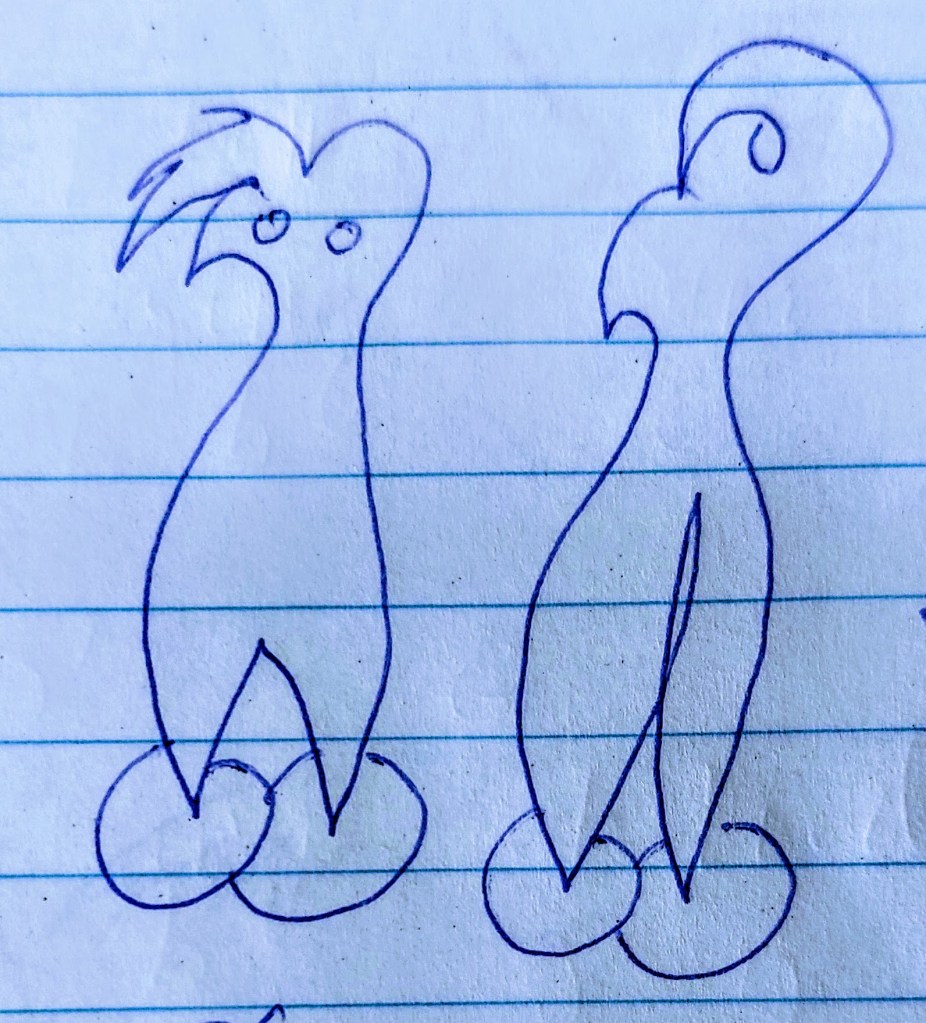
    Wanting for a word of good fit, I’ll ramble through a dictionary, in etymological pursuit. For example, just now I looked up the word pursuit and found that in a physiology context pursuit means what the eyes do, for example, when following the flight of a bird. I then looked up physiology, when what I had started looking up to begin with wasn’t pursuit at all but post. And it occurs to me that readers are like birds, flocks of readers: whodunit white-eared night herons; bibliophile bowerbirds; book-bosomed doves; frizzle-brood chickens; shelved-book house finches. Genres of readers flocked in clubs like a quarrel of sparrows, an asylum of cuckoos, a booby of nuthatches, a conspiracy of ravens, and this old couple who still perform the walk-on-water-dance of the grebes. But I can’t now seem to find the connection between post and pursuit, but perhaps it’s obvious. Even familiar words have family history and we don’t know half the story as we rush to tell.

    To post on a blog is to post in effect on nothing, the original posts one might post to being a mile marker, a signboard, road sign, doorpost, or a telephone pole, for example, on which one stuck a note giving notice, information or invitation or direction, or entertainment or argument, to passers-by, readers at random, on display in a public place. Such posts usually have (though not always obvious) some purpose, unlike graffiti, say, which usually is gratuitous. So far so good, a blog post is just that, what folks used to affix to a physical post, but there is no such real post to a blog post, unless one considers this open space where we seem to be (the internet, the web, the cloud, the blogosphere, the device – whatever it’s called) a post, but not a post like a milled fir 4 x 4, a tree shorn of its branches, returned into the ground, where to post something we might need a fashioned sign and a hammer and a nail.

                          "I have nothing to say

    and I am saying it and that is

    poetry as I need it ."

    And post it. But this, this post, to return to it, is not poetry; this is a blog post, a post on a blog. About nothing. But what is nothing, if not something? Cage also prepared something called “Lecture on Something,” but the above quote is from Cage’s “Lecture on Nothing,” from page 109 in Silence (1961). But then again I hesitate to call this (thing that I write on, post to) a blog. A blog is a form as a poem or a song or an advertisement is a form. What is a form? We grow so weary of nothing (unless we are one of the cognoscenti of relaxation). Nothing to do. Nothing to say. Nothing to eat. Nothing to drink. Nothing in the kitty.

    So we create and tend to forms. To blog is to write, but not quite, since some blog posts are devoted exclusively to the posting of pics, often posted without referent rhyme or reason. Content without form. How is that even possible? Anyway, aren’t there enough pics posted already? Yes, and words too. Is a pic a word? If you look up pic, you’ll probably see it’s classified as informal. It does not wear a cummerbund or a gown. But of course a picture is worth a thousand words. And where does that come from, that saying? We can look it up, and do. From advertising, apparently. The ads on the sides of trolley cars, which, passing as they do, a Clanging of Birdsong, provide for a moving post on which to post in pic form enough to imprint on the random viewer in passing a brand, a product, and a suggested desire or want, to follow up on later. Soap, cigarettes, auto parts, perfumes, hats, guitar picks. Are pictures worth more than words? Something called Picture Superiority Effect, from Wiki:

    The advantage of pictures over words is only evident when visual similarity is a reliable cue; because it takes longer to understand pictures than words (Snodgrass & McCullough, 1986[15]). Pictures are only superior to words for list learning because differentiation is easier for pictures (Dominowski & Gadlin, 1968[16]). In reverse picture superiority it was observed that learning was much slower when the responses were pictures (Postman, 1978[17]). Words produced a faster response than pictures and pictures did not have an advantages [sic] of having easier access to semantic memory or superior effect over words for dual-coding theory (Amrhein, McDaniel & Waddill 2002[18]). Similarly, studies where response time deadlines have been implemented, the reverse superiority effect was reported. This is related to the dual-process model of familiarity and recollection. When deadlines for the response were short, the process of familiarity was present, along with an increased tendency to recall words over pictures. When response deadlines were longer, the process of recollection was being utilized, and a strong picture superiority effect was present.[19] In addition, equivalent response time was reported for pictures and words for intelligence comparison (Paivio & Marschark, 1980[20]). Contrary to the assumption that pictures have faster access to the same semantic code than words do; all semantic information is stored in a single system. The only difference is that pictures and words access different features of the semantic code (te Linde, 1982[21]).

    With regard, then, to pics and words, as used in posts on blogs, one (pics) probably is not inherently, or intrinsically, worth more than the other (words). But what’s being measured in terms of worth is the value of advertising. Where pictures meet advertising in a meld (as in to announce, where the announcement and messenger are the same) is Instagram. Originally a place to post pics for folks with a hankering for photography, Instagram has become a wake of buzzards, a commotion of coots, a swatting of flycatchers. It’s an elevator of advertisements, the etymology of advertisement including a statement calling attention to itself and at the same time a warning. An advertisement is a solicitation, to be solicited, the more notoriously so, the better. Advertisement is a form.

    That music is   simple to make   comes from   one's willingness to ac-
    cept the limitations of structure Structure is
    simple be-cause it can be thought out, figured out,
    measured . (111)

    In Cage’s “Lecture on Something” entire pages are left blank. “Let no one imagine that in owning a recording he has the music,” Cage said (128). Nor, if we own a book, do we necessarily have the poetry. Cage often left sections of music blank, too, the better to hear, presumably, the truck passing through the street below the window within a piece. If Cage had had a blog, he might have expressed issues of frustration regarding the “limitations of structure.” And it’s amazing to see what he accomplished with a typewriter. Here on WordPress, poetry, modern poems, often difficult to arrange on a blog page or post, are given, in the so-called “block” format used to make the WordPress page, somewhat easily to the functional white needs of poetry. WordPress predicates the paragraph as the primary foundation (block) of writing. Maybe for prose, but not so much for poetry, and probably not at all for the writing of music or tablature. That said, I’m not an expert at WordPress styles and options. I want to write, not do computer programming, so maybe I’m missing formatting possibilities, but the WordPress Preformatted and Verse blocks seem to work flexibly enough to attempt some creative forms. But the block is self-contained – I don’t see the possibility of a block within a block, where, for example, the typography of one word might change in size relative to the typography of another word in the same line or block, or of letters to letters in the same word.

         writing      verse (unblocked words)     on  WordPress 
    is as simple as writing
    music
    if one accepts the
    limitations (rules)
    of structure
    the structure of limits (that which can't be measured)
    nothing has no limits

    What limitations was I talking about again? And anyway, doesn’t verse have all the limits it needs, without bringing WordPress into the discussion? Even a piece of doggerel has its limits, its boundaries. But notice Cage said “make” music, not write music, not compose music. One can make music if one has access to any kind of sound making device. To make silence is probably the most difficult challenge. If we take a pic of this post, we’ll find a picture is not worth a thousand words, since we can’t fit a thousand words into the pic, a post of 1,453 words, 8 minutes read time.

    Pic of Post
  • Commencement

  • Beach Buggy

    There’s a scene in John le Carre’s “The Spy Who Came in from the Cold” (1963) where Leamas, the tough and unsentimental spy, recalls his first experience of what for him was a foreign emotion, the fear and trembling that comes from a near miss. He was speeding down the autobahn late to an appointment and “taking risks to beat the clock” when he nigh collided with a car full of children:

    “As he passed the car he saw out of the corner of his eye four children in the back, waving and laughing, and the stupid, frightened face of their father at the wheel. He drove on, cursing, and suddenly it happened; suddenly his hands were shaking feverishly, his face was burning hot, his heart palpitating wildly” (122, Coward-McCann, 1964).

    But apart from his sudden shaking of nerves, what happens is that he imagines the scene as if he had actually hit the car, and that too is new, and

    “He never drove again without some corner of his memory recalling the tousled children waving to him from the back of that car, and their father grasping the wheel like a farmer at the shafts of a hand plow” (122).

    The new emotion is evidence that “He was slowing down. Control was right (121)….Control would call it fever” (122). What has happened to the stouthearted spy that a near miss becomes an obsessive memory that torments him almost as if the resulting imagined outcome really happened?

    I thought about the le Carre scene while reading the Roddy Doyle short story, titled “The Buggy,” that appears in this week’s The New Yorker magazine (June 24, 2024). Doyle’s story also contains a near miss. A father is standing with his kids on a train platform:

    “He let go of Colm’s hand for a second, to give the button a jab – and Colm was gone. He had tried to step onto the train; his stride fell short of the gap, and he dropped between the train and the platform, under the train” (48).

    But what happens in Doyle’s story, unlike the foreign emotion experienced by le Carre’s spy, is the father seems to have lost touch with the reality of the experience:

    “He could remember rescuing Colm, but he couldn’t imagine it – he couldn’t feel it. He didn’t believe he’d done it. Or any of the other things he’d done when he was a father” (48).

    Like le Carre’s aging and on the wane spy, the father in Doyle’s story begins to experience his memories differently from the reality of their happening. In fact, he simply can’t imagine the experiences are actually his. For example, and this is probably, while reading the Doyle story, where I remembered the scene from “The Spy Who Came in from the Cold,” the father recalls another buggy incident. Another son, Sean, had pushed their buggy out into the road and a passing car hit it. Doyle’s story turns on whether or not the bugggies are carrying babies or are empty.

    “He could remember it like a scene from a film. It was a very good film. But he wasn’t in it.

    What happened?

    Where had his life gone? Not the years – the blood. Where was the life?” (49)

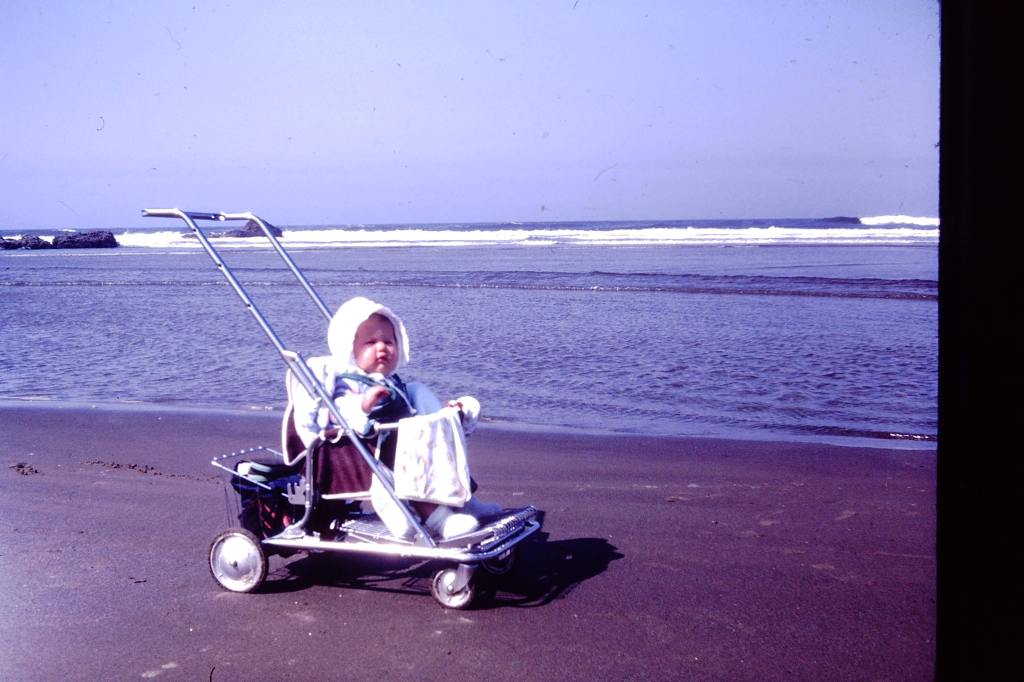
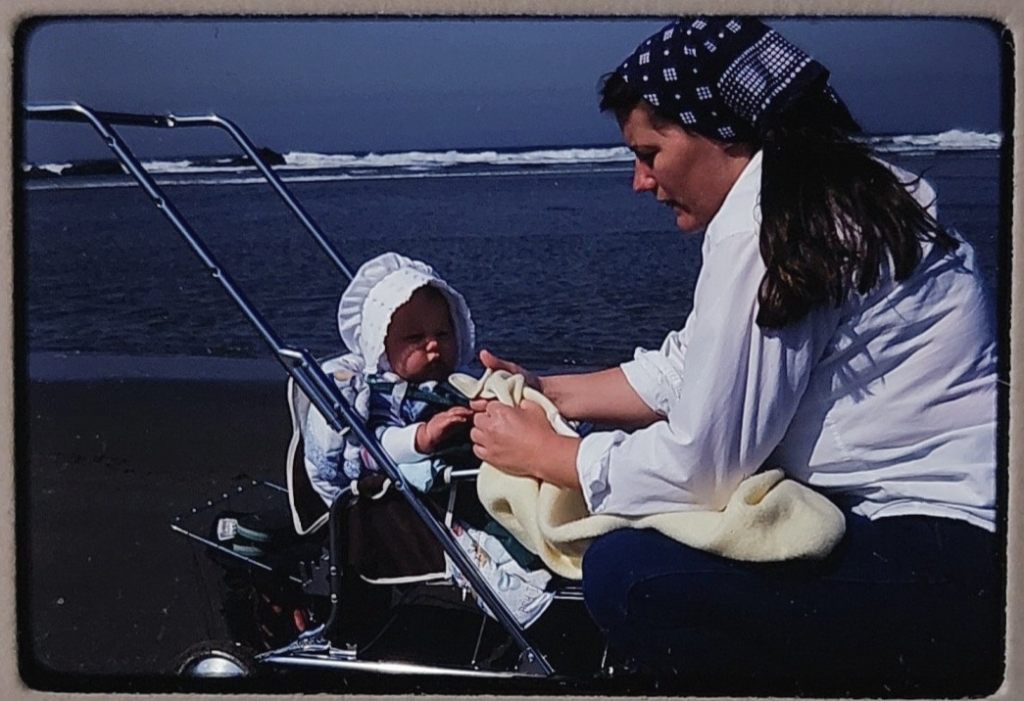
    Then there’s another buggy, in the Roddy Doyle story, at the beach, near the incoming tide, and this one reminded me of a couple of old 35mm slide photos I took years ago on a trip to Cannon Beach. There’s definitely a baby in this buggy. The tide is out, and I’m close by, and so is the mother. But why did I say I remembered the photograph and not the actual being there on the beach, the waves breaking far out, the sun still to the east, late morning, the blue steel tones of the sea and sky, the now old fashioned collapsible beach buggy with basket? And that white bonnet frilled lace like the surf foam and that blue bandanna. Is it a memory or a photograph or a short story?

  • So It Goes

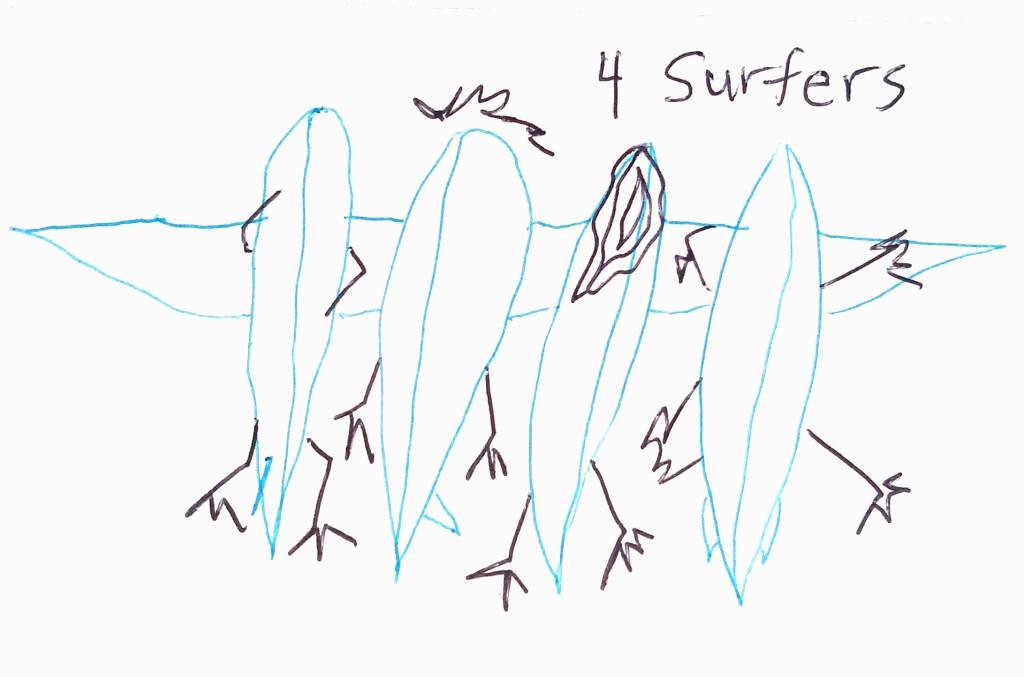
    Those who travel back and forth through time, to and fro, up and down, in and out, with the tides, over and under the swells, stopping now and then to visit. They were here, now they’re gone, return to sender. Sisters, first, then brothers, then ten of us, thoughts like tinnitus that echo like a whiffle ball others can’t hear, sounds won’t leave us alone, to night us, all ten nights of us, Knights of Tinnitus, while these guitars gently sleep, and surfboards drift. A banjo plays brightly, its tabor head a full blue moon, up on the beach. So it goes.

    But how does it go?

    Ah, but ask the winged burds!

    We look before and after,
    And pine for what is not:
    Our sincerest laughter
    With some pain is fraught;
    Our sweetest songs are those that tell of saddest thought.

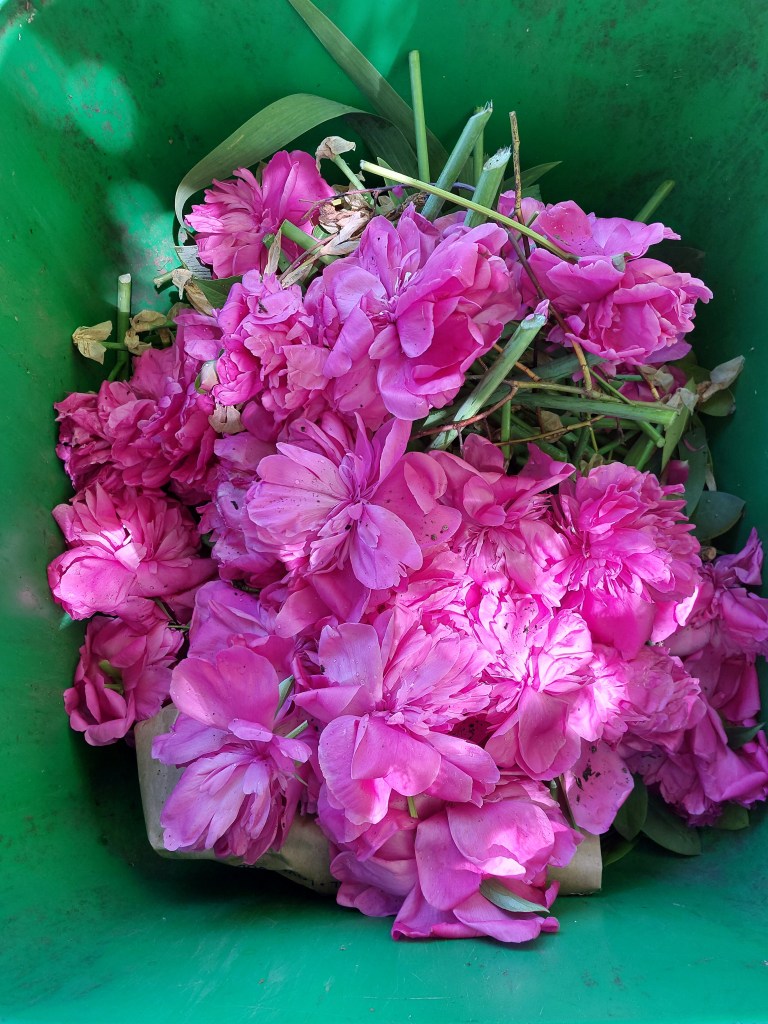
    But what did they bring along, if not knotty pine – oak or peonies?

    They brought along their come-a-longs, and along the river they walked, while in the wet reeds the wee birds nested and rested. There were peonies and pizza aplenty.

    And along the river, did they sing songs?

    Of chords they sang songs, serious songs, silly songs, songs of love and despair. Cover songs and under cover songs. Songs with no words.

    What songs did they sing?

    So it goes, so it goes. They sang so it goes.

    But where did it go?

    I don’t know. “While we look not at the things which are seen, but at the things which are not seen: for the things which are seen are temporal; but the things which are not seen are eternal.”

    And what did they take back?

    Don’t look back, but they took back a weighty tome, a mighty book, a reference book, a history book, a look into our times, past times, out of time, a book of songs.

    And did they play it as surfers or hodads?

    They played it both dolce or metalico, as the moon prevailed.

    Why did they leave so soon?

    “Blue moon of Kentucky, keep on shinin’. Shine on the one that’s gone and said, ‘Goodbye.’” So it goes.

    So it went?

    So it goes.

  • Notes on Olivia Manning’s “School for Love”

    “School for Love” (nyrb 2009) is a 1951 novel by the British writer Olivia Manning. The title comes from a conversation between the main character, Felix, and one of his housemates, Mrs Ellis, after she quotes from memory for Felix from the William Blake poem “The Little Black Boy,” from “Songs of Innocence”:

    Look on the rising sun – there God does live,
    And gives His light, and gives His heat away;
    And flowers and trees and beasts and men receive
    Comfort in morning, joy in the noonday.
    And we are put on earth a little space
    That we may learn to bear the beams of love… (166)

    Felix asks what it means, and Mrs Ellis says, “I suppose it means that life is a sort or school for love.” She doesn’t mention Blake by name, and is surprised Felix doesn’t know the poem, presumably mandatory reading for English schoolkids, but Felix has not had a typical British education. The reference comes in the last chapter, when Felix is about to complete his studies in this book that is a school for irony. The novel is set in Jerusalem at the end of World War II, where Felix, a young and naive teenager, having lost his father to an absurd fighting tangent and his mother to typhoid, comes to live in the house Miss Bohun has craftily usurped and uses like some evil landlord to manipulate and take advantage of her tenants. Finally, Mrs Ellis boldly confronts Miss Bohun:

    Mrs Ellis, breathless, her voice having about it a sort of glow and confidence of fury, said: ‘There you are Miss Bohun! I hear you are plotting to let my room….I thought I’d let you know you’re not getting rid of me so easily….’

    Miss Bohun’s voice was still mild, but her pleasantness had about it a quiet venom: ‘I thought when I saw you there was something about you . . . something vulgar and immoral. . .’

    Mrs Ellis broke in furiously: ‘I wouldn’t bring up morality or immorality, if I were you, Miss Bohun. What about you? A hypocrite, a liar, a cheat, a dirty-minded old maid’ (182-183).

    Miss Bohun of course tries to sell herself to others in terms opposite those characteristics. She does appear to have helped others, appears to hold an active and positive role in her community, and Felix is reluctant to revoke his loyalty to her for taking care of him when it seemed he had no one else to turn to and nowhere else to go. But he undergoes a slow awakening at the charges gradually revealed against Miss Bohun brought by Mrs Ellis. And Miss Bohun does not own the house in question, but has in effect stolen (saved, she would argue) the lease from a prior tenant whose family she then forces first into servitude and then out altogether. And she’s getting paid by the British for Felix’s room and board, while an element of absurdity is added to the plot when it’s divulged the curious, carefully furnished and clean but vacant front room is being saved for the Second Coming. And then it’s uncovered that Miss Bohun is receiving rent for that room also. She’s a kind of carpetbagger opportunist, and she’s very good at it, and she’s very good at explaining why she feels put upon and unappreciated.

    The characters live close to the weather and flowers and trees and one another, hungry and cold, hungry and hot, victims and refugees, and even when news comes the war is over in Europe, they can’t celebrate, because it’s assumed the local political friction will now grow much worse. Perhaps it’s too simple to say “life goes on,” but it does, and these are the people who see to it that it does, in spite of their losses or their measly gains that often come at disastrous costs to others. Miss Bohun hides all her deceitful behavior behind a facade of do-good intentions. Does she herself believe her intentions are good? Everything she’s taken she argues was a win-win. One wonders in the end what Mr. Jewel will have won. But he seems to be entering the renewed relationship with Miss Bohun with a clear vision of its costs and rewards.

    “I’m a lonely old man; she’s a lonely old woman,” Mr. Jewel tells Felix. A match made in heaven, though one can hardly imagine two people less compatible. In any case, as Mr. Jewel has already told Felix, “a wife and a fortune, they go together” (192).

    The book begins with winter snow when Felix arrives in Jerusalem and ends in summer as he’s preparing to leave for London, and throughout, Olivia Manning describes the changing weather, the landscape, walks through the colonies and to the cafes and hotels and gates and courtyards, with deft brush strokes, like impressionistic water colors, and the weather and plants are melded with the characters:

    On either side of the road the rocks were like great flints, the earth pinkish and bare as desert, and over all a silver glimmer fell from a dark sky (8).

    The garden was green and cold; the house colder. Most days the sky was stormy (24).

    Here the rains, following one another at intervals through the winter, carpeted the naked spring earth with a green as vivid as light. Later the grasses were enriched by the intricate leaves of trefoils, ranunculuses, anemones and vetches, and the spears of the bulb and tuber plants. Shortly before Mr Jewel was taken I’ll Felix saw the green cyclamen buds open, each dropping a screw of petals like a wrung-out cloth. In a day these had become flowers, alert and delicate as the ears of a gazelle (81).

    The summer was coming. There was no more rain; the sun’s heat grew, the spring flowers wilted, dried, turned to dust, and the fields grew bare. Now the beauty of the day came with the sunset and the sky turned from a pure, bright green to a peacock blue in which the stars shone each evening larger and more brilliant. The sunset translucence and colour lingered, perhaps until dawn (138).

    And there is the cat, Faro, another character in the book, that Felix loves, who gave him comfort night and day when he missed his mother so he cried helplessly alone:

    She was lying dozing along a bough shaded by ferns. Her fur, extremely soft and fitting like a loose glove, was pressed into folds along her legs and the line of her belly. Her summer coat had come in pale; there was a sheen over her whole body and a glisten of silver-white at her throat (172).

    A coming of age book, even if Felix does decide to keep the cat, adopt her as his own, and take her with him to London, another displaced, lower deck passenger, which is where Olivia Manning seems to find most of her characters:

    The liners had been turned into troop transports and perhaps the pets’ quarters had been dismantled – if so, there would be nowhere where he could shut her up at night. As a male civilian he would have no cabin. The army officers would have cabins to themselves in ‘A’ deck; the women and children would sleep about nine a cabin on ‘B’ deck; the civilian men, of whatever age and rank, would be allotted hammocks with the troops on the lower deck (175).

  • On Forms

    At the end of Mark Twain’s “The Adventures of Huckleberry Finn,” Jim finally tells Huck the dead man in the house they encountered earlier floating down the river was Huck’s father, and Huck, now aware and free of family, and now bored with his friend Tom Sawyer’s boyish ways, decides it’s time to cut out:

    “…and so there ain’t nothing more to write about, and I am rotten glad of it, because if I’d a knowed what a trouble it was to make a book I wouldn’t a tackled it, and ain’t a-going to no more. But I reckon I got to light out for the Territory ahead of the rest, because Aunt Sally she’s going to adopt me and sivilize me, and I can’t stand it. I been there before.”

    I’m with Huck, though it’s too late for me to pretend I can uncivilize myself, or maybe I was never civilized enough to begin with; in any case, I can at least decide I’ll write no more books. Eight is enough, and they are a big trouble, and troubling, and hard to take down. Civilization is a form of living that includes books, but one can live happily without being a reader or a writer.

    I’ve never put much stock in ancestry. My mother said her maiden name, though spelled differently, came from Anne Boleyn, the beheaded queen. That would make for an interesting answer on a medical form to the question, how did your ancestor die? Today’s medical forms often ask for information related to questions of genetics, presumably to help with diagnosis, but what’s wrong is still often just a guess, but lots of afflictions do carry useful genetic information. At the same time, some consideration might be given to mutations and the idea that at the cellular level some form of intelligence or at least some form of communication between or among cells, in plants and animals, informs protective changes.

    In the military, forms, identified by letters and numbers, such as the popular “DD Form 214” (DD for Department of Defense), carry orders, instructions, information. An Army is a form of military organization, and etymologically, the word army suggests to form, fit together, join, as one makes and makes use of tools.

    In high school, we learned to fill out forms. A popular question on those forms was “Father’s Occupation.” This might have been a precursor to the genetic questions on today’s medical forms. It might also help explain my being predisposed against interest in ancestry – though I would respond differently to such forms and questions today than I did when in high school. High school is a form of education, but in time the content wears thin, grows obsolete, while the form calcifies one’s entire being.

    Of history, Joyce in “Ulysses” has Stephen tell his principal, Mr. Deasy, it’s “a nightmare from which I am trying to awake.” Many of us might say the same of high school – a nightmare from which we are still trying to awake. Stephen, in conversation with Deasy:

    —History, Stephen said, is a nightmare from which I am trying to awake.

    From the playfield the boys raised a shout. A whirring whistle: goal. What if that nightmare gave you a back kick?

    —The ways of the Creator are not our ways, Mr Deasy said. All human history moves towards one great goal, the manifestation of God.

    Stephen jerked his thumb towards the window, saying:

    —That is God.

    Hooray! Ay! Whrrwhee!

    —What? Mr Deasy asked.

    —A shout in the street, Stephen answered, shrugging his shoulders.

    We’re still in episode two, “Nestor,” when Stephen makes the joke about a pier being “a disappointed bridge.” His students don’t seem to understand. Stephen is thinking of forms:

    It must be a movement then, an actuality of the possible as possible. Aristotle’s phrase formed itself within the gabbled verses and floated out into the studious silence of the library of Saint Genevieve where he had read, sheltered from the sin of Paris, night by night. By his elbow a delicate Siamese conned a handbook of strategy. Fed and feeding brains about me: under glowlamps, impaled, with faintly beating feelers: and in my mind’s darkness a sloth of the underworld, reluctant, shy of brightness, shifting her dragon scaly folds. Thought is the thought of thought. Tranquil brightness. The soul is in a manner all that is: the soul is the form of forms. Tranquility sudden, vast, candescent: form of forms.

    Cuneiform, Uniform, Reformatory.

    We might find something a bit morbid in recalling the ancient forms. No, I’m not too interested in ancestry, but somewhat (so. me. so. what). But to call out some ghost you don’t really know, yet a relation, still: from referre ‘bring back’ – see relate: couple with.

    —Pooh! Buck Mulligan said. We have grown out of Wilde and paradoxes. It’s quite simple. He proves by algebra that Hamlet’s grandson is Shakespeare’s grandfather and that he himself is the ghost of his own father.

    Joyce’s Buck Mulligan is in some form more interesting and certainly more fun than his Stephen Dedalus, even as Stephen is stand-in for Joyce himself. Stephen might be too given over to thinking about forms, while Buck more given to thinking about the form of suds atop his pint. Then again, Stephen is not Joyce, but an interesting form of.

    I was still in high school when my father was buried in an under-road big pipe project cave-in. The forms used to shore the walls of the deep ditch gave way, and he was pinned under a dump of dirt and against the cement pipe. He was rescued with seven broken ribs and some skin abrasions, a form of occupational hazard.

  • Hearty

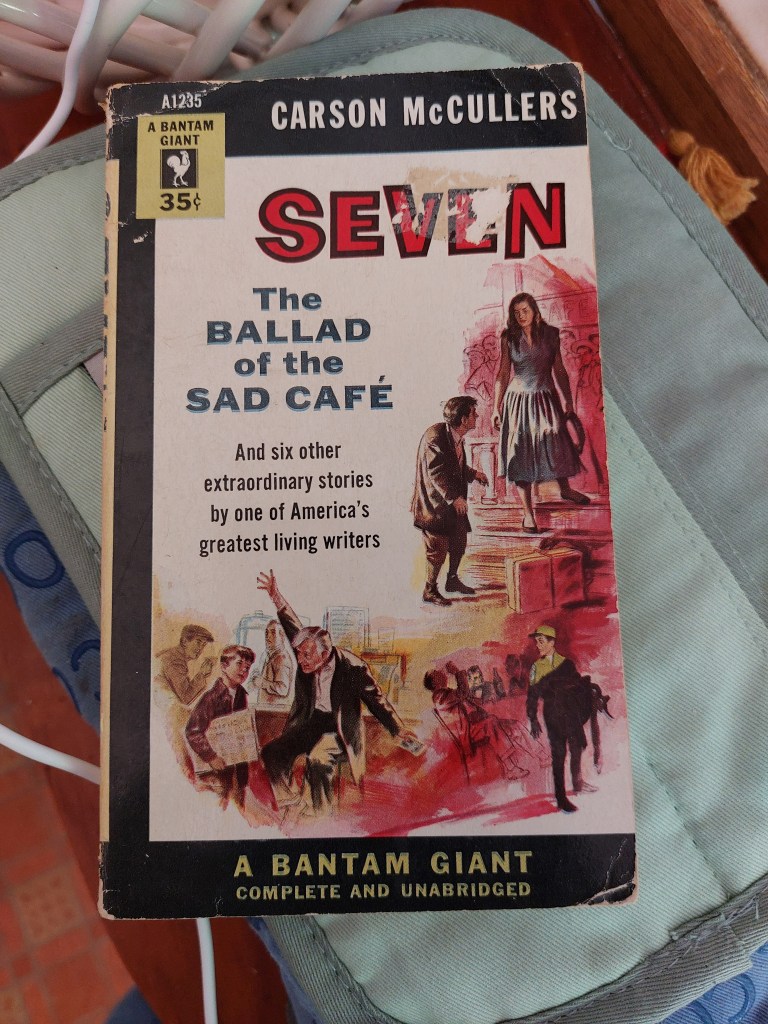
    If you’re looking for Carson McCullers, you won’t find her at the Heart Clinic, where in the waiting room the chairs are a pleasant pastel-green plastic, the color of hope, and comfortable, though the wait is not long, and the streaming station is set to 60’s and 70’s rock ‘n’ roll.

    Carson’s “The Heart is a Lonely Hunter” was published in 1940, when she was just twenty-three. We read it in high school in the mid 1960’s. The title comes from a poem by the Scottish poet William Sharp, published under his pseudonym, Fiona MacLeod. The word green appears in the 24 line poem 10 times. Here is the last stanza:

    O never a green leaf whispers, where the green-gold branches swing:
    O never a song I hear now, where one was wont to sing
    Here in the heart of Summer, sweet is life to me still,
    But my heart is a lonely hunter that hunts on a lonely hill.

    Only a poet would say of the heart it is “a lonely hunter.” But notice MacLeod/Sharp didn’t say “the heart”; he said “my heart.” Carson took his personal reflection and turned it into a universal appeal. Is the heart a lonely hunter? The answer will depend on whom you ask. But meantime we might also play around with Carson’s title:

    The Heart is a Garrulous Scavenger
    The Heart is a Forlorn Blogger
    The Heart is a Red Red Rose
    The Heart is a Hollow Muscle

    The word heart appears in Joyce’s “Ulysses” at least 200 times. Here is Stephen reflecting on one of his students in the “Nestor” episode:

    Ugly and futile: lean neck and tangled hair and a stain of ink, a snail’s bed. Yet someone had loved him, borne him in her arms and in her heart.

    But Joyce’s use of the word includes the real thing, too, as we find when we first meet Bloom:

    Mr Leopold Bloom ate with relish the inner organs of beasts and fowls. He liked thick giblet soup, nutty gizzards, a stuffed roast heart, liverslices fried with crustcrumbs, fried hencods’ roes. Most of all he liked grilled mutton kidneys which gave to his palate a fine tang of faintly scented urine.

    And this, meant to convey patience and forbearance in its context – Bloom thinking:

    Wear the heart out of a stone, that.”

    Of course many of the hearts are at the funeral for Paddy Dignam, but the young girls heart-worded “Nausicaa” episode begins with Gerty on the rocks close to sunset:

    The summer evening had begun to fold the world in its mysterious embrace. Far away in the west the sun was setting and the last glow of all too fleeting day lingered lovingly on sea and strand, on the proud promontory of dear old Howth guarding as ever the waters of the bay, on the weedgrown rocks along Sandymount shore and, last but not least, on the quiet church whence there streamed forth at times upon the stillness the voice of prayer to her who is in her pure radiance a beacon ever to the stormtossed heart of man, Mary, star of the sea.

    There is the sweetheart and the Sacred Heart. And times they might be the same. Or the heart is a flower. This from Molly Bloom:

    I love flowers Id love to have the whole place swimming in roses God of heaven theres nothing like nature the wild mountains then the sea and the waves rushing then the beautiful country with the fields of oats and wheat and all kinds of things and all the fine cattle going about that would do your heart good to see rivers and lakes and flowers all sorts of shapes and smells and colours springing up even out of the ditches primroses and violets nature it is

    And yes Molly Bloom has the last heart at the last of Joyce’s book “Ulysses” says:

    yes and his heart was going like mad and yes I said yes I will Yes

  • Happy Misfortune

    Why do some derive pleasure from some other’s misfortune, a strange joy often described as schadenfreude? The English version is epicaricacy. Now there’s a good word, suggesting epic caricature. A form of sadism, maybe. It’s not one of the seven deadly sins, though it could be related to wrath or envy. Or moral desert.

    Is it a weakness not to feel happy at a bad person’s misfortune? Is it impossible for a bad person to experience misfortune? Is misfortune a precursor to happiness? Can we even recognize true misfortune? What appears to be divine retribution may turn out to be a blessing in disguise. Likewise, do we know luck when we find it? Trina wins a lottery in Frank Norris’s novel “McTeague.” She ends up sleeping on the coins, literally, a bed of coins.

    The blessing in disguise is of course impossible to know. We can’t know what does not happen, only imagine it. But we’re good at imagining things. And our predispositions and assumptions often make no sense. We don’t believe in God, but we think people get what they deserve. We stick to the belief that good deeds are rewarded while bad acts get punished even as the headlines are proof of an alternative reality. Pride, greed, and envy are well-dressed floats in our celebration parades.

    We scan the headlines for signs of redress: the writer whose best seller is found to be plagiarized; the preacher who kept a mistress; the scholar who misspells, mispronounces, misses tenure; the sports hero hooked on drugs; the politician prosecuted. But the schadenfreude feelings these misfortunes stir up are no substitute for kindness and humility. What we seem really to be looking for is vengeance. But our code of disbelief has already struck down any possibility of such a judge.

    We are given then to randoms. We don’t know why things happen the way they do. And no event seems final. The so-called extinction of the dinosaurs is belied by the hummingbird and crocodile. I’ve been thinking of the dinosaurs recently, the ones we once thought now fill the gas tanks of our cars, but that’s a myth. Life doesn’t pass so much as alter – allegro non troppo: fast, but not so fast we can’t see or feel it go; and for the most part happy, though not permeating or permanently so. In any case, and as Slavoj Zizek points out in his segment of the Astra Taylor film “Examined Life,” the catastrophe of one species may be the good fortune of another.

    Is happy misfortune a universal truth, like the constant speed of light or theories of relativity? In the absence of proof of life elsewhere in the universe, is life on Earth a happy misfortune? Or is life elsewhere already over, ended, and not so happily? And would we feel a sense of schadenfreude to find out?

  • Ferrule

    One day, a child sitting in his grammar school classroom, I swallowed a ferrule, the metal eraser-holder cap at the top end of the pencil. I had been chewing the end of my pencil, thinking, I like to think now, was why, or maybe I was just hungry, but, in any case, I had like a beaver at work on a log, bit through, and suddenly the ferrule shot like a pill right through my mouth and down my throat. I hardly felt a thing. It didn’t lodge or get stuck, just down it went, where things go when you swallow them.

    As if chewing the pencil through and swallowing the ferrule wasn’t foolish enough, when I got home, I told my mom. That night, in the hospital bed, after visiting hours, the nurse came in to turn out the light and told me in the morning to use the bedpan so they could check to see if the ferrule had gone all the way through. The ferrule was never found, but I was discharged after the one night’s stay anyway.

    Yesterday, I Googled “Why did I chew on the end of my pencil?” and found this, from a site called “Pen Heaven,” an article titled “Pen Behaviour; Chewer, Clicker, Twiddler…?”: “Those who are in the habit of chewing and/or nibbling on their writing implements are generally nervous souls. Other than not wanting to borrow their pen, this person needs to be handled with care as they are often anxious, thin-skinned and take offence easily.” Nailed it? Not sure, but it was the most interesting answer in between all the more obvious dental hygiene warning posts.

    It’s a neat trick, of course, naming things based on casual observation of ticks and such. You can do it with just about anything, works like astrology. When something is given a name, a certain amount of control is exchanged, and explanations exceed their boundaries. But the trick after time is often exposed. Several recent articles serve to demonstrate.

    In “Why We’re Turning Psychiatric Labels into Identities,” Manvir Singh takes a close look at the Diagnostic and Statistical Manual of Mental Disorders (The New Yorker, May 6, 2024). The DSM is the desktop guide of the American Psychological Association, used to reference diagnoses. Behavior is given a name, and the named one assumes an identity. One problem with the process, as Singh makes clear, comes when the names are changed or deleted and those assumed identities are abandoned: “Revamping the DSM requires destroying kinds of people.”

    In “Who’s Afraid of Judith Butler?” (The New Yorker, April 29, 2024), Parul Sehgal profiles the Berkeley based philosopher. Butler, Sehgal says, “recently adopted they/them pronouns but doesn’t ‘police it.’” Sehgal refers to Butler as an academic celebrity – is that a non-sequitur or oxymoron, I wonder. Certainly Butler had not set out to achieve celebrity: “Butler told me that they had little notion of what was happening at first. ‘Someone from the Village Voice asked, What are you thinking about the new directions in queer theory? I said, What’s queer theory? They thought I was being Socratic.’”

    In grammar school, we were required to have two pencils, one red, the other black, and one pen, blue ink. At the top of each loose folder page we wrote “JMJ,” invoking the Holy Family to bless our work, no matter how messy or failing it might become. The pencil was used for math; in fact, to use ink for math (or arithmetic, as it was then named), cost points. So I must have been involved in some arithmetic function at the time I swallowed the ferrule. I doubt the word ferrule was at the time part of my speaking or even reading vocabulary. Imagine swallowing an iron bracelet.

    Pope Francis may seem by some bound by something like iron bracelets, but he always seems able to break free from them. In “The Pope Goes Prime-Time” (The New Yorker, May 21, 2024), Paul Elie comments on the Pope’s recent appearance on the news show “60 Minutes.” I missed the show, but found Elie’s comment piece noteworthy. The Pope had to respond to questions as if he were running for political office. Elie comments: “In substance, it was something like a highlight reel of topical remarks similar to those the Pope has previously made in interviews, homilies, and blessings. The wars in Ukraine and Gaza; women, children, and migrants; sexual abuse and climate change; the nature of the Church; the need for hope; and the attitude that Francis calls ‘the globalization of indifference’—were all mentioned, if briefly. When Francis was asked about antisemitism, for example, he replied, ‘All ideology is bad, and antisemitism is an ideology, and it is bad. Any ‘anti’ is always bad. You can criticize one government or another, the government of Israel, the Palestinian government. You can criticize all you want, but not ‘anti’ a people. Neither anti-Palestinian nor antisemitic.’”

    Also of special interest, the Pope’s definition of conservative: “A conservative,” the Pope said, “is one who clings to something and does not want to see beyond that. It is a suicidal attitude. Because one thing is to take tradition into account, to consider situations from the past, but quite another is to be closed up inside a dogmatic box.” The Pope seems to be trying to speak without a dogmatic ferrule bound around his neck.

    Dogma may be the practice of naming things. We used pencil for arithmetic because it was assumed in math we make errors, which need erasing (seemingly contrary to that was the requirement to show one’s work). I’m not sure why it was not equally assumed we’d make errors in writing sentences. The red pencil was used for both math and writing, where the lines of a diagrammed sentence would be drawn in red. We named the words diagrammed: noun, verb, adjective, adverb, pronoun, preposition, conjunction, interjection. Grammar became dogma.

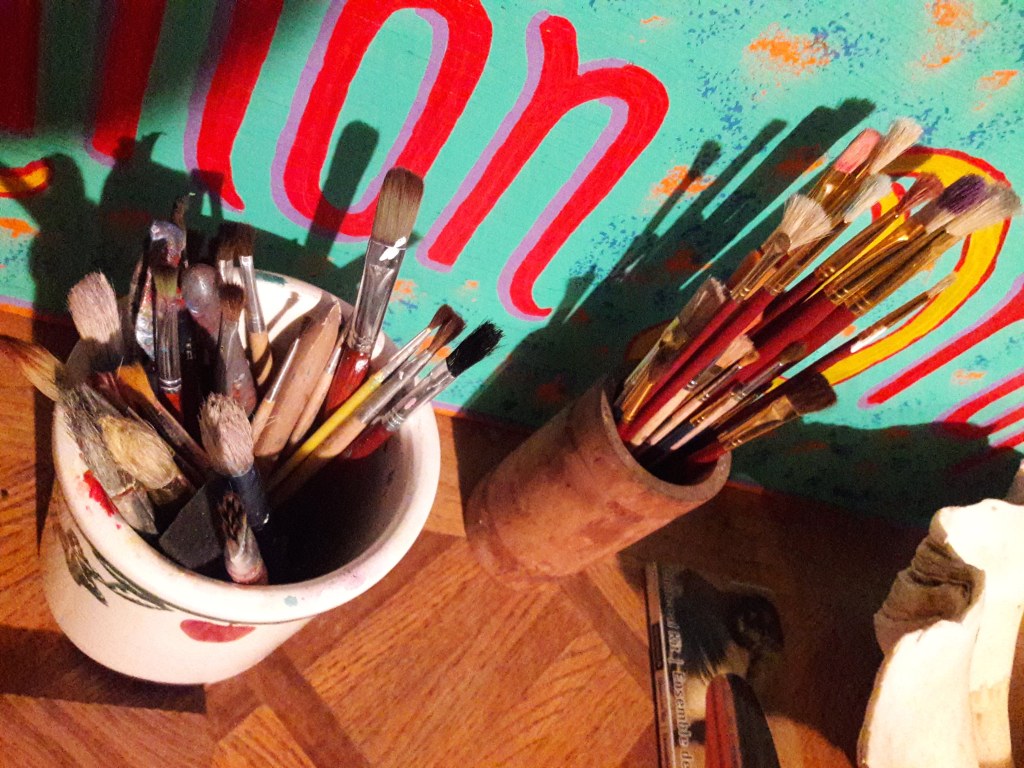
    Once you start thinking about ferrules, you might begin to see them everywhere, as, indeed, they are ubiquitous. Without them, things unravel, fall apart, come undone.

    Paint brushes with ferrules.