Category: Writing

  • Lost on Me – Fables Sans Morals

    Some time ago, a friend mentioned driving north on I-5 with California plates and being pulled over by the local highway patrol around Olympia. “In Washington,” the patrolman said, “we like to think of the speed limit as more than a mere suggestion.” Apparently, the self-satisfaction rewarded from this afflatus meant that all the more that was needed to restore calm to that section of his freeway was a warning. Was this a cop whose partner was a muse?

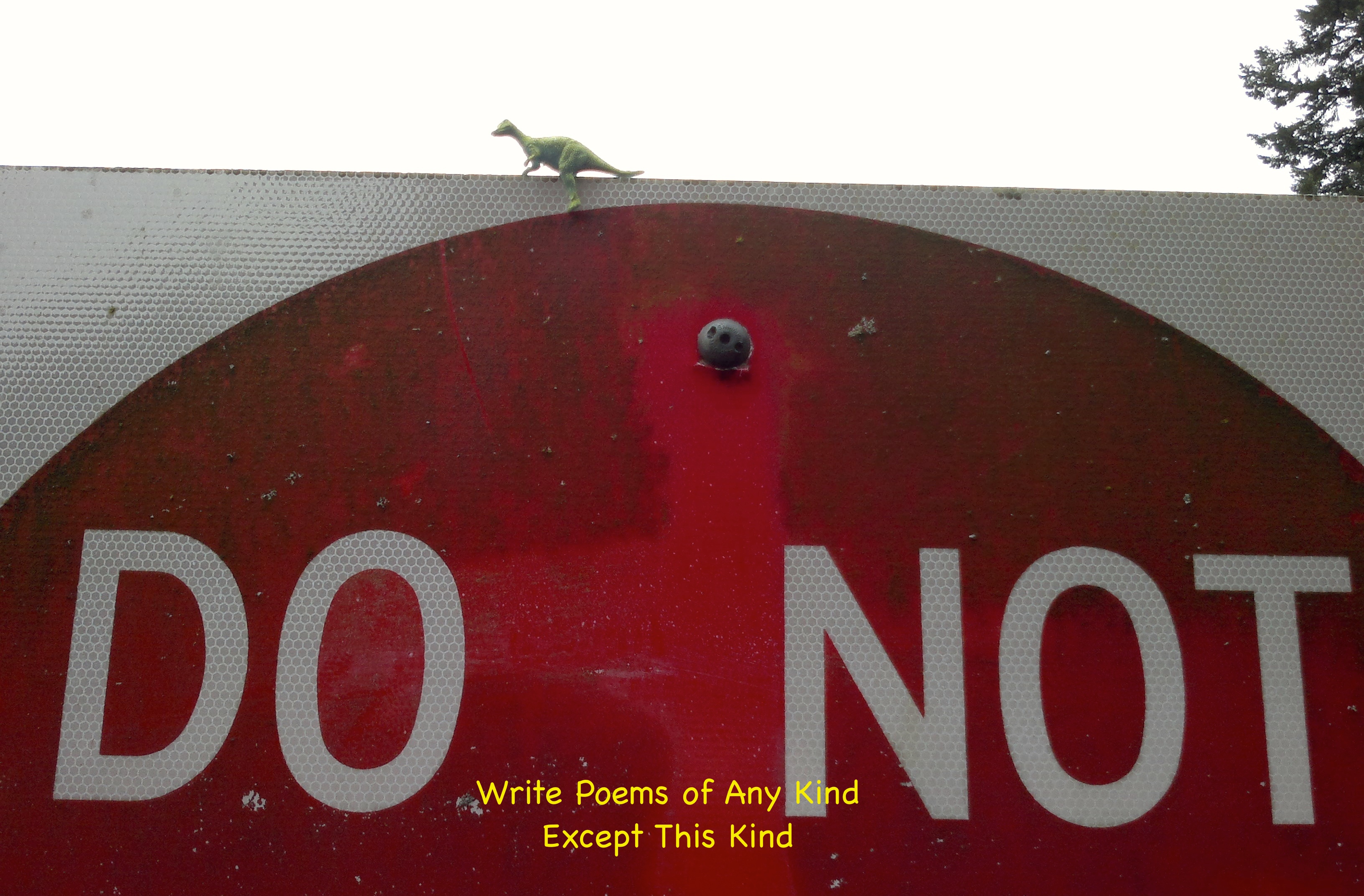
    The first critical review of my poem “16 Tiny Camels Found in Wood Box in Garage Stale,” up Monday at VERStype, began, “Beyond me my friend! I love the first line but lost on the rest.” “Ah! fellow musician,” I replied, “we often get lost on the rests.” I had, no doubt somewhat obnoxiously, tagged a few friends on Facebook to bring their attention to the newly published poem. Why? We are surrounded by poetry. No wonder erasure has become popular. If poetry habitually obliterates meaning, this is because poetry speaks allusively. We might define poetry as what can only suggest. But must we erase ourselves out of every poem? New hazards require new signs, new designs.Do Not

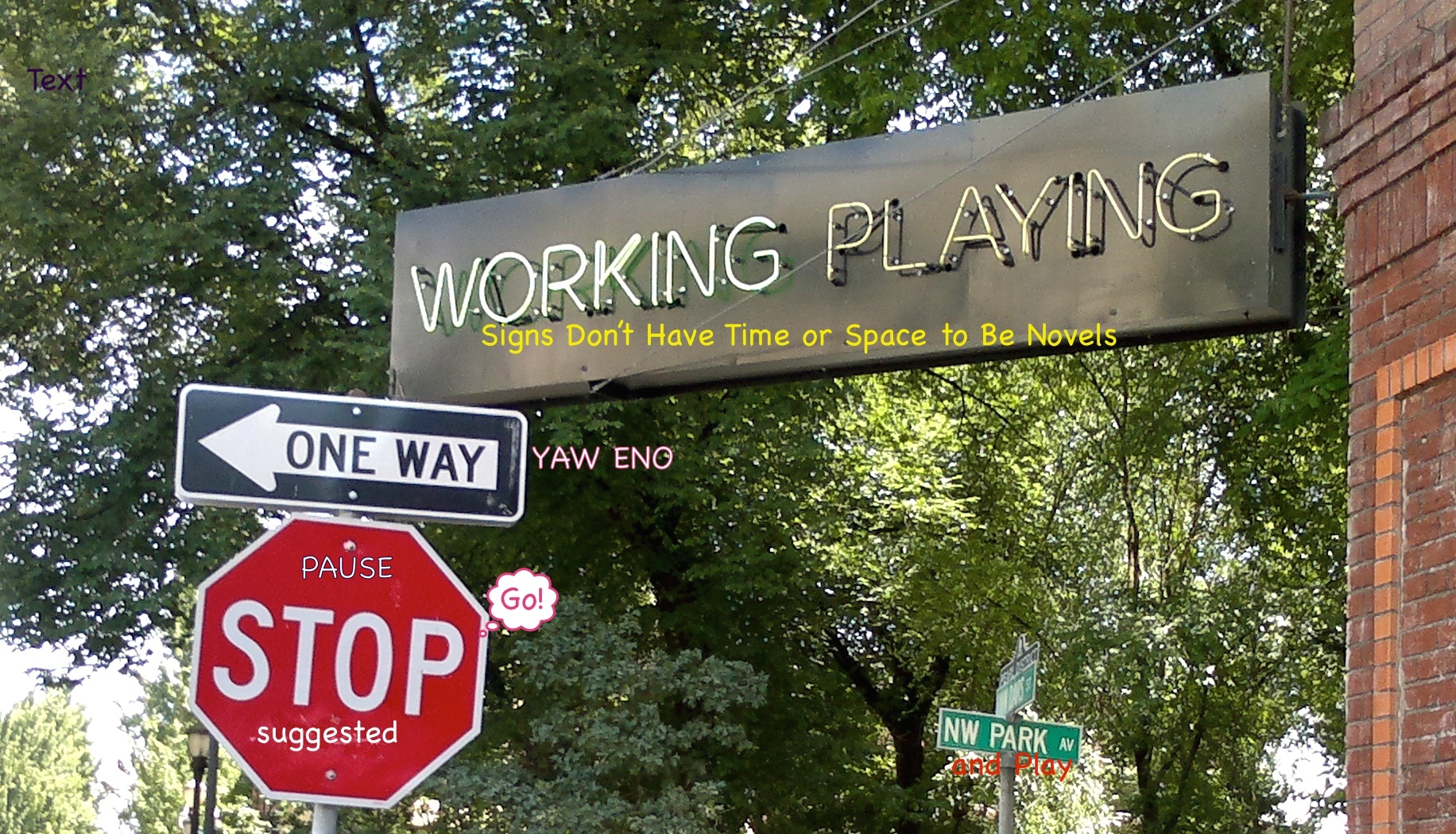
    To allude is to hint. To hint is to keep something hidden, perhaps from fear, or to play, or to tease, or because to point directly is either impossible or too dangerous (like looking directly at an eclipsed sun), or erases too much from the peripheral shadows. Maybe poetry is a peripheral device, necessary to navigate around meaning. A road sign does not have time to solve every ambiguity. Stop means stop. But after stopping, we can go. Maybe the ubiquitous Stop sign should read: PAUSE. But the idea (stop) is not up for discussion, for our consideration. But what does a bevy of signs mean? We are surrounded by instructions. It’s easy to get confused. Road signs are like poems; they speak allusively. But poetry may not be instructional.

    Sign Stories.jpeg

    But there are all manner of poems, and the function of poetry may vary with each poem. And language is an ogre whose sleep poetry tries not to disrupt, usually to little avail. There are a few one way streets in our neighborhood. Occasionally, a miscreant driver goes the wrong way, honking and freaking out at all the drivers going the correct way. That’s what the poetic experience is sometimes like – that sudden moment when you realize you’re the swine driving the wrong way down a one way street, the epiphany sending you up and over the curb, everyone honking and shouting suggestions. Every sign contains a moral. Poetry is amoral. The perfect poem traffics not in values but in virtues.

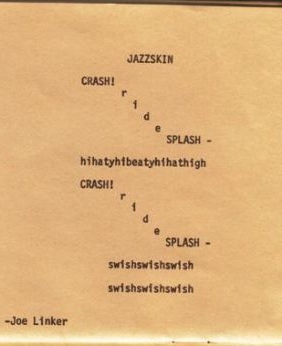
    VERStype is a new venue devoted to a particular kind of poetry. How we say something is as important as what we say, and how we say something includes both shape and syntax, tone and style, font and CamelCase. Jazz drums used to be called the skins, and to skin is to zest, peel, flay. How do you do that in a poem? Moving toward a lyric that mobilizes concrete techniques to carry melody and choreography with images of surreal dream dance. “JAZZSKIN” was published a long time ago in the El Camino College arts magazine, Silent Quicksand. No quicker way to obscurity, my friend Tim quipped at the time.

    jazzskin2 (1)

  • Involving “Involution,” a book by Philippa Rees

    For years, science was an argument that believed nothing on faith. These days, anything might be believed, as long as adequate funding materializes. Matthew Arnold’s receding “Sea of Faith” may be replenished with research dollars. What the sea might be replenished with is up in the air, and anyone’s guess.

    In “Spooked: What do we learn about science from a controversy in physics?,” Adam Gopnik (30 Nov New Yorker) explains: “The seemingly neutral order of the natural world becomes the sounding board for every passionate feeling the physicist possesses.” The subject is non-locality, or locality, depending on your point of view: the idea that we might eschew working at home and go into the office but without a commute. Gopnik is reviewing George Musser’s “Spooky Action at a Distance.” “One of Musser’s themes,” Gopnik says, “is that the boundary between inexplicable-seeming magical actions and explicable physical phenomena is a fuzzy one.” Gopnik looks at two other books, David Wootton’s “The Invention of Science,” and Thomas Levenson’s “The Hunt for Vulcan,” and concludes that scientists who suggest nature is wilder than we ever imagined “widen our respect for what we might be capable of imagining.”

    Imagining extreme life made possible by large doses of alien DNA, for example, such as the recent genome sequencing of the tardigrade makes apparent. Or of imagining a thinking both qualitatively and quantitatively different than Dickens’s Thomas Gradgrind’s facts based knowledge. In a delightful essay test-like answer, Mary Midgley said, “The Enlightenment has done a magnificent job of increasing our knowledge. The further job – which its original prophets glimpsed very clearly – of putting that knowledge in its wider context hasn’t been done so well. It is not a job for science but for wisdom. It needs more work” (“You may now turn over your papers,” 24 Sep 2010, Guardian). If you doubt that it needs more work or that funding must be involved, consider this, from Sabine Hossenfelder’s “Does the Scientific Method Need Revision?”: “I cringe every time a string theorist starts talking about beauty and elegance. Whatever made them think that the human sense for beauty has any relevance for the fundamental laws of nature?” Not that I’m a fan of string theory. As I said in a prior post, if Christo were a physicist, he would have enough string theory to wrap the universe. Beauty and elegance point to metaphor; what does physics point to? Without some extra-dose of alien DNA, it seems we’re trapped in the human.

    Imagining more work for the imagination is the lure of Philippa Rees’s erudite tome, “Involution: An Odyssey Reconciling Science to God.” “Creation has paid a high price for science’s limited certainties,” Rees says in her Introduction. Like Mary Midgley, Rees challenges Dawkins, who, Rees surmises, would call her work “bad poetry,” where metaphor is the culprit. And the Gradgrind school of physicists like Hossenfelder might also ask metaphor to leave the room. Can metaphor be tested? Is beauty falsifiable?

    The electronic copy of “Involution” is 947 pages, cover to cover, including copious notes, scholarly references, introduction, appendix, and afterword that bookend nine long cantos of free verse. If you’re looking for the gift that keeps on giving for someone who likes to read, consider P. A. Rees’s “Involution.” The paperback copy is only 444 pages (CollaborArt Books, 4 Jul 2013), but with the many references and notes, the e-copy might be a better choice because it’s efficient and effective to navigate.

    A synopsis of “Involution,” or a paraphrase of its argument, for purposes of this blog post, might best be substituted with Rees’s opening quote: “We are not human beings having a spiritual experience; we are spiritual beings having a human experience” (attributed to Père Teilhard de Chardin). The stylistic treatment of such themes often results in alternatives to standard forms of non-fiction. This is true of McLuhan’s “The Gutenberg Galaxy: The Making of Typographic Man”; of Norman O. Brown’s “Love’s Body”; and of much of Joseph Campbell’s work; and of Bachelard’s “The Poetics of Space.” These are works replete with references, written in a mosaic form, non-lineal. Their form challenges the status quo as much as their content. The poetry is not what makes “Involution” difficult. Involution’s poetry is not a post-modern puzzle. In many places we find a piece of the mosaic that alone is worth the price of entry:

    “It was all I had to bring
    For words must pull against the grain
    Shackled to their past
    Employed in other houses, poorly trained…
    Blacking scuttles, shining brass…
    All marred like aprons with old stains
    Or rigid in a tail and bow.
    Unable to use a common tongue…”

    But “Involution” is not an easy read. The seemingly protean nature of its narrator, moving in and out of italics; the mosaic history of science where each new discovery does little to complete the mosaic; the ambiguity of both protagonist and antagonist; the encyclopedic setting; the essential mystical nature of poetry; the science specialties – these all point to a work that is not meant simply to be read but to be lived with. At the same time, the book is carefully constructed, the layout accessible, the erudition softened in accessible notes and explanations. I remain perplexed by most of the figures, but they are helpful in the sense of being contributions to a new language form. I was initially a bit put off by the title, feeling no particular need or want for any kind of reconciliation, too cynical, I guess, but the title is true to the content; still, it gives little clue to the enjoyment of the reading experience.

    Sometimes, books are discovered by an unintended audience. How we say something is every bit as important as what we say, maybe more important. And it takes a staunch realist to speak to every audience in the same voice. Likewise, we should read difficult books. I’ve been working on Joyce’s “Finnegan’s Wake” forever, and he cunningly made it a circle, so I’ll never be able to finish it. The occasion of reading is also important, as important as the occasion of writing. The occasion of “Involution” may be now for both Philippa Rees and her reader: “From whence comes this recognition of beauty, economy, and elegance if not from our internal experience of being part of it?” (“Involution,” e-copy, p. 492).
  • 78 RPM Saturday Night

    Three new short pieces up over at SoundCloud with The Variable Trio. “Little Richard” and “Easy on the Blues” were attempts to recreate the shellac 78 sound, using aged vocals recorded open microphone into a portable recorder on tape cassettes then playing them back through a boombox into GarageBand, using the laptop open microphone and the “telephone vocal” setting with increased reverb. “Coffee House Scramble” was recorded using six tracks of GarageBand settings (Wide Wide Wah, Spring Theory, Alien Waves, Echolalia, Old School Punk, and Swampland), using the Fender Telecaster played unplugged acoustically into the laptop open microphone, and adding tracks of Yamaha Bass, hand claps and thigh slaps and slides, and acoustic piano.

  • Poem for Ones Who Know One When They See One

    What W. H. Auden said
    “In Memory of W. B. Yeats,”
    not modified in the “guts”
    or on the blog:
    “For poetry makes nothing happen: it survives”
    so there it is,
    no one need worry.

    “Encore! Encore! More! More!”
    OK, ok, settle down;
    this is no time for pathos, but,
    “Wild nights – Wild Nights!”
    Emily Dickinson reasoned,
    racked with want on the windy,
    open sea of her dainty,

    daunting room of gloom,
    and who knew better even
    than the audible Auden
    how poetry makes nothing
    happen, again and again,
    like seizures,
    and so I give you this, this wildcalm night:

    Poem for Ones
    Who Know One
    When
    They See One:

    Poem for Ones

  • New Cat, Mew Cat

    New CatHave you seen the new cat?
    How could I miss?

    Big cat.
    And fast.

    The new cat changes a lot.
    Big house, zero lot.

    So comes here.
    Our lives will never be the same.

    They never were the same.
    What were we doing?

    Waiting.
    Waiting for what?

    It’s what we do.
    How does the new cat change that?

    The new cat does not appear to wait.
    What are we doing if not waiting?

    Wait not, want not.
    Want not, think not.

    Think not, wake not.
    Wake not, watch not.

    Watch not, pine not.
    Pine not, itch not.

    Itch not, cat not.
    Cat not, can’t not.

    I am a cat.
    That I know.

    The new cat changes
    not that cat.

    New Cat Happy Cat

  • Privacy Poem

    Where do we get this notion
    of privacy?
    Is privacy a value,
    or is privacy a virtue?

    If privacy is a value,
    it’s simply a worth
    we want, and what we want
    is not always what is good
    for us:
    we want alcohol,
    tobacco, and firearms;
    fast cars with sound
    so loud we need
    earplugs;
    instant accesses
    to tête-à-tête boxes
    where we spy
    on our bosses.

    But is privacy a virtue,
    like love, patience, for
    giveness,
    joy of living, or courage
    to befriend?

    Abuse of surveillance
    does not make a virtue
    of privacy,
    just as, as Ivan Illich
    explained,
    protection
    is not the same as
    safety.

    But getting back
    to privacy:
    we want to be seen
    and heard at the party
    but not in the morning
    when the porcelain white
    face throws up
    its image in the little pond.

    The poet wants to be read:
    “Read me! Read me!”
    But the words seem so
    private,
    no way to enter
    the text.
    “I’m in here!”
    the poet exclaims,
    as if from the depths
    of some Xanadu privy,
    and when we hear
    the roller of big cigars,
    his call a private scream
    behind a rude screen,
    we know the poem
    is finished
    and about
    to go
    public.

    In public the words squirm
    for privacy, wriggling
    across the page
    heading
    for a clear margin.

    IMG_20151023_131339

  • Cold Reading

    “Yr lines, sunny boy,
    bingy, not calm,
    head busy jabots,”

    read Madame Fraus,
    by the tide that rips
    rocks thru yr palms.

    “Saline swim,
    bit sweet lit life,
    palms stage aligned,

    neck aflame, hair
    shorn horizon
    frizzled smile.

    Silverfish whitecaps
    aquiline wings smack
    & bay across draft brow.

    Paddle out, palms
    cupped, plod, slog,
    moil, & no sloom.”

    No sleep, steep crag
    to pine green palms,
    in line for clay water.

    Around another point,
    the persuasive ocean
    spreads open palms.

    “I’ll see you next week,”
    Madame Fraus said.
    “Leave the door open.”

    Cold Reading