Notes on Jessica Sequeira’s “Rhombus and Oval” (117 pages), 2017, What Books Press, The Glass Table Collective, Los Angeles:
“Rhombus and oval” is the title of the lead piece in this collection of stories by Jessica Sequeira, a translator of Spanish and French and a writer. The text of twenty-one stories runs 112 pages, each story from 3 to 9 pages long. They are fictional short stories.
What is a fictional short story, and why write or read one? “I used to work at a translation agency,” we learn from the narrator of “A journey that leaves no trace.” We should not confuse the author of a work with the narrator of a work, but toward the end of this second story in the collection, we hear, “I was tired of being a medium, of having words pass through me. Now I wanted to create.”
Fifteen of the twenty-one stories were previously published in small magazines. “In the rose garden” appears in Hawansuyo under the title “In the Rose Garden: A Tale of Researching Ribeyro,” and the story concludes with an interview conducted by Jessica Sequeira with the Peruvian writer Jorge Coaguila, a specialist of Ribeyro. The piece was published in the book Sounds and Colours Peru. The story provides a clear glimpse of Sequeira’s style, where genre expectations might be mixed together to form new perspectives. Other stories in Sequeira’s collection appeared in Berfrois, Glasgow Review of Books, Queen Mobs Teahouse, and Entropy.
For a long time, The New Yorker magazine opened, after “The Talk of the Town” section, with a fictional short story or two. I used to read them. I remember looking forward to seeing a new Donald Barthelme story. The May 24, 1969 issue featured his “At the Tolstoy Museum” (including odd pics, drawings, and diagrams). Barthelme’s story was the lead piece, immediately following “Notes and Comment.” Following the Barthelme story was “The Corner,” a short story by John Updike. But the reader was not told these were fictional short stories. The writer was identified only at the bottom of the piece (and in the table of contents). Today’s New Yorker subscribers can access all its past issues in the magazine’s online archive. Of particular interest in older issues are the ads, which often look today like fiction, though at the time, readers may have considered them real. Today’s New Yorker short fiction piece has been moved farther back into the magazine, usually just ahead of the critics.
I’m not arguing cause and effect here, but now I spend most of my New Yorker time reading the non-fiction. I make exceptions; if I see a Roddy Doyle story I’ll read it right away. We might have learned by definition non-fiction is true and fiction imaginative, or not true, though fiction may contain truths, while non-fiction may, through errors of omission or commission, be mistaken or otherwise fallacious. Neither fiction nor non-fiction should be confused with “the news.” The New Yorker, a weekly, is not a news magazine, though some articles may comment on or analyze what’s been going on lately. A fictional short story is by definition imaginary, and any resemblance to the real disclaimed as purely coincidental, but it’s possible an unsuspecting reader might take a fictional short story as non-fiction, and a non-fiction piece as imaginary. Crossing that threshold back and forth is maybe one characteristic of how fiction works. At the time it was first broadcast, many listeners believed Orson Welles’ radio play “The War of the Worlds,” about a Martian invasion of Earth, was really happening, was real news. That the broadcast was in fact fiction made no difference to those listeners who at the time believed aliens had landed and were on the move. Today’s audiences often seem as easily duped.
Deliberate fake news is a form of fiction. Fiction, like non-fiction, is an attempt to persuade – to persuade, if nothing else, that what you are reading is in some way real and true. The more we read both fiction and non-fiction, the larger and stronger our antennae for discerning the real from the unreal. Actual news (to the degree there is such a thing) is neither fiction nor non-fiction. The news in no way should attempt to persuade. To persuade is to argue. There should be no argument in the news. Statements of fact may be used in persuasive arguments, but standing alone, these statements are not claims of viewpoint. To the degree that the news is factual, there can be no argument, no reason for any kind of persuasive means: pathos, ethos, or logos. Fiction may be considered anti-news. No promises are made, no guarantee, no warranties. Ratings are of no consequence. There are no sponsors, no ads. But why then are some books banned, others censored or abridged? Dust jackets are covered with persuasive means. Read me! Why?
We might consider reading fictional short stories part of our daily experience. We don’t need to ask what anything means. It’s enough to observe, pay attention, and go about our day. What is the experience of reading one of Jessica Sequeira’s short stories? We might find a hint of this experience when the protagonist of “Conversation outside El Pastizal” decides to satisfy an obsession by trying to get a closer view of a building complex: “…I began to make my way down the path. As I continued it seemed to grow increasingly narrow, the air increasingly thin. At some point I even found it difficult to walk. But at last I reached the end.” But instead of satisfying his curiosity, he experiences “Something you can’t fathom…a flickering presence, inexplicable, beyond the known.”
One of the characteristics of Sequeira’s stories includes densely packed paragraphs that both detail and enlarge setting and plot. In a few pages, the story expands like a bubble made of soap blown through the small hole of a wand. The bubble has a short life drifting with the breeze, soon popping into spray. Most of the stories are told in the first person, and characters appear from nowhere, around a corner, as if by random, the narrator working, on break, taking a coffee, walking, thinking, observing. An exception, “The Hypersound,” begins, “Under normal circumstances Leo never would have visited the sauna.” Something is apparently out of place, a character introduced, and a setting suggested, and we’re on our way into the story, just like that. In the story “Bouvier,” on the other hand, we hear, “I was still studying then, and in those years, the great debate carried out in journals of anthropology and at congresses concerned the value of direct experience against secondhand analysis. Bouvier, my supervisor, was firmly in the camp of those defending experience. He considered it important to be out in the field, writing as elegantly and clearly as possible, openly incorporating oneself as a first person in the description.” Sequeira strikes an interesting balance between experiential description and analysis of that experience. Almost always in the background lurks a mystery shrouded in surreal overtones. But as in the best surrealism, the details shine with clarity and control. The writing is concise and not rambling, yet each turn may surprise: “Perceptual experience is what matters, I know; with big data you still only key in searches for things you expect, predetermined coordinates. But what if perceptual experience turns up something really ‘unbelievable’, which doesn’t sync with consensus reality?” Then you might have the occasion of a fictional short story.
In “On the island,” we get another view into Sequeira’s predicament and solution: “I knew he was interested in the interaction between subject and object, the form in which a literary or artistic work can comment on itself or call attention to its conditions of production or industry.” The stories in “Rhombus and Oval” do contain dialog, but not in any sense, for example, like Henry Green’s fiction. The paragraphs are thick blocks, though aligned left and not justified, and the reading is a bit slower than the slim volume might seem to promise. The tone sounds formal, without being academic, polite, creating distance, in spite of the close first person so prevalent. The writing style is consistent throughout: clear and concise, effective and efficient, the vocabulary accessible, the sentence structure mixed, always purposeful. “What convincing words can I use?” the narrator of Bouvier asks. At the end of “Inflamed eye,” we get another glimpse into the world of the fictional short story, why it’s written and read: “Just like the mouth with red lipstick, however, it returned to him from time to time when least expected – a vision that was unsettling, out of place – a reminder that other worlds exist.” And we are reminded of the collection’s epigram: “What would it matter, what would it change if these pages were written in Buenos Aires?” In the story “Limbo,” we get this: “There must be an infinity of older felines in this world as if it were a warehouse, disappearing progressively, one by one. Right now there may also exist a Jessica in the ‘real world’ younger than me. (If not now, someday there will be.) When she reaches my age, I will disappear.”
The stories in “Rhombus and Oval” are about as short as they can be, averaging just under five pages. This might be in deference, in part, to Internet reader habits, where distractions are rife and attention spans short. In fact, these stories are probably all too long to qualify as what’s been called “flash fiction.” The length of the collection’s stories might also be a requisite to a convention, or a habit, of writing that combines notes, reflections, diary entries, conversations, things seen or read or experienced or thought on the go. “Any variation could be folded into a narrative (110).” Having read some of the stories previously online, I’m interested in how different the experience of reading them was for me in hard copy form. The experience is sort of like the difference between watching a movie on TV and seeing it in a big screen theatre. Or watching a baseball game on TV and watching it out at the ballpark. But read either way, the stories are inventive, sophisticated without being pretentious or portentous, entertaining, and interesting examples each of the form of the fictional short story, particularly its continuing popularity and possibilities.


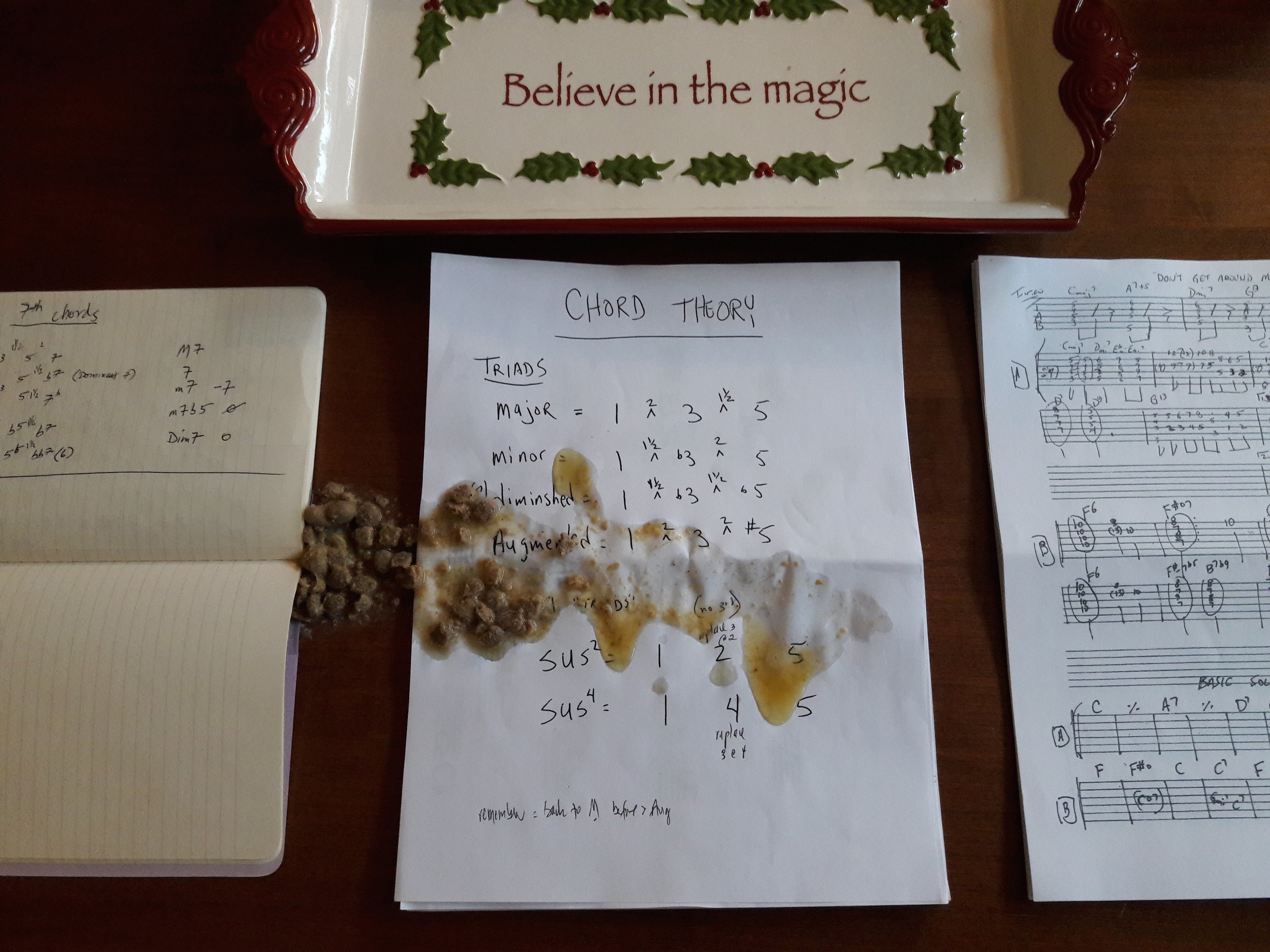 I’ve noticed when I pick up the guitar and the cat Zoe is hanging out, she’ll scurry off to a quieter corner. Cats have excellent ears.
 The Coming of the Toads