To turn the heater on would signal the surrender of summer, so I put on a coat. A bit damp out, Fall oozing in the offing, low 60s inside, open the Chromebook with a cup of bleak coffee.
In the email, from The Library of America, “A Cartoon Universe: Celebrating 75 Years of Charles Schulz’s Peanuts.” Schulz apparently didn’t like the title. In his opinion, it lacked “dignity and it’s not descriptive.” Not only that, but when asked if he had a newspaper with “Peanuts” in it, a local news stand fellow replied he did not, nor did he “have any with popcorn either,” thus confirming Schulz’s concern over the given title. “Peanuts” worked out, of course, but these days “Good Grief!” might make a good title, both dignified and descriptive.
Which reminds me of my blog title, “The Coming of the Toads,” borrowed from a short, obscure poem. While the poem itself remains dignified and descriptive, the title as allusively used for this blog has grown over time to lack connection to the daily posts – or maybe that’s the case from the beginning. The title, for a blog, is distinctive and memorable, but what does it mean in the absence of the About page? And might it not be a bit much asking readers to figure it out, and might they not wonder, to what end? If readers don’t recognize where a borrowed title comes from, the allusive effect is lost. To complicate matters further, the poem itself borrows or alludes to other works.
But isn’t all that the words of the absent parents in the Charley Brown TV specials? We hear their voices but can’t make out what they’re saying. The form says it all, no content necessary.
Anyway, it was Fall of 2007 when I discovered blogging and decided I’d try my hand at a WordPress blog, for which I needed a title. It’s not that I’ve come to dislike the title, but I wish somehow, like MTV creatively and against the commercial tide did with its logo branding in the early 80s, I could change it with every post, but to what, and to what end, and what confusion?
A Blog Universe: Celebrating 18 years of Joe Linker’s The Coming of the Toads
Old pond
frog jumps
sound of water

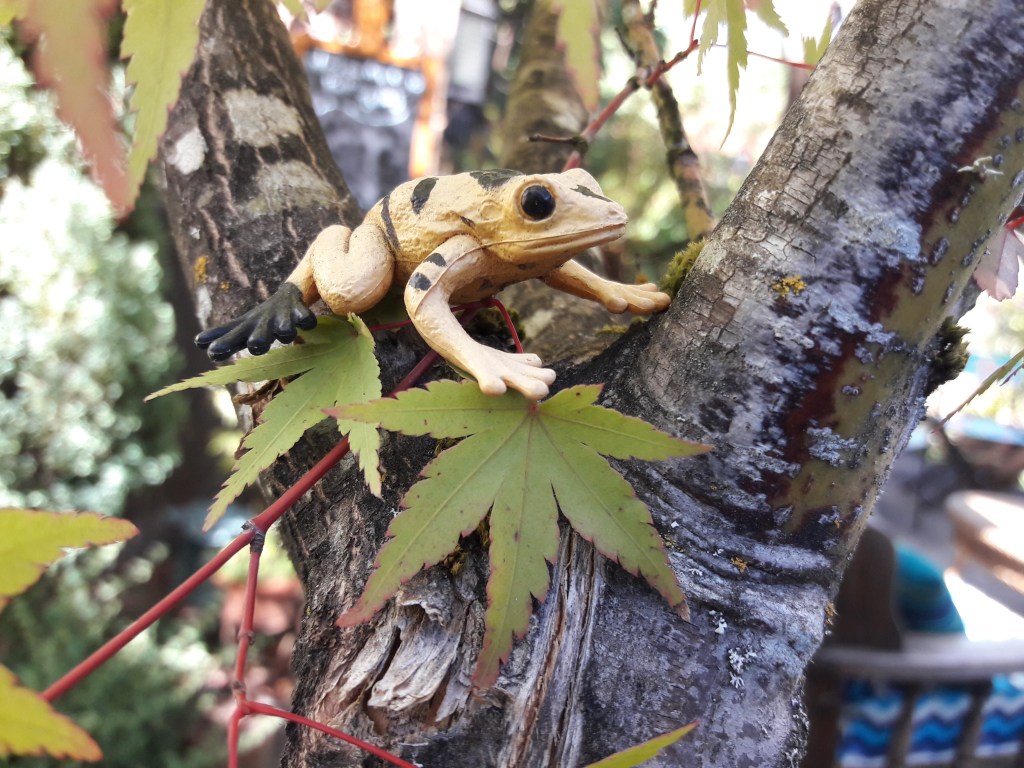
Old toad
flops in
blogs about

Where the toad
plops into a pond
echoes of Basho

Splish splash splosh
splushes an old toad
in the same pond
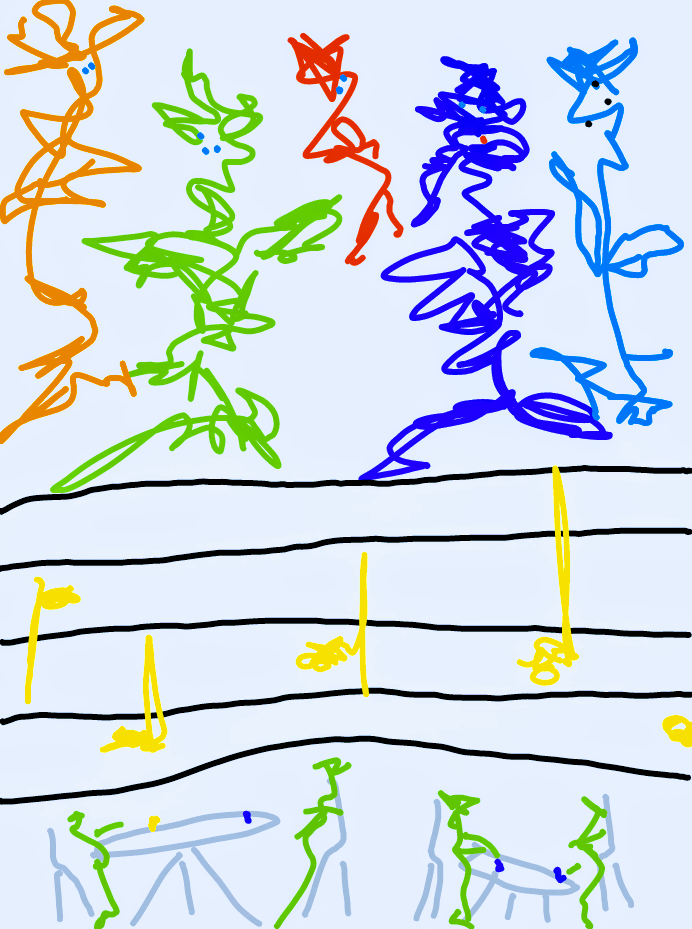
Going about without making any noise is perhaps the most difficult task of our day. If we try to make sense of the noise, we discover music.
I was thinking the blog was a silent activity, but then I began hearing my fingers striking the keyboard, padded notes, which, if given time, could be organized into a piece of music.
The quieter we try to be, the more noise we hear.
We might think of silent noise, tinnitus, for example, an apparent oxymoron, a noise but silent because it’s not really a sound, but simply the perception of sound, hearing a sound that has no outside source. Others can’t hear it, no matter how hard they listen. But they have their own silent noise playlists.
The keyboard went quiet as I reread the above paragraphs. I’m in real time for the moment, but my reader, if there is one, will not be in the same time. Thus the blog is like a recording, but the reader will not be able to hear the keyboard as I type, or as I typed, unless I made a recording.
There are 24 time zones around the globe. They allow for music to occur internationally. But not everyone pays strict attention to the time zones. In China, for example, everyone uses the same time, all the time, regardless of which of the five geographically separated time zones they might be in. What time is it becomes an interesting question, since sunrises and sunsets can occur hours apart, depending on where you are at the time. In other words, to awake at sunrise for one person, could be sleeping in for another, not getting up until noon! For some reason, we try to match our time with the position of the sun. But most people work inside, unlike our ancestors, so what does the sun have to do with it? Circadian rhythms. We can’t hide from the sun.
I’m making a recording now of the keyboard, using my cell phone. Note the pauses, as I try to figure out what to say. The spaces between the notes create music, because they are separated in time (duration). But is there rhythm? The recording has now gone on for just over one minute.
A default has given the keyboard recording the title “Voice 0061.” I’ve tried to upload the recording to this blog post, so readers can follow along, hearing the typing as they are reading the paragraph, but I received a message saying I’m unable to upload the file, to wit: “Sorry, you are not allowed to upload this file type.” Thus we discover that learning to play an instrument is harder than we might think. Undaunted, I’ll now try a video, using the keyboard and my cell phone.
I’ve set the phone against the screen, and I can’t see what I’m typing now, feeling much like the player in a jazz band. But I type on, being video-recorded. I don’t feel much like continuing the experiment, but having pushed on this far, I keep typing. As Cage said, “What we re-quire is silence; but what silence requires is that I go on talking.”1 Similarly, what music requires is that I go on typing. Many mistakes in this typed paragraph, like playing the worong [sic] notes on the guitar or piano, but I’ve gone back and corrected the text, but the mistakes, as recorded, sound just like all the other notes, no problem.
Now I have the video recording on my phone. Because I set the phone so close to my screen, the video is a white grey cloud, but the viewer can hear the keyboard. Now I have to figure out how to get the video from my phone into this blog post, so readers can listen to it as they read along. Alas, I try to email it to myself, but get a Gmail message saying it’s too big a file. Yet it’s only 1:33 minutes.
But you can perform your own keyboard music. All you have to do is type and listen. You don’t even have to type real words, but that should probably be the subject of a different blog post.
John Cage, “Lecture on Nothing” (1959), from “Silence” (First printing 1961. Wesleyan Paperback, 1973). ↩︎
My Heavy Metal brother was here: “… It’s a long, long road, from which there is no return, while we’re on the way to there, why not share?” (Lyrics from “He Ain’t Heavy, He’s My Brother,” by Scott and Russell, and a 1969 soft rock hit by The Hollies). And share we do, for example the “Live at 5” pandemic concerts we played weekly on Instagram Live; by the way, Instagram now limits “live” streaming to Instagramers who have at least 1,000 followers, creating a perceived scarcity – as if anyone watches anything to its end anyway, attention spans diminished as they are these days. So now we record short videos and post them as pre-recorded videos to Insta but also to our YouTube channels.
Anyway, while CB was here, he wanted to do a cover of “Stray Cat Strut,” the 1981 hit by the rockabilly group “Stray Cats.” Mainly, he wanted to try out my Gretsch1, which is good for playing in the rockabilly guitar style. It’s interesting that once again the British brought back a defunct American song style. Rockabilly was a 1950s sound originating in the South by players like Carl Perkins (“Blue Suede Shoes, 1956), Gene Vincent (“Be-Bop-A-Lula,” 1956), Buddy Holly (“Midnight Shift,” 1956), and Eddie Cochran (“Summertime Blues,” 1958). Rockabilly, the word, comes from a combination of the rock in rock ‘n’ roll, and the billy in hillbilly music, a description of mountain folk music, which evolved into country western, but which is still played in its original forms where it’s usually called old-time music.
Though his preferred guitar sound is heavy metal, CB is more of a perfectionist than I am on the guitar or with vocals. He also knows more than I ever will about guitar electronics, pedals, influences, and songs and players of the Metal sound. But I do like a raw sound, and a simple format. The original Buddy Holly and the Crickets, for example, was a simple trio of electric guitar, drums, and a stand up bass, and in those early recordings, you can hear the instruments individually, and it’s not a wall of sound coming at you like an electronic tsunami. Even when the rhythm guitar was added, the sound was still clear and concise. Meantime, volume has reached a reducio ad absurdum in some musical venues and recordings. Ironically, that loudness is often subdued by streaming platforms using loudness normalization.
After CB left, I decided to give “Stray Cat Strut” a go, but after a short while gave up on it, but as I studied it, I found both its lyrics and chord progressions interesting. The cat is a cool cat indeed, and I ended up taking the idea a couple of steps further, into the arena of the absurd, with an anthropomorphic pickup truck the main character. I satisfied myself with a short imperfect recording in a kind of country style, though others may of course have a different view of it. I made two recordings, one with vocal (with the 1970 Yamaha Red Label FG180), the other instrumental (with the Gretsch). Song chords and lyrics below, and link to YouTube instrumental recording at bottom.
Pickup Truck Strut

G7                                      E7
Sitting in a lot watching the lights go by
A7                                   D7
Gas tank on empty, tires pretty much flat
G7                                  E7
Surfboard sticking fin up out of my bed
       A7                     D7     G
I'm an old pickup truck and I got no strut

C7                  B7
Stray cats climbing into my cab
E7                      A7
Kids stealing all of my mooncaps
C7                      B7
I don't take off chasing Chevys in town
E7                     D7
I rumble away from the big city crowd

G7                        E7
Surf guitar playing on my radio
A7                          D7
Stand up bass, high hat and snare
G7                   E7
No red Corvette candy apple chic
      A7                          D7
I got tools and a surfboard in my bed

G7                            E7
Sitting in a lot watching the lights tonight
      A7                D7           G
I'm a used pickup and I ain't got no strut
The Gretsch is a G2420 Streamliner Hollowbody Electric Guitar with Chromatic II Tailpiece – “Village Amber” finish. Year 2021: with Maple Top, Back, and Sides, Nato Neck, Laurel Fingerboard, and 2 Humbucking Pickups. ↩︎
Since quitting a traditional 9 to 5 Monday thru Friday job some time ago, my sense of Saturday has changed. While working through the week, one looked forward to Saturday, sleeping in, hanging out, taking it easy – none of which happened, since one was forced to squeeze into that single day a week’s worth of chores and outside commitments. And it’s almost impossible to sleep very late when you’ve been getting up at 5 every morning all week. And I usually had work to take home. Have laptop, will travel, and work through the weekend.
So I begin this blog post on a Saturday, thinking of those Monday through Friday working readers today sleeping in, sliding into their Saturday, or having walked down to the corner cafe, opening their laptop looking for a brief and casual post that gives Saturday its day off due.
I finished reading Satoshi Yagisawa’s “Days at the Morisaki Bookshop.” By way of review, I remember this passage, from page 90:
Wada picked up the book and showed it to me. I secretly breathed a sigh of relief that we’d moved on from the last topic. “Oh? I don’t know. Is it a good book?” “It’s hard to say, actually. It’s kind of one of those tragic love stories. The author is a guy who had this one book and ended up dying in obscurity. When you read it, the writing can be clumsy, and there are a lot of places where it feels like it’s missing something. But there’s something about it that fascinates me. I’ve read it around five times already.” As he talked, he was staring at the oil painting of a road in the hills on the book jacket. There was something tender in the loving way he looked at the book that ended up making me want to read it. “Really? Five times? Maybe I should check it out.” “I’m not sure I can really recommend it. What are you reading, Takako?”
That’s sort of the way I felt about the book itself, that I was reading (I just finished it last night), “Days at the Morisaki Bookshop.” I mean, the writing did seem clumsy in parts, but the story and the lonely narrator and the neighborhood of bookshops in Tokyo were at the same time, if not fascinating, charming and diverting, inviting repeat visits, though I probably won’t read it again, let alone five times. And I do recommend it, for what that’s worth, to someone awake too early on a Saturday with nothing to do.
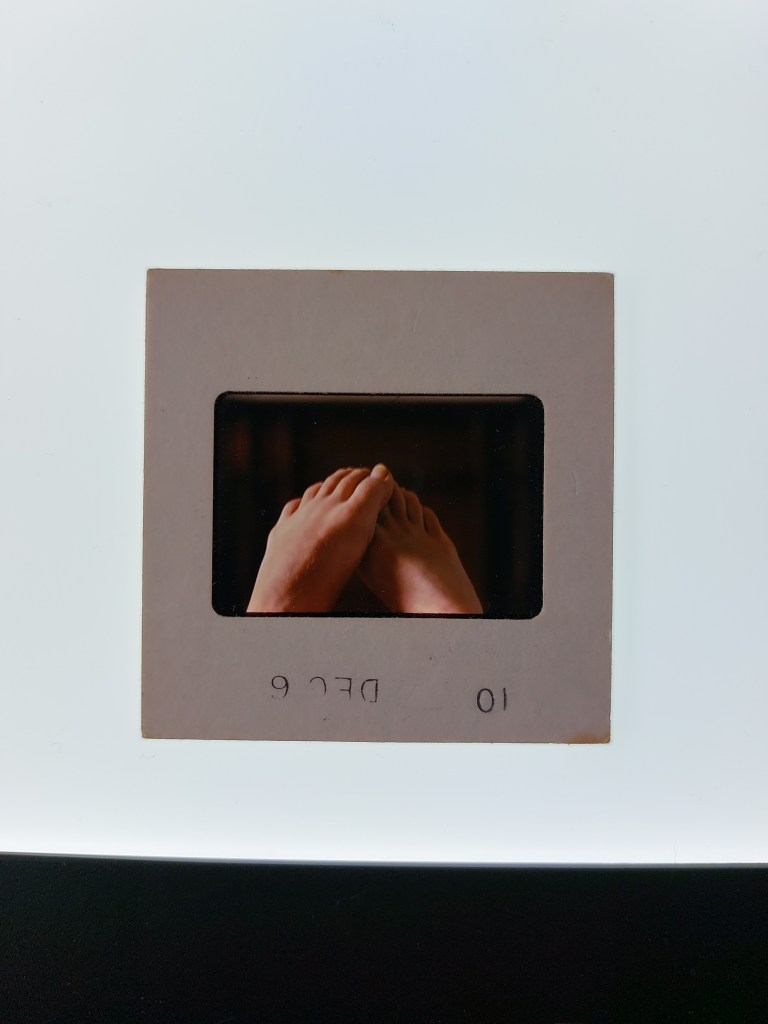
I’ve noticed that naming blog posts after a day of the week seems to have found followings, like “Wordless Wednesday,” or doors on a Thursday, or flowers on Friday. So I thought I’d put up an old photo slide on a Saturday, and call it “Sliding into Saturday.” This one’s from December, 1969.
I’ve been enjoying the New York Times game called “Connections,” even if it’s usually as stacked as a one armed bandit in a Western saloon. And I noticed they’ve created a sports version called “Connections: Sports Edition,” which I’ve not tried. I’ve enough sports watching my home team Dodgers falter down the stretch. But it occurred to me to try my hand at a poetry puzzle version.
How to Play: Find the solution that ties all the words in the puzzle table together. Click the footnote number in the bottom right hand corner of each table to view that table’s solution. Or feel free to post your own solution in a comment to the post.
From Disney’s Mary Poppins, here changed to an adverb, a multi-compound word.
A musical term: “As Slow As Possible” (notable example, John Cage’s organ composition ORGAN²/ASLSP).
A person who uses long words, from Latin for a foot and a half long.
Making connections.
Making an essay out of it.
To be unable to move forward for fear of “ifs.”
The correct spelling of irresistably.
1953 Samuel Beckett novel: The Unnameable.
Once considered the longest word in English. Refers to a 19th-century political movement in Britain opposing proposals to disestablish (separate) the Church of England from the state. It’s a turnaround word.
Last night around midnight I finished my nightstand book “All the Lovers in the Night,” the second of three Japanese fiction books I recently picked up. I read it after “Convenience Store Woman.” Next I’ll read “Days at the Morisaki Bookshop.” Meantime coincidentally I heard about “The Second Chance Convenience Store,” by the Korean writer Kim Ho-Yeon, so I added it to the stack on the nightstand.
I had been about to begin reading again Penelope Fitzgerald or Barbara Pym or Elizabeth Taylor, after “Seascraper” and “In the Cafe of Lost Youth,” both of which followed “The Dissenters.” The last Elizabeth Bowen I read was “Eva Trout.” My reading of course is a tale neither here nor there nor anywhere, but I try not to write book reviews, ever since Jessica commented, “It’s not a book review,” about something I’d written about one of her books, a simple reflection, drawing unexpected connections. But I was happy with that, with her comment. Too many book reviews seem template formatted and start to sound too similar. But blurbs, blurbs are the worst, exaggerated cartoons of reviews. Before “Eva Trout” I’d read “Spring Garden” and “Forbidden Notebook.” I also read, back in May, a book of short stories one of my brothers wrote, titled “Roxy, Reincarnated.”
But the last book I read, just before deciding on the Japanese trio, was “The Invention of Morel,” by Adolfo Bioy Casares, influential Borges friend and collaborator. I found the Casares book interesting but not suitable for midnight reading, though some may find it precisely written for the middle of the night. Still, I find it’s still with me, its strangeness. And it too is a kind of cartoon, exaggerated, comic book matter. It deals with metaphysics and light and predicts television and movie popularity. Think of the characters as all movie stars, among which you walk, but they don’t see or hear you. Indeed, one should approach such books with a keen reliance on circumspection:
“The case of the inventor who is duped by his own invention emphasizes our need for circumspection. But I may be generalizing about the peculiarities of one man, moralizing about a characteristic that applies only to Morel” (80).
Yet here I am duped by my own book reviews, if you can call them that, and Jessica said you cannot call them that, and she is right. Earlier this year I read “All Our Yesterdays” by Natalia Ginzburg, thick blocks of prose, this one, as if she were trying to save paper. And I read Hemingway’s “Across the River and Into the Trees,” which is not as bad as everyone has ever said, but there seems to be fewer sympathetic readers of Hemingway these days, but which I enjoyed nevertheless. Adam Gopnik had revisited back in a February New Yorker the controversial 1950 takedown profile of Hemingway in The New Yorker by Lillian Ross. Gopnik’s article was a piling on. He claims to have uncovered in recently revealed letters the true nature of the Ross and Hemingway relationship and why Hemingway postured he was not offended by the offensive profile. Something like that. Anyway. Gopnik quotes from Ross the section where Hemingway is buying a belt. Really? I first read the Ross piece in the book format that followed the article. It’s a classic, on that I agree with Gopnik, but for different reasons, but I won’t continue to bore you with Gopnik on Hemingway via Ross any further.
Nick Hornby used to write a short column for the monthly “Believer” magazine called “Stuff I’ve Been Reading.” I subscribed in its early days and saved all the issues, like deluxe paperbacks, the thick paper, the cartoon-like covers, until I’d had enough, after a few years, and carted them down to the corner book box where they went like Pokemon cards at a garage sale. Hornby’s articles contained two sets of books for the month: books he had bought, and books he had read, seldom exactly the same lists. Two books on my night shelf I’ve not read and they’ve shifted to the bottom: “The Colony” and “Ten Thousand Miles of Clouds and Moons.” “The Heart in Winter” was a gift, but I couldn’t get into it. I’m waiting for the heart in spring to come out. Eileen Chang’s “Written on Water” I’m still reading, slowly, slowly. And “The Uncollected Essays of Elizabeth Hardwick,” also slowly, on page 76, the next essay titled “Things,” following short, magazine like pieces on Faye Dunaway, Susan Sontag, and Katherine Anne Porter. Slowly, of necessity. I might have mentioned in some previous post I read Salinger’s “Nine Stories” aloud to Susan, except I skipped “A Perfect Day for Bananafish.”
But I started off here wanting to say something about “Convenience Store Woman.” It’s one of the more original books I’ve read this year. But its form is a novella length cartoon, but without drawings. It’s anime without comics. It’s not anti-literary, though it might appear so to some. It’s a first person narrative of a protagonist who must have a manual to live by, and the manual she finds suitable to her needs is the manual of the convenience store where she works. “All the Lovers in the Night” is more literary formally, but it also involves a single woman at odds with family, social expectations, being different, and aging. And where and what and how to work and establish and nurture relations, and who and what to trust as one navigates the busy streets of a lonely life looking for light in the middle of night, a night light.
Susan came down to say it’s raining and did I want to bring in the cushions. I hadn’t heard the rain, though I’ve got the doors and windows wide open, but I knew it wouldn’t last long, a trace only had been predicted, but I also knew she’d be disappointed in me if I didn’t hop up and go grab the cushions, and in the moment she waited to see if I was going to go out or continue thinking at my laptop for how I wanted to say something about Benjamin Wood’s novel “Seascraper,” I pictured her dashing out and snatching the cushions herself from the rain in her nightgown and slippers.
I stood at the edge of the porch, cushions safely secured from getting wet, watching and listening to the rain, falling harder now than I had expected. Yesterday morning I was in the yard watering when I felt the drops hitting my hat and hands, but it lasted not even one minute, a trace, and I continued with the yard work, and the sun melted another day. But today as I stood at the opening of the porch and began to smell the dry ground oils stirred by the new rain I suddenly felt almost like an epiphany the end of summer.
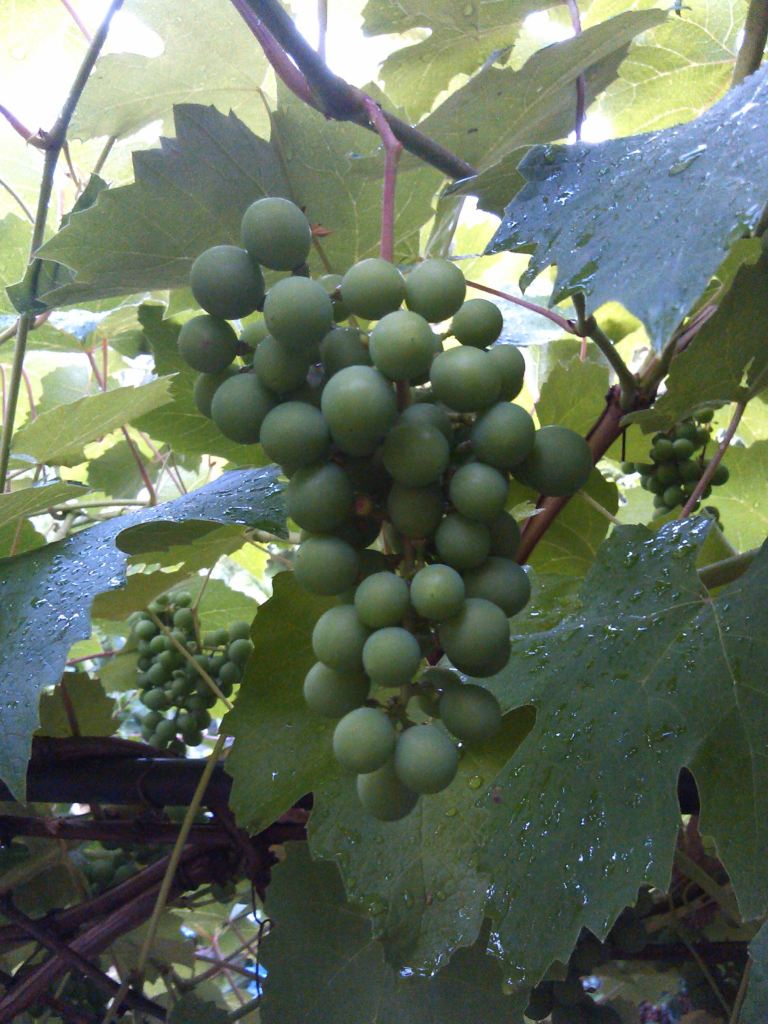
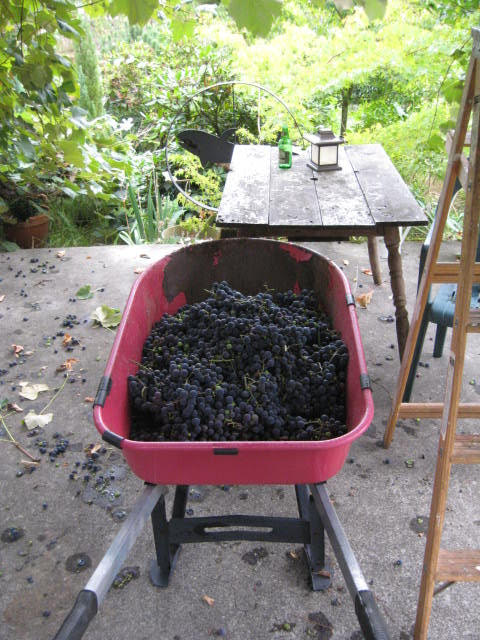
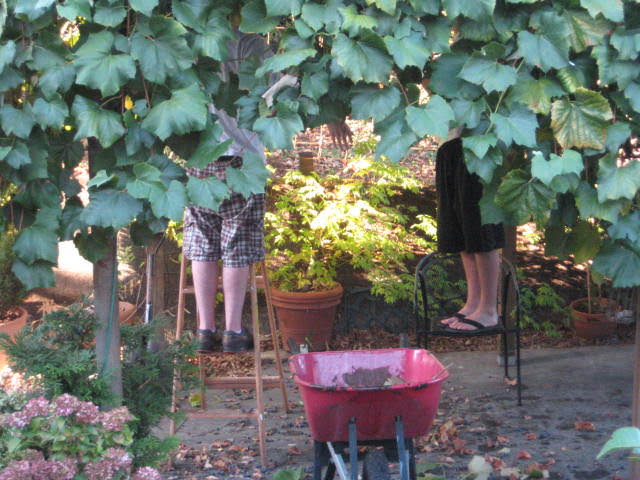
Yesterday I harvested the grapes from the pergola I built 35 years ago, the oil of the cedar boards dry and the wood crackling and splitting and fraying like an old T-shirt. I’ve been thinking for a few years of taking it down. By August the grapes are heavy. Scuttling the pergola will be a hard task. Meantime, the dwarf apple tree has overgrown the grape trunk and the Blaze Climbing Rose has reached the stratosphere, entangling its barbed links through the grape vines and the apple branches, a beastly hairdo that winds its way through the aged cedar board barrettes.
As I had predicted the rain stopped after a minute or two, my epiphany manifesting the end of summer yet another illusion of insight, a pseudo-epiphany, as too often happens. The rain was but a trace. And while I’ve got my copy of “Seascraper” sitting here by my side waiting for me to say something about it, I’ve lost the gumption. I’m going back out to take another look at the pergola; might even have a go at the Blaze.
Patrick Modiano’s novella “In the Cafe of Lost Youth” opens with an epigraph attributed to the French philosopher Guy Debord:
“At the halfway point of the journey making up real life, we were surrounded by a gloomy melancholy, one expressed by so very many derisive and sorrowful words in the cafe of the lost youth.”
I was unable to track down the source of the quote. It’s possible it comes from a memoir or some throwaway magazine article. But it reminded me of the opening to Dante’s “Inferno”:
“Midway in our life’s journey, I went astray from the straight road and woke to find myself alone in a dark wood.” John Ciardi translation, 1954.
Dante is comparing having lost his purpose or direction in life in middle age, 35 or so, to getting lost in a wilderness where one has wandered off a steadfast, well-worn path. He’s unable to locate himself on some reputable and credible map, either from an external or internal viewpoint. Why doesn’t he back up, retrace his steps? Instead, he forges on in the dark on a crooked path. At that point, a step forward could just as well be a step backward.
Dante both forges purposefully ahead and rambles on, caught in the web of the woods, presses on like some point man cut off from his platoon, tracking deliberately with some goal of trying to map a new way out. Though he lacks an immediate target, he’s not aimless.
“I placed the typewriter on the small pitch-pine table in my room. I already had the opening sentence in my mind: ‘Neutral zones have at least one advantage: They are only a starting point and we always leave them sooner or later.’ I was aware that once I sat down in front of the typewriter, everything would be much less straightforward.” (89-90, “In the Cafe of Lost Youth,” Patrick Modiano, 2007 Editions Gallimard, 2016 NYRB, 118 pages).
Modiano was the recipient of the 2014 Nobel Prize in Literature. The only other book of his I’ve read is “Young Once” (1981 Editions Gallimard, 2016 NYRB, 156 pages):
“Does life ever start over at thirty-five? A serious question, which made her smile. She would have to ask Louis. She had the feeling that the answer was no. You reach a zone of total calm and the paddle boat glides all by itself across a lake like the one stretching out before her. And the children grow up. They leave you.” (5).
Both novels are sepia-tinged with the kind of suggestive noir one begins to associate with normal life, which is to say there is no normal, but everyone you meet is obsessed, or ought to be, with their past and future but are actually caught up in the web of their now, hopelessly trying to live in the moment but forced to move on, like Dante, or Beckett, in spite of having lost track of where they are in the moment. Even trying to move back is another futile move forward. Yet at some point, maybe that middle age point, one is given pause, a kind of grace – to reflect, to look back, to sense forward, lost in that very stillness:
“They did not know that this was their last walk through Paris. They did not yet exist as individuals at all; they were blended together with the facades and the sidewalks. In macadam roads, the stones, patched together like an old cloth, have dates written on them to indicate when the successive layers of tar have been poured, but perhaps also recording births, encounters, deaths. Later, when they remembered this period in their life, they would see these intersections and building entryways again. They had registered every last ray of light coming off of them, every reflection. They themselves had been nothing but bubbles, iridescent with the city’s colors: gray and black.” (154)
In “Through the Looking Glass,” Alice converses with a gnat:
“I know you are a friend,” the little voice went on; a dear friend and an old friend. And you won’t hurt me, though I am an insect.” “What kind of insect?” Alice inquired a little anxiously. What she really wanted to know was, whether it could sting or not, but she thought this wouldn’t be quite a civil question to ask.
A gnat is a small fly, but this one seems huge, as gnats go:
She found herself sitting quietly under a tree — while the Gnat (for that was the insect she had been talking to) was balancing itself on a twig just over her head, and fanning her with its wings. It certainly was a very large Gnat: “about the size of a chicken,” Alice thought. Still, she couldn’t feel nervous with it, after they had been talking together so long.
Alice tells the gnat she’s not overjoyed when she sees an insect, because she’s afraid of them, particularly the larger ones.
I’m not fearful of bugs, spiders and such. It’s the season here though when I’ll run into an orb-weaver spider web spread across the walkway between tree branches, face level, too, but invisible unless backlit with the rising sun, and I feel the sticky web as it envelops my face. I shake my shirt and comb through my hair with my fingers and watch a little reddish bug falling to the ground.
Then came another of those melancholy little sighs, and this time the poor Gnat really seemed to have sighed itself away, for, when Alice looked up, there was nothing whatever to be seen on the twig, and, as she was getting quite chilly with sitting still so long, she got up and walked on.
A problem with bugs is not that they are gigantic, but that they are small, and they are quick, and usually invisible to us. If you allow yourself, you might get all obsessive about bugs hiding behind baseboards, in the yard, or in your hair. But most bugs we never see, and they don’t bother us, in spite of the fact that about 10 quintillion bugs are living on Earth at any given moment.
I enjoy reading blogs foreign to me, made possible by Google Translate. I recently read a blog post by a Japanese woman about centipedes. I was curious, having myself come across a couple of centipedes in our humble abode this summer. But this woman was nonrationally fearful and sprayed her unfortunate centipedes with excessive amounts of insecticide. She even posted a word of caution to potential readers at the top of her post, concerned some might be scared out of their wits reading about bugs, and she posted a deliciously horrible photo of a centipede slightly curled. Maybe something was lost in translation.
Not too long ago I posted a piece on ants in our coffee maker. The infestation was so severe we had to abandon the electric coffee maker, and I went back to using a manual French press. I was reminded of E. O. Wilson, who changed his mind about how evolution works, as he found group altruism at work in ant colonies. He said that cooperative workers were more successful than competitive ones. Thus he favored altruism as a collective trait. His reversal of his prior position on the matter greatly upset his scientific community; many stuck in the web of their old position.
As if real bugs aren’t enough, we find in Kafka’s story “The Metamorphosis” a metaphorical bug. A human awakens one perfectly normal morning to find himself turned into a true liking of his image, for he’s already living the life of a bug, a small bug-like creature working a menial job for the hive. Not all bugs are insects, but for our purposes here, I’m calling them all bugs. Bugs may seem a far fetched idea for an anthropomorphic story, but E. B. White wrote a very successful book with “Charlotte’s Web,” about a pig, a spider, and a little girl living on a farm. When walking outdoors this time of year, and watchful of walking into a web, always be sure to check for web messages.
Science Lesson: I once knew a bug who for a short time kept a blog. Bugs don’t leave likes or comments; they leave bites and itches. Why are there so many insects living here on Mother Earth? Bugs have had a long time to adapt. Nature tends to overseed tiny organisms. Elsewhere no doubt there are planets full of bugs, oceans where none have yet decided to leave their salty paradise, tiny and invisible even to our new space telescopes. They don’t send messages and have no need for technology other than their own three part harmonies. Bugs are not picky eaters. Bugs are good pollinators and some, centipedes, for example, feed on other bugs perhaps dangerous to humans. Centipedes are not particularly harmful to humans. They are masters of the 100 yard dash.
Theory: I had a friend in high school I admired for he was fearless and loved snakes. Then I discovered he was afraid of spiders. Whenever a spider was at hand, he called me in to deal with it. Over time, I developed a theory: people afraid of spiders are not afraid of snakes, while people afraid of snakes are not afraid of spiders. Occasionally, as the topic may arise, I’ll ask the question in conversation – below I’ve created a “poll” to test my theory (and to test the format of a poll, which for this blogger is a first). Please feel free to answer the poll, or leave a comment below to the post, or simply enjoy the cartoons I’ve added at the end. Time now to bug out.
Update: I’ve already been advised my poll block didn’t work, so I’ve removed it. Not sure what I did wrong. But please feel free to answer the question (Snakes or Spiders) in a comment to the post below. And enjoy the cartoons!
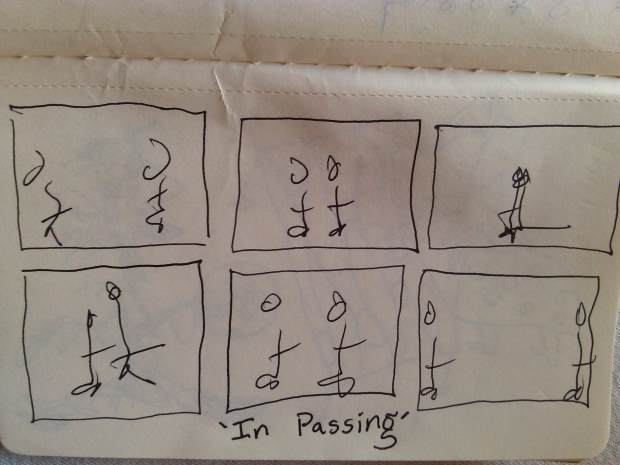
He awoke to find a giant spider hovering.Infestation.“It’s a giant bug!” “Want a piece of tissue paper?”I’m having the chocolate covered ants.
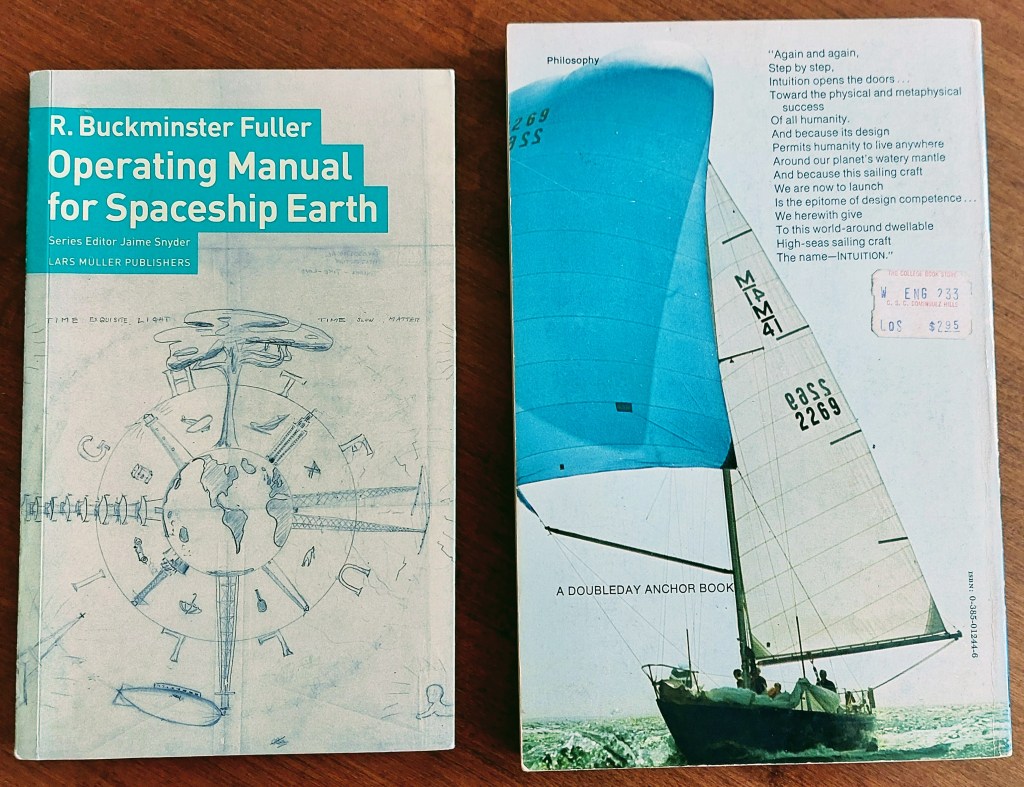
Buckminster Fuller was the most optimistic of scientists. He believed synergy solves the problem of entropy. Synergy, simply put, is working together to achieve more. Synergy is sometimes defined as a whole unpredictable from the sum of its parts (1+1 = 3). And Fuller thought there is enough to go around:
“Once man comprehended that any tree would serve as a lever his intellectual advantages accelerated. Man freed of special-case superstition by intellect has had his survival potentials multiplied millions fold. By virtue of the leverage principles in gears, pulleys, transistors, and so forth, it is literally possible to do more with less in a multitude of physio-chemical ways. Possibly it was this intellectual augmentation of humanity’s survival and success through the metaphysical perception of generalized principles which may be objectively employed that Christ was trying to teach in the obscurely told story of the loaves and the fishes.1
Dostoevsky said the same thing in his “Notes from Underground” (1864):
“I admit that two times two makes four is an excellent thing, but if we are to give everything its due, two times two makes five is sometimes a very charming thing too.”
Though Orwell in “1984” (1949) suggested we be careful with arithmetic and keep an eye on who’s controlling the data. William Blake also reasoned reason could be a tyranny (“The Book of Urizen,” 1794).
For my own alone little part of the network, I’ve been wondering about the popularity of Doors, Wordless Wednesdays, and other prompts, and have opted to contribute a little poem on the subject of synergy and entropy:
Loves and Fishes
Planets like cauliflower heads can’t go it alone; entropy a flat bald universe, produces no combs.
Love like the neutrino difficult to detect, plentiful and invisible, with no electrical net.
“Operating Manual for Spaceship Earth,” R. Buckminster Fuller. First published 1969, new edition 2008/2011, edited by Jaime Snyder. Lars Muller Publishers. ↩︎
Operating Manual for Spaceship Earth (1969) and Intuition (1972) – books by Buckminster Fuller
There’s a full moon this week, the daytime temps near 100, so we’ve been out walking late, out for some cooler air, the house so hot. A while back I made a playlist of songs with the word moon in the title:
It’s Only a Paper Moon, Moonlight in Vermont, Moon River, Fly Me to the Moon, Moonglow, Paper Moon, Moondance, Moonlight in Vermont, Havanna Moon, Blue Moon of Kentucky, Blue Moon, Polka Dots and Moonbeams, The Moon Song, By the Light of the Silvery Moon, Moonlight Serendade, Moonlight Becomes You, No Moon at All, Oh You Crazy Moon, Shame on the Moon, Walking on the Moon, How High the Moon, When My Moon Turns to Gold Again, Au Clair de la lune, The Stars the Night the Moon, Shine on Harvest Moon, Harvest Moon, Moonlight (Claro de Luna).
When we got back from our walk I played a few of the moon songs on the acoustic guitar. Still later, still unable to sleep, I got out of bed and from the open window took a photo of the moon. There’s nothing special about that photo, taken with my cell phone, of the moon over the fir trees over the old they say extinct volcano in the city.
“Ah, they’ll never ever reach the moon, at least not the one we’re after,” sang Leonard Cohen, in “Sing Another Song, Boys” (1971), which doesn’t have the word moon in its title, so it didn’t make the playlist.
Things appear different at night, are different. There are so many distractions during the day, chores, reels, but it’s different at night.
“It’s easy to be hard-boiled about everything in the daytime, but at night it is another thing,” says Hemingway’s Jake Barnes, in “The Sun Also Rises,” from 1926.
But a full moon can take the edge off of things at night, soften the heat. Draws you up. And besides, unlike Hemingway’s Jake, lately I’ve been looking forward to the night, a book waiting on the nightstand, moonlight streaming through the open window, lucky to have Susan by my side, not having Jake’s problem, my playlist of songs with moon in the title streaming in the kitchen earlier while I put together something cold for dinner, playing in my memory. Memories of the Moon. Moon Momentoes.
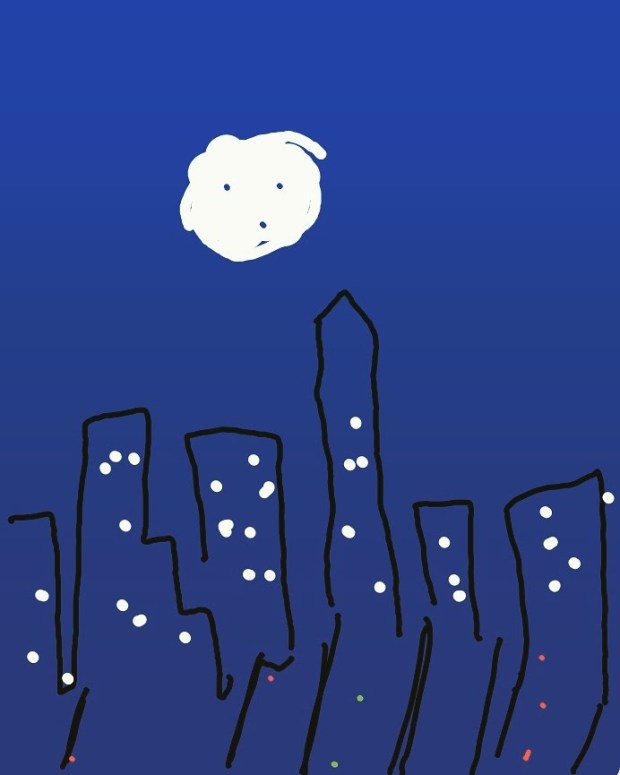
And you don’t want to go getting too literal about it, so-called science of the thing, the light of the silvery moon, how it’s dead, and it doesn’t really have its own light, but is simply reflecting the sun. The mechanics of the thing. There you go again. See, you’ve ruined another night. The moon is a cartoon.
 The Coming of the Toads