Category: Writing

  • The Reading Crisis Revisited: Amazon and the Gatekeepers Against the Wall

    Mark McGurl has a new book out. I enjoyed and reviewed his previous book “The Program Era,” here, and his new work, “Everything and Less: The Novel in the Age of Amazon,” which appears to revive the Reading Crisis theme I first started following over at Caleb Crain’s site, is reviewed by Benjamin Kunkel in a recent Bookforum post: Sense and Saleability: How Amazon changed the way we read. After reading the Kunkel review, I don’t feel I need to read the new McGurl take.

    First, it’s still too early to say what’s really going on or how dramatically it’s affected our reading, particularly the reading of the common reader (who seems to persist, in spite of the odds). Second, Mcluhan, who explains the effects of the printing press, and predicts a long time ago now the current reading crisis (not to mention a plethora of other ideas), I still find more convincing. And while McLuhan did not personally look forward to the changes in literacy his theories explained or predicted, he didn’t necessarily feel the world would be a worse place as a “global village.”

    In any case, if I’m reading Kunkel correctly, what today’s gatekeepers seem to want protecting turns out to have been cut off only in its infancy:

    Between the Great Recession and 2019, the number of undergrads majoring in English shrank by more than a quarter, and it’s difficult to imagine the pandemic has reversed the trend. Meanwhile, over approximately the same dozen years, professors in English and other literature departments have more and more bent their attention away from the real or alleged masterpieces that formed the staple of literature courses ever since the consolidation of English as a field of study in the 1930s, and toward more popular or ordinary fare. Sometimes the new objects of study are popular books in that they belong to previously overlooked or scorned genres of “popular fiction,” such as crime novels, sci-fi, or horror: this is popularity from the standpoint of consumption. And sometimes they are popular books in the different sense that they are written, in huge quantities, by authors with few if any readers, whatever the genre of their work: this is popularity from the standpoint of production.

    Bookforum, Dec/Jan/Feb 2022

    Theory and the Social Sciences, not to mention Reagan as governor of California ruining a good thing for the children of laborers who might have somehow discovered literature in the 50’s and 60’s and where McGurl now sits as public intellectual gatekeeper at Stanford, presumably with small cohorts of readers filling sandbags, had already altered how we read and precipitated the slide of the English Major, still a baby if born as recently as 1930. Amazon has not changed anything, at least not having to do with literature.

    Meantime, James Lardner posts a recent Gatekeeper entry on the New Yorker online site, lamenting and lambasting the so called for profits (as if schools like the factory at UCLA pumping out Phds in the 60’s and 70’s is not de facto a for profit).

    But not all English majors are created equal, and this one wishes he would have become a plumber like his father (having never read a book, good or bad) wanted him to become. And then he wouldn’t be sitting here writing a post no one will read on a subject few care about when he should be down in the basement checking that the plumbing didn’t freeze last night.
  • “pond”

    (Pond, by Claire-Louise Bennett, Riverside Books, 2016, originally published in Ireland by Stinging Fly Press, 2015, 195 pages)

    There are thirty snippets of “Praise for Pond,” cutlets from big and small zines and papers (and authors selected or solicited for blurbs) on and offline, from reviews, presumably, four full pages of front matter, mostly adjectives and adverbs describing the author’s (Claire-Louise Bennett, Riverside Books, 2016, originally published in Ireland by Stinging Fly Press, 2015, 195 pages) “prose… mind…debut…sensibility”:

    1. sharp, funny, and eccentric;
    2. dazzling…and daring;
    3. unnerving…sensitive…porous…lucid, practical…cognizant;
    4. ardent, obsessive-compulsive, a little feral…kookily romantic;
    5. innovative, beguiling…meditative…fresh;
    6. witty;
    7. dreamlike…startling;
    8. attentive…baroque and beautiful;
    9. stunning;
    10. cool, curious…intense;
    11. elegant and intoxicating;
    12. fascinating…immersive…readable;
    13. exhilarating…comfortable…confident;
    14. deceptively simple…unsettled…formidably gifted;
    15. strange;
    16. muddiness…deliberate and crisp;
    17. sharp…discursive;
    18. weird;
    19. impressive;
    20. compelling;
    21. quirky…opinionated;
    22. inventive;
    23. believable…dazzling;
    24. captivating…wonderful;
    25. quiet and luxurious;
    26. ablaze;
    27. absorbing, compassionate;
    28. distinct;
    29. provocative;
    30. wry.

    But I will add that what Bennett requires of her reader is patience, the kind of indulgence one might assume will not make for a popular reading, yet here it is, an “eccentric debut…of real talent.”

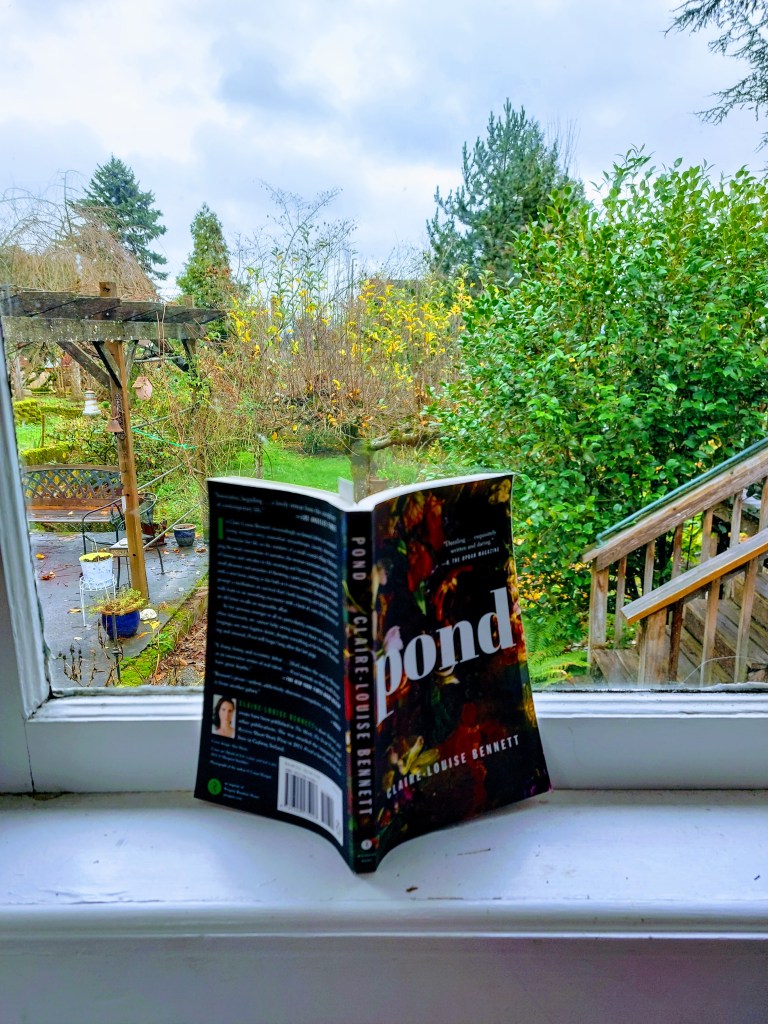
    The common reader might already suspect we are in for deep waters in “pond” when we see the page that comes after the list of twenty titles in the table of contents, quotes from Nietzsche (The Birth of Tragedy), Natalia Ginzburg (“A Place to Live”), and Gaston Bachelard (The Poetics of Space). I can’t explain why the titles of the Nietzsche and Bachelard books are placed in italics (in the Riverside paperback copy under review – i.e. the one I read, the first American edition, and have posted a pic of above, sitting in the kitchen nook window looking out on the wet yard as I type) while the title of the Ginzburg book is placed within quote marks. But, as it happens, the book I finished just prior to opening “pond,” coincidentally, (and I don’t really know if it should be typed as “pond,” “Pond,” or “POND”; or pond, Pond, or POND) was a Natalia Ginzburg book: “Family and Borghesia” (nyrb reissue, 2021), a very different kind of book from “Pond,” though similar in its wanton flow of words and focus on detail (how’s that for blurbing?). Moreover, as I looked up “patience,” wondering if it was the right word, appropriate and all that, for where I wanted to put it, adding my own descriptive, albeit with a noun, to the thirty clips, knowing full well it will never nor would have made the cut, I came across this sample sentence to illustrate the use of “indulgence”:

    “Claire collects shoes—it is her indulgence” (Google dictionary, Oxford languages).

    I don’t collect shoes, nor, I suspect, does Claire-Louise Bennett, who apparently lives or lived during the making of POND on the Atlantic Coast of Ireland in a small stone hut of some kind, again, apparently, as I put together a few clues from the book as well as from rummaging around. I live on the Pacific Coast of the US, not within a stone’s throw of the water, anymore, but close enough to enjoy the waterlogged winters of the Pacific Northwest, about ninety miles away from the big pond as the roads go, about seventy miles for the birds, assuming they take a direct route over or through the passes of the Coast Range. The coordinates for Galway are 53.2707° N, 9.0568° W; while for Cannon Beach, Oregon are 45.8918° N, 123.9615° W. It’s currently (as I type) 44 degrees in Galway and wet at 8pm, a bit of wind maybe a bit of sun tomorrow to close a rainy week and start a new one; while at the Oregon coast it’s wet and 47 degrees finishing the morning with a high wind warning in place for this evening to close a wet week and start a new one. That’s not to say living on the Pacific coast of the US is anything like living on the Atlantic coast of Ireland. Except that, we both get our weather for the most part from our close proximity to what some call wild oceans.

    In any case, I very much enjoyed reading “pond,” and thought I might put up a post from another West Coast of rivers and streams dampness and moss and ponds and puddles galore:

    “aplenty
    in abundance
    in profusion
    in great quantity
    in large numbers
    by the dozen
    to spare
    everywhere
    all over (the place)
    a gogo
    by the truckload
    by the shedload”
    (Google dictionary)

    I think galore is the descriptive word I’ll end this review (if, indeed, it can be called that, and, if not, I don’t know what) of “Pond” with.

    Claire-Louise Bennett’s “Pond” presents writing galore.

  • Dolling Down

    Some folks like to dress
    others down for a night
    on the town to be seen
    or to mingle in the pile

    to start a scene walk
    the prowl talk the chat
    say a prayer to the folks
    at the top of the stares

    go-go with the up-flow
    the effluvium of the
    affluent dressed
    in advertisements

    ads in fashion zines
    Fellinists puttin’ on
    the style the smile
    all the while they

    used to say it was
    a young folks way
    but we can put on
    the style any while

    doll it up or doll
    it down the grin
    showing couth
    or clown frown.

  • What We Do When We Talk About What To Do

    One gives notice. Another grins and abides. The one no longer interested in content, the other insisting on diary entries reaffirming his firm grip on reality. One is motionless, the other still moves about. One accepts but withdraws, the other complains, and even though there’s little to complain about, finds a way to complain about that too. One prays in an empty space, the other watches the news in a room full of knickknacks and memorabilia no one remembers. One drifts, the other plans outings.

    One falls silent, another gets up and talks. One is more interested in conversations without words. One deactivates, the other continues to like and comment and, in short, feels engaged.

    One stops the vertical fall and the horizontal push, and edges fall away. Another scrolls up and down and takes cuts.

    The one never did make sense, the other insists on making sense.

  • Notes on Hearing Loss

    A house down around the block is getting a new roof, hammers echoing like giant flickers. Since the big virus outbreak the neighborhood seems quieter, fewer cars speeding up the bumpless street, the park above closed to the outdoor concerts, though a few bicycle races and random music groups have come and gone. We frequently hear music though, through the trees, over the roofs, through the backyard fences, but can’t always be sure of where the sound is coming from. No fireworks this year. Not a single yard sale. But some noise seems louder, the trash trucks on their weekly binge, the mailman at the mailbox, the yapping yellow dog behind and a yard over, skateboards, our tinnitus.

    A loss of sound seems paradoxically to quicken our sense of hearing. That is dynamics, change in pressure and temperature, frequency and consistency. Some sounds we don’t hear until they go silent. Sound can baffle, bounce around dancingly. If you’re uncertain where a sound, particularly a voice, is coming from, the disorienting distraction bewilders. Just because you don’t hear a sound doesn’t mean you can’t feel it, its pressure in your ears, resounding around your head. Likewise, you might hear voices, but the words lack clarity, and you can’t make out what’s being said.

    Some sounds are tight, other loose fitting. A flash flood of sound leaves a wake of mud. The beginning of rain drips into the ears, like its relative petrichor, that newly wet earthy scent in the nose, a slow awakening to something that’s been asleep for a long time and is now looking for a new bed to spend the night, one of your ears unfolding asymmetrically.

  • For the Good of the King

    Subjects are topics one should not avoid.

    Every day is the best ever in the life of a King.

    You’re not a real King unless you’re in a Shakespeare play.

    /kiNG/ rhymes with bring the King his spring slippers.

    A soft King is hard to find.

    Louis XIV (the Sun King) reigned for 72 years and 110 days, and behaved like one might want of a King (but born too late for Shakespeare). Louis might have been called the Woke King, for that’s a long time to go without sleeping. Or the Ballet King, for he loved to dance, and insisted his court keep its knees up.

  • Precepts

    The faster you go, the more time you waste.

    The quicker to dicker, the sooner to yearn.

    To talk is to argue.

    To identify is to accuse.

    Music is buried in the piano.

    To hold a grudge is to jackhammer water.

    If you’ve read one poem, you’ve read them all.

    Art is not art.

    We always have enough for now.

  • Poetry Post

    The poetry post was taken down  over night spirits the rules  of cultural worm tongues  relevance ad hoc heresy.  Kicked to the ground  old fashioned paper  pages bestrew the weeds  of diction and grammar. Who put up the poetry post  unknown nor who kicked  the post down still cadence  broke at the base cracked  where it entered the yard  near the sidewalk free  for passersby to read  not the news and certainly  nothing about a poetry post  pushed over in the night  nor who picked up the pieces  and raked clean any evidence Who put up the poetry post  unknown nor who punched   the post's still cadence  broke at the base cracked  where it entered the yard  near the sidewalk free  for passersby to read  not the news and anyway  nothing about a poetry post  pushed away in the night  broken
          where      entered the ground    empty
    the post head
                    where displayed
                                     a page a day
    now empty
                abandoned
                               unfulfilled
    leaning
    
               fallen
                        pushedfall


  • pure poetry, 2000

    Readers who like unlikeable characters will love Binnie Kirshenbaum’s Lila Moscowitz. Lila is stubborn, spoiled, angry, bitter, promiscuously self-destructive. And, frosting on the cake, she’s a poet. That’s not to say she’s without redeemable qualities. She’s funny, hilarious, in fact, a natural wit, and as honest as a person can be without losing all of one’s family and friends and readers. Her humor is laced with sarcasm and irony. She’s quick, street smart and intelligent, independent. Experienced readers will recognize that Lila is not Binnie, that the narrator of a novel should not be confused with the author. This narrative truth is emphasized toward the end of the book when Lila takes some questions after a poetry reading:

    “‘Did you really dance topless at the Baby Doll Lounge?’ Another one of the college girls is contemplating a career move, no doubt.
    I smile as if I’ve got a secret, and I say, ‘I refuse to answer on the grounds that it could incriminate me.’”

    Lila may be a poet, but she’s not stupid:

    “That I never danced topless at the Baby Doll Lounge or anyplace else either is not what they want to hear.”

    Does she “write every day,” another student asks, and Lila pretends for the audience that she does write every day. She’s then asked “how much money do poets make?” Here she tells the truth (192-193).

    But while the perspicacious reader knows Lila is not Binnie, we all know that poetry does not sell, so why not only does Binnie put “poetry” in her title but structures her book with poetic devices, informing each chapter with epigraphs, definitions of poetic conventions? Didn’t she want her book to sell? The answer has to do with wheels within wheels, or how to turn a stand up routine into literature:

    “Many of the poems I write are about sex. I have a gift for the subject. The ins and outs of it. My poems lean toward the sordid side of the bed, the stuff of soiled sheets” (21).

    We don’t get to hear those poems, but they apparently are full of the tension created by want harbored in inhibitions freed in seduction, romp enclosed in forms, procedures, praxis, which express mores without which somehow sex is not nearly as much fun. The fun is enclosed in a box of gravure etchings. The notion of form as enclosure is conservative. The poet might want out, not in. Lila’s own explanation might solve both Binnie and the reader’s questions:

    “There is freedom within the confines of form the way a barrier protects you from the elements of disaster. The way there is love in the bonds of marriage. ‘Without boundaries, you can be only adrift,’ I say. ‘Lost. Without lines drawn on the map, you are nowhere. It is better to be a prisoner of war than to be without a nation, a place, a people’” (194).

    Jesus may have said the opposite – Come, follow me, and leave all that nonsense behind. Of course, most of his followers wound up wanting it both ways.

    “Maybe they should stay in their cages and sing their hearts out. Unbridled passion…results from being tied to the bedpost” (194).

    Which is to make of Lila a dynamic character, one who’s changed over the course of the work. She finds love only by losing love. She’s human, fallen, having slipped on her own banana peel, but she gets back up, and writes a book that stirs and calms the forms.

    Pure Poetry, by Binnie Kirshenbaum, a novel, Simon & Schuster, 2000, 203 pages.