Category: Writing

  • Notes on Kingsley Amis and “Lucky Jim”

    War leaves everyone destitute, champs as well as losers. At least that seems the case in some quarters in England following its WWII victory. But out of the drained sensibilities comes Lucky Jim, whose primary motive is to avoid being chumped. His new arms are not mod Joyce’s “silence, exile and cunning,” but scoff, erosion, and contumely. He finds himself immersed in a milieu devoid of usefulness, stupefied:

    It wasn’t the double-exposure effect of the last half-minute’s talk that had dumfounded him, for such incidents formed the staple material of Welch [Jim’s mentor] colloquies; it was the prospect of reciting the title of the article he’d written. It was the perfect title, in that it crystallized the article’s niggling mindlessness, its funereal parade of yawn-enforcing facts, the pseudo-light it threw upon non-problems. Dixon had read, or begun to read, dozens like it, but his own seemed worse than most in its air of being convinced of its own usefulness and significance. ‘In considering this strangely neglected topic,’ it began. This what neglected topic? This strangely what topic? This strangely neglected what? His thinking all this without having defiled and set fire to the typescript only made him appear to himself as more of a hypocrite and fool. ‘Let’s see,’ he echoed Welch in a pretended effort of memory: ‘oh yes; The Economic Influence of the Developments in Shipbuilding Techniques, 1450 to 1485. After all, that’s what it’s…’

    Page 9 of “Lucky Jim,” by Kingsley Amis, first published in 1954; New York Review Books Classics 2012 with an Introduction by Keith Gessen.

    Jim’s problem (to date still unresolved for so many in galleries of classrooms) is simply what to do, and while Beckett is now back in Paris resolving “Nothing to be done,” Jim Dixon is back in England, having made his way through a back door into contemporary academia, which doesn’t necessarily equate to a decent job:

    ‘Well, you know, Jim. You can see the Authorities’ point in a way. “We pay for John Smith to enter College here and now you tell us, after seven years, that he’ll never get a degree. You’re wasting our money.” If we institute an entrance exam to keep out the ones who can’t read or write, the entry goes down by half, and half of us lose our jobs. And then the other demand: “We want two hundred teachers this year and we mean to have them.” All right, we’ll lower the pass mark to twenty per cent and give you the quantity you want, but for God’s sake don’t start complaining in two years’ time that your schools are full of teachers who couldn’t pass the General Certificate themselves, let alone teach anyone else to pass it. It’s a wonderful position, isn’t it?’

    177

    Some guys will do anything to avoid working on commission:

    Dixon agreed rather than disagreed with Beesley, but he didn’t feel interested enough to say so. It was one of those days when he felt quite convinced of his impending expulsion from academic life. What would he do afterwards? Teach in a school? Oh dear no. Go to London and get a job in an office. What job? Whose office? Shut up.

    177-178

    But why would office life, in sickness or in health, not be preferable to the games teachers play, particularly the major league players:

    Amis and Larkin graduated into a literary world still dominated by the modernism of Eliot and Pound, and haunted by the shadow of William Butler Yeats. Though Larkin went through a long apprenticeship to Yeat’s poetry, both men eventually came to think that the modernists had made English-language poetry vague, pretentious, and verbose…Chelsea represented the artsy crowd, the modernist crowd, the posh crowd that had taken English literature too far into the realm of abstraction, had turned it into an elite pursuit. Not that the rest of contemporary literature was any better.

    Page x-xi of Keith Gessen’s Introduction.

    While much of today’s poetry remains “vague, pretentious, and verbose,” some reaches further into the pit of the common reader’s hand reaching out for not meaning but significance lately lost thanks largely to poetry being conquered in academia by the philistinism of the sociologists and psychologists, not to mention the political polemicists. Yet, as Keith Gessen points out in his “Lucky Jim” NYRB Introduction: “But of course then as now the world was filled with young college graduates convinced of the sheer absolute idiocy of everyone, living or dead” (xiii). But how accurate is that statement? Not to say that everything is not idiotic, but that everyone thinks that everything is idiotic. And anyway, anyone can feel that way. It doesn’t take a college degree. And it might be true for high-schoolers these days, or high school dropouts, or college graduates in search of a job in their area of obsolete, irrelevant, or antiquated study, or retirees from any number of careers or pseudo careers. If everything is idiocy, one can at least prefer one’s own.

    The problem is not only what to do but how to do it and how to think about what to do and how to think about doing it and to feel about all of it and how to remain free in spite of all of it, if one can even keep track of what is meant by it. And all without undo influence from the idiots one once might have admired but have now come to scorn but not enough to ignore. Gessen puts hate as the great motivator for both Amis and his pal Larkin. But hate is far too strong a word to describe what they were all about, or what Jim is about. To be unable to achieve satisfaction is not to hate the losing streak, the white shirts, the wrong cigarettes, the useless information, the starved imagination. One might though hate that one still feels one wants to be a part of it, even if that part entails making fun of it. If you live a life of pure loathing, what’s left you in the end to loathe but yourself?

    And “Lucky Jim” is a comic novel, not one of fear and loathing, and with literary precursors. If Jim (or Amis) makes fun of “The Canterbury Tales,” it’s in their being removed from life and buried in a classroom. Given his tastes and dislike of the phony and the mannered, it’s understood he values Chaucer’s use of flatulence to create lasting, well digested literature. He doesn’t hide the compost. He loves it. And he’s not angry about it. And if Jim “hates” Welch’s son, Bertrand, his evil nemesis, it’s for good reason. Bertrand makes an excellent foil character. One feels an author’s love for his Iago, Lady Macbeth, Polonius. In any case, Henry Miller had already written his Tropics, and they’re not about graduate school. Ginsberg is working on Howl, but neither are the Beats angry young men. They are bent on living. They will eschew an air-conditioned nightmare, thank you.

    And an elderly Jim would no doubt prefer self-loathing to schadenfreude. Smug and complacent, he is not. And he’s not falsely self-deprecating. He doesn’t insult himself as bait for what he might fear an otherwise hostile audience. He’s not self-satisfied. He recognizes his faults but doesn’t take credit for them.

    An interesting companion reading to “Lucky Jim” might be Barbara Pym’s “Excellent Women,” published two years earlier, or her “Jane and Prudence,” a year earlier, or “Less than Angels,” a year later. It hardly seems the same world, but it is. One might find Pym’s heroines rescued from the arms of a horned and horny but hardly hating Kingsley Amis.

  • Notes on Sebastian Barry’s “A Long Long Way”

    It was sometime over the recent long Memorial Day weekend I received a worn copy of Sebastian Barry’s “A Long Long Way” (2005), a gift from my old friend Dan, first person blogger at Tangential Meanderings at WordPress. I had mentioned Barry to Dan after reading a New Yorker piece about the Irish author’s writing (March 20, 2023). I had never read Barry.

    I dug into “A Long Long Way” as into a trench somewhere along the Western Front. Barry in his technique seems to take the encyclopedia entries that summarize events and rewrites them using imagined characters, though apparently the Dunnes were part of his own family. My interest in WWI grew, and I read that a few years ago a trove of diaries written by soldiers during the war was digitized:

    Many older people in Britain knew veterans of World War I. But the diaries provide a different level of detail, says Michael Brookbank, 84. On a recent day, he was drinking a coffee in the archives cafeteria. He had come to learn more about his father.

    “My father very rarely talked about the war, and I think that is common with most of the veterans of the war,” says Brookbank. “The experiences that they went through and the conditions that they lived in were just something that, unless you were actually there, nobody could really comprehend.”

    “From The Trenches To The Web: British WWI Diaries Digitized.” Heard on Morning Edition, 23 Jan, 2014. Ari Shapiro. Read here.

    That idea of what it might take to comprehend, and of what point there might be to talk about it, about anything, one might add, incomprehensible to another, plagues many veterans. And in the Army, one does not step out of place, let alone speak out of place. Who does tell the stories then? And who will listen with comprehension?

    The reader has no privileges. He must, it seems, take his place in the ranks, and stand in the mud, wade in the river, fight, yell, swear, and sweat with the men. He has some sort of feeling, when it is all over, that he has been doing just these things. This sort of writing needs no praise. It will make its way to the hearts of men without praise.

    New York Times book review of “The Red Badge of Courage,” 31 October, 1896.

    Crane, like Barry must have, had read accounts of those who had experienced the war in some way (Crane had not), and used them to create a truthful but fictional (a psychological rendering) account. The danger here, for most writers, is the chance the result will sound like a second hand telling. Also that it might affront those who actually did the fighting, or who in some way, psychologically, if not physically, experienced the war. But that begs the question: does a distant war not create an experience for the moms and dads, the girlfriends, the boyfriends, the folks back home, reading the headlines, the news, the letters from the front? And does not that experience test the dichotomy of mind and body – the psychological is physical.

    In his blog “Time Now: The Wars in Iraq and Afghanistan in Art, Film, and Literature,” Peter Molin, himself a veteran and writer, furthers the discussion of who can write what with what authority:

    The question of whether a writer who hasn’t been to war can write well about war also intrigues me. Gallagher cites Ben Fountain as the example par excellence of an author who never served in the military, let alone saw combat, but who can still convey what it is like to be a soldier. I love Billy Lynn’s Long Halftime Walk, too, but have noted that Fountain evades extended description of battle. Is that a place he just didn’t feel comfortable going? Brian Van Reet, a decorated vet, portrays two horribly mangled veterans in comic-grotesque terms in “Big Two-Hearted Hunting Creek.” Would a civilian feel as comfortable doing so? Is there something wrong with someone who isn’t disabled portraying characters who are? Both these cases reflect the issues of credibility and authority that permeate discussions of war writing.

    “Veterans Writing,” Peter Molin, 29 September 3013.

    Sebastian Barry, in “A Long Long Way,” gives all his characters the credibility of war experience, even those who have no comprehension of what they’re going through, of the dehumanizing effects war tattoos on one’s memory, and a tattoo becomes a story:

    ‘And what happened to her, Pete?
    ‘Who?’
    ‘That Belgian woman, Pete, that you – just like the sainted Germans did, just like all those stories we were told, Pete, what they did to the women.’
    ‘Don’t be so holier than thou, Willie. You’d’ve done the same.’
    ‘What happened to her, what happened to her?’
    O’Hara said nothing for a moment.
    ‘All right, all right.’ But he didn’t seem able to say it for another few moments yet. Then he nodded his punched face. ‘She died of what had happened to her. She was bleeding all those hours. She was not treated right. She was fucking torn to pieces, wasn’t she? And she died. And we tried to save her.”
    ‘You think so?’
    ‘It’s just a story, Willie, a story of the war.’
    ‘You can keep your story, Pete. You can keep it.’

    168

    Willie’s girlfriend’s (Gretta) father shares a test he uses to qualify one’s experience. It has to do with knowing one’s own mind. Gretta repeats it:

    ‘We have to wait, Willie.’
    ‘For what’ he said, a touch desperately.
    ‘For the war to be over and you to be home and you to know your own mind. There’s never any sense in a soldier’s wedding, Willie.’

    77

    If Barry’s characters and scenes seem stereotyped it’s because we’ve seen them so often. There’s not much of a plot. Boy goes to war, not really understanding why, maybe comes back, maybe not, still not understanding why. All the arguments are pandered down the ranks, where, in the end, they don’t hold water. The grunts do the work, the dirty work, for which they receive insult and despair. Barry’s approach gives the reader a kind of historical fiction without the overt history, such that the Easter Rising happens real time, with Willie and his cohort working laboriously trying to figure out what’s going on and why and how they should feel about it, what side they should side on, a process of getting to know one’s mind.

    Who is the narrator? Not exactly Willie, neither can it be Barry. Some figure hovering over the gas clouds, looking through, picking out a figure here or there to zone in on. There are many to choose from. But the main characters are Willie, his sergeant-major Christy Moran, Willie’s father, Willie’s girlfriend, Gretta, Willie’s sisters, a few of Willie’s platoon members, Father Buckley, a Catholic priest who makes the rounds through the trenches trying to clean the spiritual and mental messes (which he does a fair enough job of). And Pete O’Hara whose single act of betrayal does more damage to Willie than anything the other side may have thrown at him.

    The theme is irony, though it might seem somewhat backwards – the characters seeming to know something the reader does not, in spite of the reader’s armchair advantages. The book is composed of set pieces (gas attack, up and over charge, furlough – and the results thereof, field boxing match) and the action is described in realistic detail, too much detail some readers may feel. There’s humor, the excellent cussing of the sergeant-major, sarcasm and wit. On the whole, maybe it’s all a bit romantic, though, so full of purple vestment, not maudlin, but still sentimental, like the customs of Memorial Day, even if that day has yet to come anywhere in the novel. The dialog is brisk and easy and rings true. The point of the novel, if the reader must have one, is probably the Irish need and desire to have and know its own mind, which might also explain the need for every narrative trick, the deceit and betrayal writ large and small, the pawn-like movements that when stacked one upon the other make up the family histories that add up to a country’s history.

    The title comes of course from the song, used to march by:

    Up to mighty London
    Came an Irishman one day.
    As the streets are paved with gold
    Sure, everyone was gay,
    Singing songs of Piccadilly,
    Strand and Leicester Square,
    Till Paddy got excited,
    Then he shouted to them there:

    It’s a long way to Tipperary,
    It’s a long way to go.
    It’s a long way to Tipperary,
    To the sweetest girl I know!
    Goodbye, Piccadilly,
    Farewell, Leicester Square!
    It’s a long long way to Tipperary,
    But my heart’s right there.

    Paddy wrote a letter
    To his Irish Molly-O,
    Saying, “Should you not receive it,
    Write and let me know!”
    “If I make mistakes in spelling,
    Molly, dear,” said he,
    “Remember, it’s the pen that’s bad,
    Don’t lay the blame on me!”

    Molly wrote a neat reply
    To Irish Paddy-O,
    Saying “Mike Maloney
    Wants to marry me, and so
    Leave the Strand and Piccadilly
    Or you’ll be to blame,
    For love has fairly drove me silly:
    Hoping you’re the same!”

    Jack Judge, 1912.
  • Write with Calmness

    Recently, I’ve been writing on WordPress using the Jetpack application installed on my cell phone and tablet, deprived of a real keyboard and downsized to essentials, but able to pull out the tool and continue playing around with a post throughout the day, adding, subtracting, dividing, etc., on the go (to the extent I ever am on the go these days, where go might look very much like stop). Writing is a disappearing act.

    The laptop, my usual tool for developing and publishing posts, as get up and go as the laptop is, is not as flexible and doesn’t travel as easily as the phone or tablet (for one thing, the laptop batteries are down to a trickle, and it must be left plugged in to work). I thought the recent posts from the cell and tablet were displaying wysiwyg (what you see is what you get), but a couple of faithful readers let me know not so. Yesterday’s post, for example, a short poem titled “A Bout,” apparently appeared on their reading devices in a pale white font on a fog colored background, difficult, but not quite impossible, to read. By Jove, I thought, that format (if that’s what it’s called) accurately describes the theme of the poem, but it was unintentional. And the pale white font on fog colored paper was an improvement – posts previous to that one had not appeared at all, those same readers had informed me; under the title, on their devices, the post was blank.

    I assumed the problem was user error, and set out to discover how I’d messed things up so, and in the process found (under a three dot dropdown menu at the far top right of the WordPress screen) “Options,” one of which is labeled “Distraction free: write with calmness.” In other words, we have a choice: write, and consider yourself a writer, or fall down the convoluted rabbit hole of blocks, styles, editor this and that, and things Jetpack related – a dichotomy that is of course distorted, unfair, and entirely inaccurate. Well, maybe not entirely. Like the guitarist who trades in the acoustic classical guitar for an electric guitar and a panel of guitar pedals, the writer who incorporates a full spectrum of technological gimmicks or tools, as opposed, say, to simply using pencil on paper – um, one senses a loss of calmness. And yes, I know I just split an infinitive, but I do so in perfect calmness. It’s impossible to split an infinitive in Latin, which is where the absurd rule comes from, but this isn’t Latin class. Well, maybe that last bit is not so calm, after all.

    And the point of writing is to becalm. If you find writing does not invite calmness, you may not be actually writing, but are engaged in some other method of spending time – not to say any one way has more value than another. Writing usually has some purpose, which is to say occasion, argument, intended audience, none of which would seem to invite calmness. Still, the act of writing, if one is to find the sweet spot, is a path toward calmness, invites calmness – because once under way, all else falls off. One becomes, indeed, free from distraction.

    Swā, this post is being written on the laptop, as an experiment to see if the problems don’t correct themselves on the readers’ devices, thus isolating the cause to Jetpack on the cell and tablet. Let me know in comments below, if you’d like, what you see, or don’t see. But remain clam. I mean, calm.

  • Only the Lonely

    Only the Lonely

    Dr. Vivek H. Murthy, the United States Surgeon General, has declared loneliness a national health crisis. It’s as if the Pope questioned the doctrine of transubstantiation. The pioneer spirit feels a needle puncturing its balloon. It reads like a headline in the Onion, a bad joke.

    Loneliness is epidemic, Murthy says, crosses and affects all sociodemographic boundaries and classes. There are no distinctions. The loneliness virus can infect anyone. Murthy recently traveled around the country, and everywhere he went, he talked to folks who questioned their self-worth, their connections to family and friends, the value of their very existence.

    We might jump to an explanation, our personal predispositions and assumptions slipping into gear. Apparently, a trip to Walmart to stock up on beer and chips for the big game on TV is not enough to fill the void, but then neither is driving to Rodeo Drive in your Rolls Royce for a new dress. In church, one feels pewed-in, and the kiss of peace lacks true touch. And the more Mega, Meta, or MAGA one gets, the worse the symptoms of loneliness.

    Loneliness looks and feels much like depression and anxiety, a lost in the world feeling, made worse by the vast numbers of people surrounding, none of whom one might talk to. One’s old drinking buddy is on the wagon. One’s ex (spouse, friend, religion, school, job) is full of the need for schadenfreude gotchas. One’s pronoun choices come up short. One feels a need to be a verb, as Buckminster Fuller said, only to have one’s grammar or usage corrected. And in one’s own home, one might feel like a direct object, put upon by a subject, or a noun without a verb.

    I’m sorry I don’t have a cure, but Murthy has proposed a plan. Might be worth Googling (or see link below). Meantime, I’m reminded of the old Roy Orbison song:

    Only the lonely
    Know the way I feel tonight
    Only the lonely
    Know this feeling ain’t right

    https://www.hhs.gov/surgeongeneral/priorities/connection/index.html

  • The Kids Are Alright

    “When I wrote this song I was nothing but a kid, trying to work out right and wrong through all the things I did. I was kind of practising with my life. I was kind of taking chances in a marriage with my wife. I took some stuff and I drank some booze. There was almost nothing that I didn’t try to use. And somehow I’m alright.”

    The Who, Live at the Royal Albert Hall, 2000

    Rock and roll has no doubt saved many a kid from an unjust boredom or dysfunctional unrest, just as it has probably toppled many more into an excess of abuse and waste or early use of hearing aids. But that’s an argument of causality, which is to say we need to determine what causes can be clearly traced in an unbroken chain of events from proximate cause to results and effects and distinguish those causes from correlations – connections that are more associate than causal – associated with the cause but not primary producer, if at all, of an effect. If we don’t clearly isolate the cause, we run the risk of treating a cause that doesn’t affect the negative effects we’re trying to cure. But The Kids Are Alright is also a moral argument: how should youth be spent?

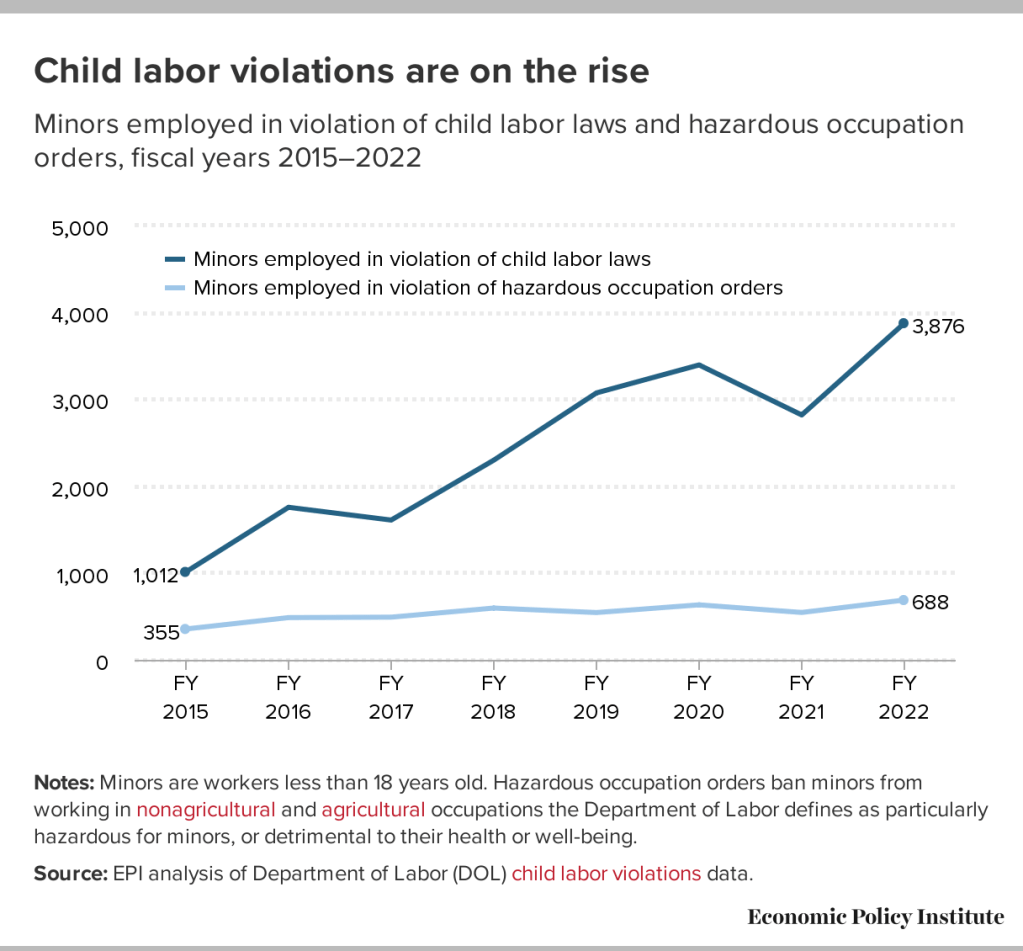
    Consider, for example, the current rise in legislative efforts to weaken or repeal child labor laws. What’s provoking these new but seemingly archaic and draconian measures? Child labor laws have been implemented over the years to protect children from low wage and excessive work-hour exploitation; workplace injury; and stunted emotional, intellectual, and physical growth. Who would want to repeal such protections for children, and why?

    First, we note that violations of the laws have been increasing in recent years. If you’re a business found in violation of a law, one solution might be to try to get the law changed:

    According to Pew, the root cause driving attempts to repeal child labor laws is workforce shortage. Business and industry can’t find enough workers. Workers that have historically filled the jobs in question (restaurant and hospitality; unskilled manual labor; assembly line work; industrial laundering, sanitation services) are staying in school longer. But that doesn’t account for the historically large number of missing workers. Where have all the workers gone?

    According to the US Chamber of Commerce, there are several reasons for the current workforce shrinkage: increase in family savings fueled by the pandemic; early retirements; lack of access to childcare; and new business starts. And, we might add, the so-called gig economy – which has allowed greater freedoms, flexibility, and opportunity for entrepreneurs. In short, there are currently more jobs than workers, and the reasons are several and varied.

    And some see the solution as allowing younger children to work more jobs. But take a look at the industries most affected by the workforce shortages (again, according to the US Chamber of Commerce). Food Service and Hospitality jobs have been hard hit. These are jobs that can’t be worked from home. But not all must-report-for-work jobs have seen high quit ratios.

    Not all jobs are created equal, even if the pay might be equal. Who are the industry and business leaders and their pandering legislators trying to repeal child protections? According to Pew (citing EPI), supporters of repealing child labor laws include: “national and state branches of the National Federation of Independent Business, the Chamber of Commerce and the National Restaurant Association, as well as lodging and tourism associations, homebuilders and Americans for Prosperity, a conservative political advocacy group.”

    These are not necessarily guys and gals all wearing MAGA hats. If we oppose repealing child labor laws, and we find ourselves wanting to criticize the businesses mentioned above, we might ask ourselves how often we support these businesses by buying or using their products or services. As an example that illustrates the problem, consider this, from the same Pew study cited above:

    “Arkansas and Tennessee enacted changes last month. A new Arkansas law removes a requirement that children under 16 provide proof of parental consent to work, while the Tennessee law scraps the prohibition on 16- and 17-year-olds working in restaurants that derive more than a quarter of their revenue from alcohol.

    “We’re desperately needing some extra workers between the ages of 16 and 17 to work at some of these restaurants,” Tennessee Republican state Rep. Dale Carr said during a February hearing on the legislation, which he sponsored. Carr represents Sevierville, a tourist destination in east Tennessee.

    “With Workers Scarce, Some States Seek to Loosen Child Labor Laws,” Pew, 17 April 2023.

    Pour your own drinks. Tour your own backyard. Camp out instead of holding up in a hotel. Meantime, where there are labor shortages, businesses should consider how they can attract and retain workers. They need to offer adequate and equitable pay, benefits, job security, safety and protection, and flexibilities they have not previously considered. Business owners and managers need to treat their employees as persons, as humans, with dignity and respect, regardless of their age, yet according to their age. And users of their products and services should recognize their complicity in the economic interconnectedness and responsibilities throughout our consumer society. Then, just maybe, we’ll all be alright.

  • Loomings & Readings

    “High time to get to sea,” Melville’s Ishmael says, feeling weary and wornout, petulant and putout. I’m with Ishy these days, but like Camus, find myself far from the sea – too, too far, not close by at all.

    So it came to me, unable to put in with my surfboard at 42nd in El Porto as I might have were it somehow still 1969, to start a bookclub. Talk about absurd! Where’s Camus when you need him?

    In any case, I find myself these days growing closer to music, away with words, music without words, instrumentals I guess their called in popular lingo. So I’m already ditching the idea for a bookclub, and thinking of a garage band. We’d do train songs (with a few words), maybe in homage to my grandfather who was an engineer on the Louisville Nashville Line, though I never met him.

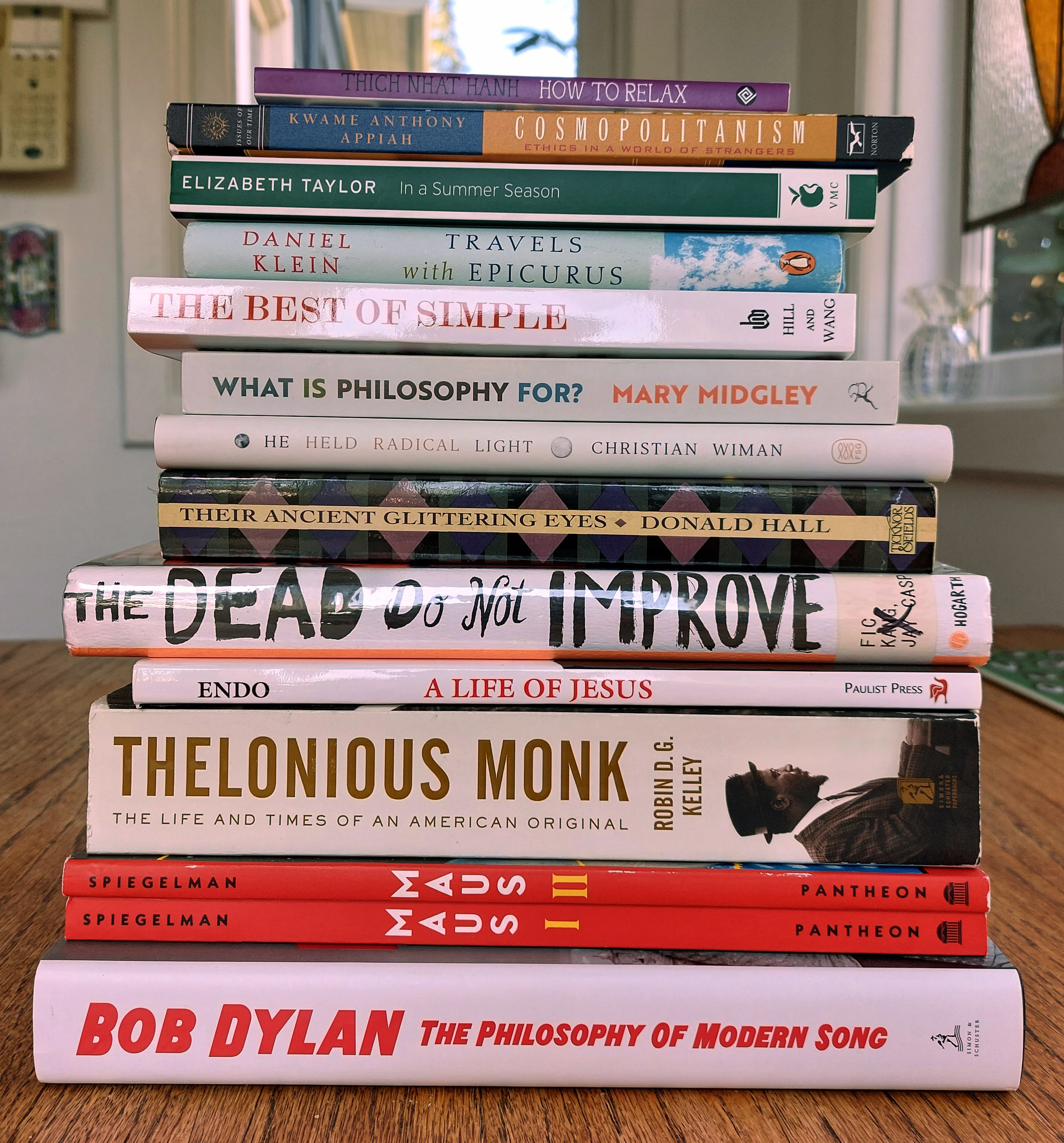
    Where did the idea for a bookclub come from? My stack of recently read books is about to topple over. This set began with Art Spiegelman’s “Maus: A Survivor’s Tale,” which he worked on through the 1980’s and won a Pulitzer in 1992. It’s a graphic novel in two parts about his father’s life in Germany during World War II and later living postwar in New York. Its ghostly and maniacal scenes are not quiet surreal, but leave a similar feeling – for it is, after all, predicated on the cartoon. It’s a comic book. The irony of that is so penetrating. It’s told in first person that shifts between his father’s recounting and Art’s narrative coming of age the son of survivors. It’s a masterpiece. And I don’t know how anyone could read it without wanting to share it. But who wants to relive it? The secret sharer puts it in a blog few read. Never mind the book club.

    But speaking of music, I also recently read Robin G. Kelley’s biography “Thelonious Monk, The Life and Times of an American Original” (Free Press, 2010). Monk’s mistreatments (self-inflicted or at the hands of others) are legendary; for example, the noted jazz critic Leonard Feather did more than criticize Monk – he attacked him for not being what Feather wanted him to be: “He has written a few attractive tunes, but his lack of technique and continuity prevented him from accomplishing much as a pianist,” Feather said (150). To be an original (in technique, continuity, or otherwise) is not necessarily to be accepted; on the contrary. Kelley’s book includes a good amount of history, Monk’s 20th Century environments: the causes and outcomes of the race riots of New York neighborhoods; the difficulties of surviving in the music industry; the difficulties for families of musicians who must travel to make a living; the prevalence of drugs in American cities, and the changes over time of police response; war, economic collapse, building and rebuilding, travel. Kelley gives us 600 pages, any one of which we might turn down a different street for readings to learn more about those subjects – again, the idea of a bookclub. But repeatedly we find Monk’s music dismissed by many of his contemporaries for its difficulties – difficulties which entertain rather than perplex today’s ears. Interestingly, the Beats and their poets found partnership in clubs that helped Monk finally flourish.

    Bob Dylan’s “The Philosophy of Modern Song” (2022) would make a good bookclub paring with Kelley’s Monk book. Dylan is another American Original, and his writing might strike many ears with difficulties similar to Monk’s piano. I’m almost never disappointed with Dylan, and this latest warrants reading and re-reading and listening. I put together a YouTube playlist of the 66 songs Dylan explicates in his book. Many of them have been recorded by more than one artist, so the trick is to get the version that most coveys the feeling of its mystery – that being how something so simple as a popular song can both create and evoke an entire era or single day in the life of an American coming of age in the age of “modern song.” And for those readers turned off by philosophy, not to worry, there’s not much philosophy to sing about here – the philosophy, like music theory, remains in the background.

    Speaking of philosophy, somewhere recently I noticed a new Mary Midgley book out, and quickly got a copy and read it. And, as it turns out, it’s her last one (Bloomsbury, 2018). Imagine living to 99 and the title of your last book? “What is Philosophy For?” Indefatigable, indomitable, Mary (look her up on YouTube and tune in to one of her conversations) defeats Dawkins and his ilk with real philosophy – that is to say, thought without propaganda.

    Shusaku Endo’s “A Life of Jesus” (Paulist Press, 1973) is a strange book. I like strange books. It’s about the Gospels, how they came to be first talked then written. The environments and people described are different from what we might come away with from the Bible versions. Here, for example, we get a fuller picture of John the Baptist, where he came from and what he wore, what he ate, what he said and did. Life can be strange in the desert. Essentially, we get closer to Jesus in the sense that the time itself comes alive. There is no question but that Jesus was a real person; he lived, in a real place, in a real time. The question of his divinity and why it has to remain such a mystery, almost a game, Endo does not quite answer, though it’s clear that he is a believer. It’s strange even to try to put this into words. I really like Endo’s book, and will read it again. It reminded me in some ways of Pasolini’s “The Gospel According to Saint Matthew” (film, 1964).

    A couple of books recently read did produce some disappointment: Christian Wiman’s “He Held Radical Light” (FSG, 2018) and Donald Hall’s “Their Ancient Glittering Eyes” (Ticknor and Fields, 1992). Don’t get me wrong; I liked both books. I even sent the Wiman to one of my sisters, thinking it would be to her liking also. These are both books about poetry, about poets, about poems and how and when they might be read and their purpose and import, their meanings, and the poetry and surrounding discussion I did enjoy. What I found disappointing was the emergence of an ego, a manic wanting on the part of both Wiman and Hall to write the poem to end all poems. Silly, that. It’s easy to see why and how poetry fails to live up to any kind of popular status in the marketplace – except for what we might find in popular song, in the philosophy of popular song, a philosophy that is lived but rarely talked about.

    I also read and enjoyed Jay Caspian Kang’s “The Dead Do Not Improve” (Hogarth, 2012). I had read that it was about surfers in San Francisco, so of course was interested. It’s not too much about surfing though. It’s a mystery, and accomplishes what it sets out to do. It’s entertaining, provoking, somewhat in the classic noir tradition, its characters representative of types of a kind, also of that noir setup. The dialog is fresh and accurate, the scenes clearly drawn, you get the smell and the feel of the place. The plot is convoluted, a bit like a shuffled deck of cards, and then reshuffled.

    That pretty much concludes my daytime recent book readings. To bed (to read) I’ve been taking Elizabeth Taylor lately (not the movie star). Reading now her “In A Summer Season.”

    In the end, writing about writing is rarely as interesting as the writing one is writing about, but there are exceptions, and those exceptions I’m always on the lookout for. Meantime, I’m still working on the guitar. I’ve been playing guitar almost as long as I’ve been reading. Have no intention of giving up either, but talking about reading, like talking about music, is a different pastime than writing or playing original pieces.

  • Simple Studies # 2

    Slow, but not lugubrious
    
    [wait a moment]    here   now 
    here    nut     classical 
    here    nut     spring all 
    spring sound spring now now 
    here    there   tuned tuned 
    tuned   a boat a 
    slow  turn ing 
    where   there   fingering 
    good    soil    try try 
    sharp   nut     dampening 
    rose    nut     here there 
    rose    nut     sharpening  
    rose    nut     roseate 
    there
    
    (being a transcription 
    of Leo Brouwer's 
    Etudes Simples #2)
  • One Night on the South Bay Strand

    I walk past Willy’s Wine Bar, its surf blue
    umbrellas hung over the wall, pointing
    to the water, patio piano
    jazz diminished by the incoming tide.
    The noise crashes, a wave through pilings.

    Mabel, the waitress, I used to know her,
    does not say hello, busy with cheese plates,
    her white apron purple stained thin cotton,
    her silver hair held behind her long ears.
    Years younger the torched sommelier tattooed

    head to toe oranges and lemon yellows
    over a bed of ivory azure.
    Happy she looks even joyful against
    brave Mabel’s bluejeans rustling all night long
    amongst the grape aficionados.

    A line for a table, fifty dollar
    cover charge, and Komos, a cruel bouncer,
    pushes me along to keep clear the Strand,
    where people still adhere to atmosphere
    of theatrical scenery, putting

    off the real ocean as it floods the set,
    rising up the old dunes to the green palms,
    centurions on display bend and sway,
    the Sergeant of Police, “Tarantara”!
    recalls the popular air of pirates.

    The ocean recedes and Mabel soon swoons,
    soldiers in pirate costume sing cadence:
    “Tarantara!” When danger is afar
    leaves its deepest scar and never comes close
    to the body but the mind’s eye closes.

  • In My Easter Bonnet

    A friend of mine writes he’s broken a rib. The circumstances (he doesn’t recall how it happened) remind me of Genesis:

    The Lord God caused a deep sleep to fall upon the man, and he slept; then he took one of his ribs and closed up its place with flesh. And the rib that the Lord God had taken from the man he made into a woman and brought her to the man. Then the man said, “This at last is bone of my bones and flesh of my flesh; this one shall be called Woman, for out of Man this one was taken.” Therefore a man leaves his father and mother and clings to his wife, and they become one flesh. And the man and his wife were both naked, and were not ashamed.

    New Oxford Annotated Bible, Full Revised Fourth Edition, Oxford University Press, 2010.

    A lot gets done in that first week of the Bible, at the end of which even God apparently needed a rest (and, in like miraculous manner, my friend with the broken rib somehow still got the tree pruned and the ladder put away). Readers might well question the facts of the matter. But in the introduction to Genesis in the Oxford, we get this:

    In the modern era, Genesis has been an important battleground as communities have worked to live out ancient faiths in a modern world. For example, much discussion of Genesis, at least among Christians in the West, has focused on whether the stories of Genesis are historically true. Astronomers, biologists, and other scientists have offered accounts of the origins of the cosmos and humanity different from those in Gen 1-2. Some believers, however, insist on the importance of affirming the historical accuracy of every part of Genesis, and have come to see such belief as a defining characteristic of what it means to be truly faithful. This definition is relatively new: the historicity of Genesis was not a significant concern prior to the rise of modern science and the historical method; in fact, in premodern times, the stories of Genesis were often read metaphorically or allegorically. Moreover, many would argue that an ancient document such as Genesis is not ideally treated as scientific treatise or a modern-style historical source. Instead, its rich store of narratives offer nonscientific, narrative, and poetic perspectives on values and the meaning of the cosmos that pertain to other dimensions of human life.

    page 10.

    Yet one may still argue, as Mary Midgley does in “What is Philosophy For?” for a single dimension, a holistic approach that accepts one without discounting the other:

    For instance, adding or removing the idea of God is not just changing an empirical detail, like adding or removing Australia from the map of the world. It is much more like changing the idea of that world as a whole. … In actual life, each of us has a world with a great background which our culture makes ready for us, including a whole population of human and non-human creatures, forces, atmospheres, opportunities, customs, tendencies, ideals, dangers and challenges. As Irish Murdoch has sharply pointed out, this ‘culture’ is not just a matter of a few recent films and fashions; it contains everything that we believe in, including our fashionable views about science itself:

    It is totally misleading … to speak of two cultures, one literary-humane and the other scientific, as if they were of equal status. There is only one culture, of which science, so interesting and so dangerous, is now an important part. But the most essential and fundamental aspect of culture is the study of literature, since this is an education in how to picture and understand situations. We are moral agents before we are scientists, and the place of science in human life must be discussed in words (Murdoch, The Sovereignty of Good, 34).

    Midgley, What is Philosophy For? Bloomsbury, 2018, 54-55.

    While it might make modern sense (scientific or otherwise) to read Genesis as allegory, what are we to make of the Resurrection? If read as metaphor, of what? As allegory, with what hidden meaning, and why hide it to begin with? Does being born again free us from that “great background which our culture makes ready for us”?

    One of the most interesting books I’ve read during the pandemic is Shusaku Endo’s “A Life of Jesus” (Paulist Press, 1973). At its close, having written about the life of Jesus as actual biography, Endo returns to metaphor and allegory:

    Where Mark and Matthew have written that the whole earth shook when Jesus died, and that the high curtain split in two, the evangelists are not recording events which actually happened, but are rather expressing the lamentation of the disciples and their consternation at the death of Jesus….Did Jesus therefore accomplish nothing? Was Jesus simply helpless after all? Was God silent? Was the sky merely dull? In the end, was the death of Jesus really no more than the death of any other powerless ineffectual man?

    154

    And then Endo, when it comes to the Resurrection, puts the allegory to test:

    Did these events actually take place? Are they historical facts, things that really happened? Or is this a fiction produced by the early Christian Church, perhaps an episode written to inculcate through symbols the undying memory of the Christ?

    157

    Endo questions how the disciples could have behaved so cowardly during the crucifixion but later turn about and emerge as courageous martyrs for the fledgling church. Was there some incredible but undeniable event that explains their conversion? Yet, Endo asks:

    But the concept itself of resurrection – did the idea even exist in the age of Jesus and his disciples? And if it did exist, what did the concept actually involve?

    161

    But don’t go out and buy and read Endo’s book thinking he has the ultimate answer. Once one has proof, one no longer needs faith. And Endo, in his reflective conclusion, says:

    For all I know, there may well be an analogy here between their [the disciples] inability to understand Jesus during his lifetime and our own inability to understand the whole mystery of human life. For Jesus represents all humanity. Furthermore, just as we, while we live in this world, cannot understand the ways of God, so Jesus himself was inscrutable for the disciples. His whole life embraced the simplicity of living only for love, and because he lived for love alone, in the eyes of his disciples he seemed to be ineffectual. His death was required before the disciples could raise the veil and see into what lay behind the weakness.

    178

    As for broken ribs, my father once broke seven at once, buried in a cave-in, where he was crushed against a huge underground concrete pipe, a project he’d been working on, the deep ditch he was down in inadequately shored. I sent my friend with the recent broken rib a copy of the newspaper account, as proof. How my father escaped further serious injury is one of the mysteries of his life. From Midgley again:

    During the past century, philosophers have provided enquirers with one more alternative: mysterianism. This is the view that there are some questions which our minds are simply not fitted to resolve, and that free will is one them. In order to resolve this metaphysical puzzle Noam Chomsky adopted the name ‘mystery’ for these cases, apparently from a pop group called Question Mark and the Mysterians. He suggested that these unmanageable questions are not really problems at all but mysteries, situations in which scientists should stop saying (as they always do at present), ‘We do not have the answer to this yet,’ and should simply say instead, ‘This one is beyond us.’ He adds that this limitation is not surprising since the cognitive capacities of all organisms are limited, which indeed is true.

    Will this do? It is surely a relief to hear the learned admitting that there are some kinds of things that they do not and cannot know. But we need to ask next, which ones are they? And why?

    33
  • A Talk Story

    We recently purchased a used copy of the 2001 Modern Library Paperback Edition of “The Fun of It: Stories from The Talk of the Town,” edited and with a preface by Lillian Ross, who wrote for The New Yorker for some 70 years. Her “Portrait of Hemingway” appeared in the 13 May 1950 issue, and is still read today as a classic first example of literary journalism.

    The earliest “Talk Stories,” in the 1920s, didn’t have bylines (the group of stories were signed “The New Yorkers” at the bottom of the “Notes and Comment” section) and their style was intended to entertain while educating with facts. Harold Ross, the first New Yorker editor, no relation to Lillian, “didn’t like bylines,” she tells us in her editor’s preface to “The Fun of It.”

    “He wanted the stories in The Talk of the Town to sound as though they’d been written by a single person, and he wanted that person to have what he called ‘the male point of view.’ ‘We’ was always supposed to be male.” In spite of those constrictions, Lillian Ross went on to write “hundreds of Talk stories,” with “the singular challenge of creating these stories pure fun for all of us who do them.”

    Harold Ross himself contributed Talk Stories, also anonymously, so it’s possible he was responsible for the August 12, 1927 Talk piece titled “Fence Buster,” about the new New York Yankees baseball player Lou Gehrig. The piece includes the staples of the Talk Story: “By the late twenties,” Lillian Ross says, “the department usually featured a ‘fact’ piece plus a ‘personality’ piece plus a ‘visit’ piece; the mix became traditional.”

    Thus we learn, in about the required length of around 1,000 words, that the young Gehrig’s father was a “janitor and grass-cutter” at Columbia University, and that Lou looked up to Babe Ruth, though unlike the Babe, he did “not drink, smoke, or gamble.” Lou enjoyed fishing for eels, which his mother pickled. And in 1927, at the age of twenty-four, he made “about $10,000 a year.”

    $10,000 a year is double what I made in my first teaching job around 50 years later. Of course, I had the summer off, while Lou Gehrig had to work. I suppose we could say now that I taught for the fun of it.

  • El Porto at Night

    Out of ocean back to sun
    slow purple tide drifts down
    darkness like a tidal wave
    floods and a dark fog falls.

    Strand partygoers barefoot
    swimsuit prance in sandals
    streets car-lined seldom trees
    dwellings cliche toe crammed.

    Sleep cans built on sand hills
    swept of seawrack the breeze
    the moon in her habit prays
    and down rains grace gently.

    Each drop 15% ABV the lifeguard
    says and turns on your nightlight
    what a concept and flies away
    into south Santa Monica Bay.

    In the distance the bass bob bloom
    of close-in closed out hollow waves
    like artillery shells down the line
    hear water mewling through shingle.

    In the morning late for the school
    bus stops for you up on Highland
    you forget now why all those tears
    on a lovely morning such as this.