Category: Writing

  • Post on Nothing

    Wanting for a word of good fit, I’ll ramble through a dictionary, in etymological pursuit. For example, just now I looked up the word pursuit and found that in a physiology context pursuit means what the eyes do, for example, when following the flight of a bird. I then looked up physiology, when what I had started looking up to begin with wasn’t pursuit at all but post. And it occurs to me that readers are like birds, flocks of readers: whodunit white-eared night herons; bibliophile bowerbirds; book-bosomed doves; frizzle-brood chickens; shelved-book house finches. Genres of readers flocked in clubs like a quarrel of sparrows, an asylum of cuckoos, a booby of nuthatches, a conspiracy of ravens, and this old couple who still perform the walk-on-water-dance of the grebes. But I can’t now seem to find the connection between post and pursuit, but perhaps it’s obvious. Even familiar words have family history and we don’t know half the story as we rush to tell.

    To post on a blog is to post in effect on nothing, the original posts one might post to being a mile marker, a signboard, road sign, doorpost, or a telephone pole, for example, on which one stuck a note giving notice, information or invitation or direction, or entertainment or argument, to passers-by, readers at random, on display in a public place. Such posts usually have (though not always obvious) some purpose, unlike graffiti, say, which usually is gratuitous. So far so good, a blog post is just that, what folks used to affix to a physical post, but there is no such real post to a blog post, unless one considers this open space where we seem to be (the internet, the web, the cloud, the blogosphere, the device – whatever it’s called) a post, but not a post like a milled fir 4 x 4, a tree shorn of its branches, returned into the ground, where to post something we might need a fashioned sign and a hammer and a nail.

                          "I have nothing to say

    and I am saying it and that is

    poetry as I need it ."

    And post it. But this, this post, to return to it, is not poetry; this is a blog post, a post on a blog. About nothing. But what is nothing, if not something? Cage also prepared something called “Lecture on Something,” but the above quote is from Cage’s “Lecture on Nothing,” from page 109 in Silence (1961). But then again I hesitate to call this (thing that I write on, post to) a blog. A blog is a form as a poem or a song or an advertisement is a form. What is a form? We grow so weary of nothing (unless we are one of the cognoscenti of relaxation). Nothing to do. Nothing to say. Nothing to eat. Nothing to drink. Nothing in the kitty.

    So we create and tend to forms. To blog is to write, but not quite, since some blog posts are devoted exclusively to the posting of pics, often posted without referent rhyme or reason. Content without form. How is that even possible? Anyway, aren’t there enough pics posted already? Yes, and words too. Is a pic a word? If you look up pic, you’ll probably see it’s classified as informal. It does not wear a cummerbund or a gown. But of course a picture is worth a thousand words. And where does that come from, that saying? We can look it up, and do. From advertising, apparently. The ads on the sides of trolley cars, which, passing as they do, a Clanging of Birdsong, provide for a moving post on which to post in pic form enough to imprint on the random viewer in passing a brand, a product, and a suggested desire or want, to follow up on later. Soap, cigarettes, auto parts, perfumes, hats, guitar picks. Are pictures worth more than words? Something called Picture Superiority Effect, from Wiki:

    The advantage of pictures over words is only evident when visual similarity is a reliable cue; because it takes longer to understand pictures than words (Snodgrass & McCullough, 1986[15]). Pictures are only superior to words for list learning because differentiation is easier for pictures (Dominowski & Gadlin, 1968[16]). In reverse picture superiority it was observed that learning was much slower when the responses were pictures (Postman, 1978[17]). Words produced a faster response than pictures and pictures did not have an advantages [sic] of having easier access to semantic memory or superior effect over words for dual-coding theory (Amrhein, McDaniel & Waddill 2002[18]). Similarly, studies where response time deadlines have been implemented, the reverse superiority effect was reported. This is related to the dual-process model of familiarity and recollection. When deadlines for the response were short, the process of familiarity was present, along with an increased tendency to recall words over pictures. When response deadlines were longer, the process of recollection was being utilized, and a strong picture superiority effect was present.[19] In addition, equivalent response time was reported for pictures and words for intelligence comparison (Paivio & Marschark, 1980[20]). Contrary to the assumption that pictures have faster access to the same semantic code than words do; all semantic information is stored in a single system. The only difference is that pictures and words access different features of the semantic code (te Linde, 1982[21]).

    With regard, then, to pics and words, as used in posts on blogs, one (pics) probably is not inherently, or intrinsically, worth more than the other (words). But what’s being measured in terms of worth is the value of advertising. Where pictures meet advertising in a meld (as in to announce, where the announcement and messenger are the same) is Instagram. Originally a place to post pics for folks with a hankering for photography, Instagram has become a wake of buzzards, a commotion of coots, a swatting of flycatchers. It’s an elevator of advertisements, the etymology of advertisement including a statement calling attention to itself and at the same time a warning. An advertisement is a solicitation, to be solicited, the more notoriously so, the better. Advertisement is a form.

    That music is   simple to make   comes from   one's willingness to ac-
    cept the limitations of structure Structure is
    simple be-cause it can be thought out, figured out,
    measured . (111)

    In Cage’s “Lecture on Something” entire pages are left blank. “Let no one imagine that in owning a recording he has the music,” Cage said (128). Nor, if we own a book, do we necessarily have the poetry. Cage often left sections of music blank, too, the better to hear, presumably, the truck passing through the street below the window within a piece. If Cage had had a blog, he might have expressed issues of frustration regarding the “limitations of structure.” And it’s amazing to see what he accomplished with a typewriter. Here on WordPress, poetry, modern poems, often difficult to arrange on a blog page or post, are given, in the so-called “block” format used to make the WordPress page, somewhat easily to the functional white needs of poetry. WordPress predicates the paragraph as the primary foundation (block) of writing. Maybe for prose, but not so much for poetry, and probably not at all for the writing of music or tablature. That said, I’m not an expert at WordPress styles and options. I want to write, not do computer programming, so maybe I’m missing formatting possibilities, but the WordPress Preformatted and Verse blocks seem to work flexibly enough to attempt some creative forms. But the block is self-contained – I don’t see the possibility of a block within a block, where, for example, the typography of one word might change in size relative to the typography of another word in the same line or block, or of letters to letters in the same word.

         writing      verse (unblocked words)     on  WordPress 
    is as simple as writing
    music
    if one accepts the
    limitations (rules)
    of structure
    the structure of limits (that which can't be measured)
    nothing has no limits

    What limitations was I talking about again? And anyway, doesn’t verse have all the limits it needs, without bringing WordPress into the discussion? Even a piece of doggerel has its limits, its boundaries. But notice Cage said “make” music, not write music, not compose music. One can make music if one has access to any kind of sound making device. To make silence is probably the most difficult challenge. If we take a pic of this post, we’ll find a picture is not worth a thousand words, since we can’t fit a thousand words into the pic, a post of 1,453 words, 8 minutes read time.
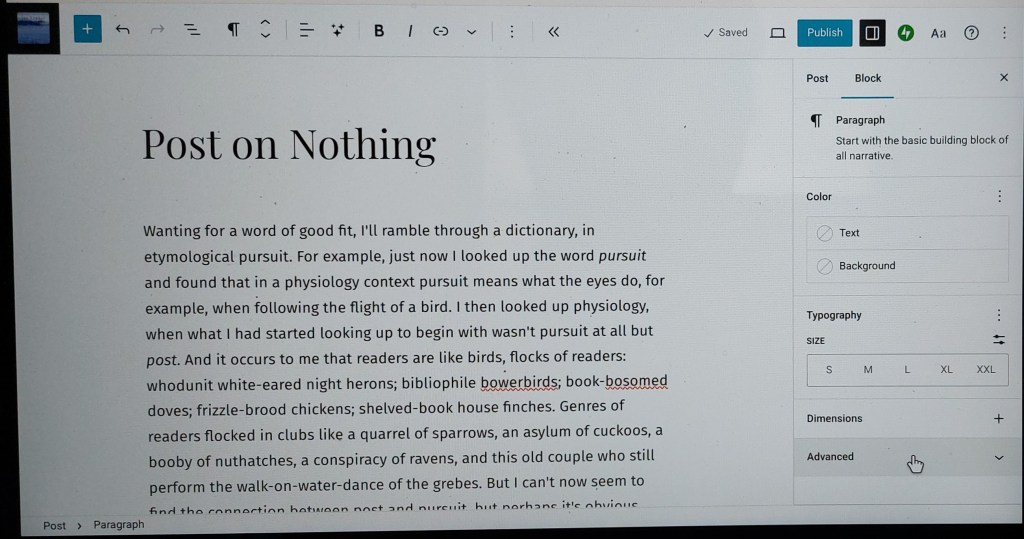
    Pic of Post
  • Beach Buggy

    There’s a scene in John le Carre’s “The Spy Who Came in from the Cold” (1963) where Leamas, the tough and unsentimental spy, recalls his first experience of what for him was a foreign emotion, the fear and trembling that comes from a near miss. He was speeding down the autobahn late to an appointment and “taking risks to beat the clock” when he nigh collided with a car full of children:

    “As he passed the car he saw out of the corner of his eye four children in the back, waving and laughing, and the stupid, frightened face of their father at the wheel. He drove on, cursing, and suddenly it happened; suddenly his hands were shaking feverishly, his face was burning hot, his heart palpitating wildly” (122, Coward-McCann, 1964).

    But apart from his sudden shaking of nerves, what happens is that he imagines the scene as if he had actually hit the car, and that too is new, and

    “He never drove again without some corner of his memory recalling the tousled children waving to him from the back of that car, and their father grasping the wheel like a farmer at the shafts of a hand plow” (122).

    The new emotion is evidence that “He was slowing down. Control was right (121)….Control would call it fever” (122). What has happened to the stouthearted spy that a near miss becomes an obsessive memory that torments him almost as if the resulting imagined outcome really happened?

    I thought about the le Carre scene while reading the Roddy Doyle short story, titled “The Buggy,” that appears in this week’s The New Yorker magazine (June 24, 2024). Doyle’s story also contains a near miss. A father is standing with his kids on a train platform:

    “He let go of Colm’s hand for a second, to give the button a jab – and Colm was gone. He had tried to step onto the train; his stride fell short of the gap, and he dropped between the train and the platform, under the train” (48).

    But what happens in Doyle’s story, unlike the foreign emotion experienced by le Carre’s spy, is the father seems to have lost touch with the reality of the experience:

    “He could remember rescuing Colm, but he couldn’t imagine it – he couldn’t feel it. He didn’t believe he’d done it. Or any of the other things he’d done when he was a father” (48).

    Like le Carre’s aging and on the wane spy, the father in Doyle’s story begins to experience his memories differently from the reality of their happening. In fact, he simply can’t imagine the experiences are actually his. For example, and this is probably, while reading the Doyle story, where I remembered the scene from “The Spy Who Came in from the Cold,” the father recalls another buggy incident. Another son, Sean, had pushed their buggy out into the road and a passing car hit it. Doyle’s story turns on whether or not the bugggies are carrying babies or are empty.

    “He could remember it like a scene from a film. It was a very good film. But he wasn’t in it.

    What happened?

    Where had his life gone? Not the years – the blood. Where was the life?” (49)

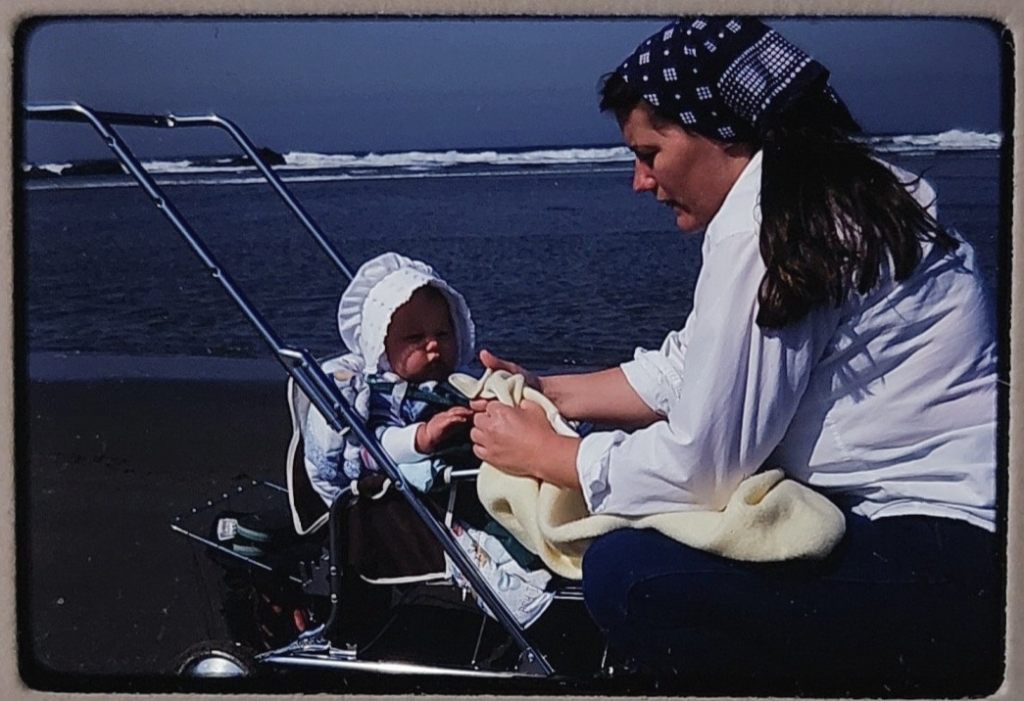
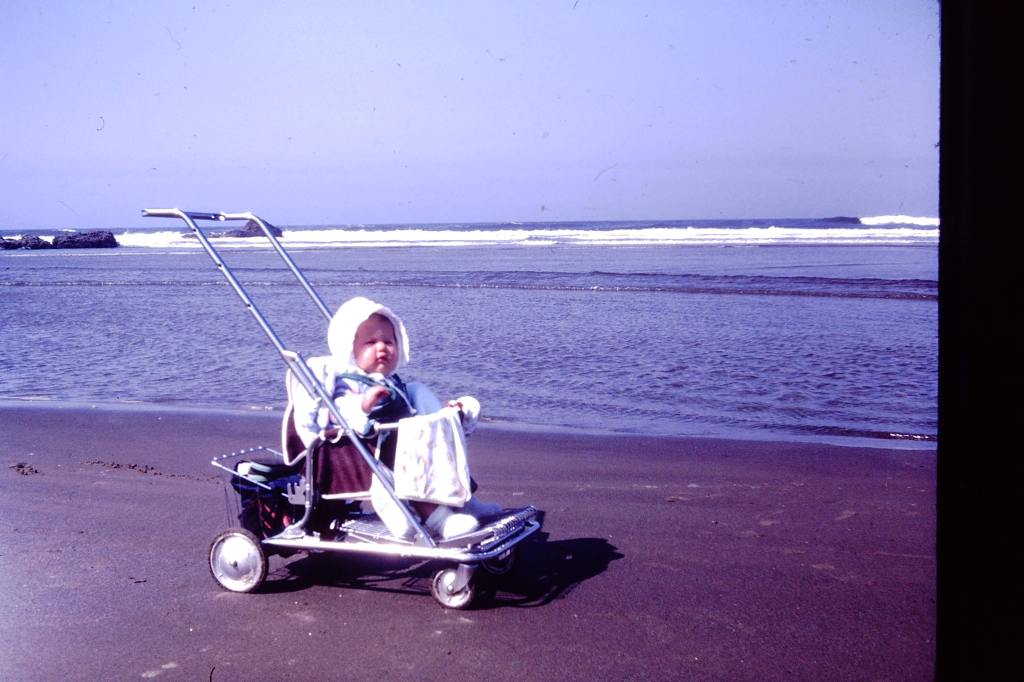
    Then there’s another buggy, in the Roddy Doyle story, at the beach, near the incoming tide, and this one reminded me of a couple of old 35mm slide photos I took years ago on a trip to Cannon Beach. There’s definitely a baby in this buggy. The tide is out, and I’m close by, and so is the mother. But why did I say I remembered the photograph and not the actual being there on the beach, the waves breaking far out, the sun still to the east, late morning, the blue steel tones of the sea and sky, the now old fashioned collapsible beach buggy with basket? And that white bonnet frilled lace like the surf foam and that blue bandanna. Is it a memory or a photograph or a short story?

  • So It Goes

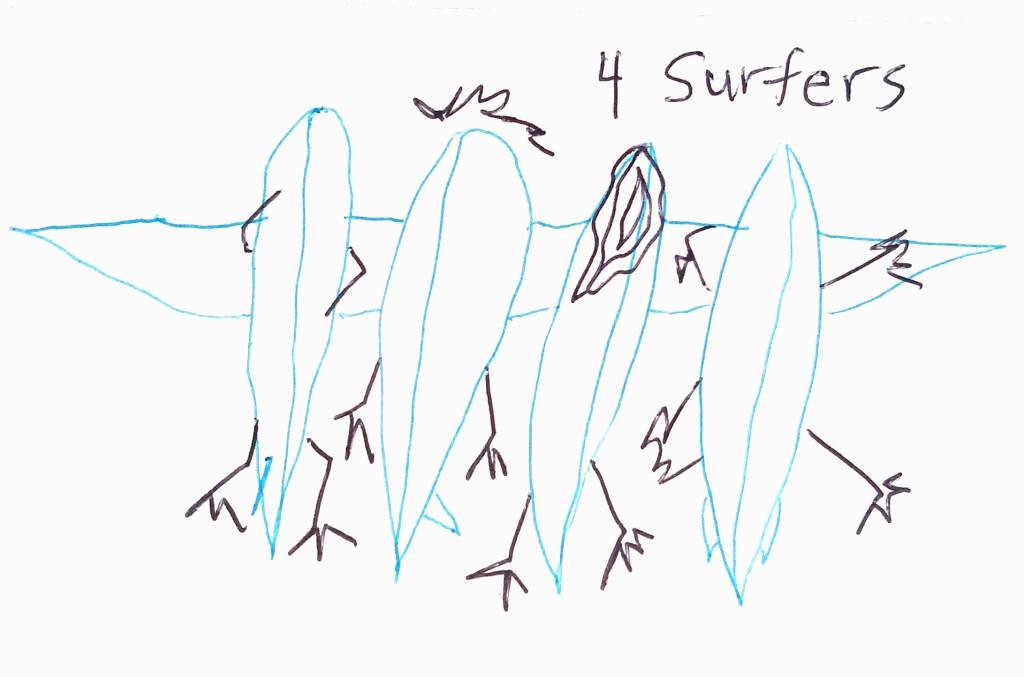
    Those who travel back and forth through time, to and fro, up and down, in and out, with the tides, over and under the swells, stopping now and then to visit. They were here, now they’re gone, return to sender. Sisters, first, then brothers, then ten of us, thoughts like tinnitus that echo like a whiffle ball others can’t hear, sounds won’t leave us alone, to night us, all ten nights of us, Knights of Tinnitus, while these guitars gently sleep, and surfboards drift. A banjo plays brightly, its tabor head a full blue moon, up on the beach. So it goes.

    But how does it go?

    Ah, but ask the winged burds!

    We look before and after,
    And pine for what is not:
    Our sincerest laughter
    With some pain is fraught;
    Our sweetest songs are those that tell of saddest thought.

    But what did they bring along, if not knotty pine – oak or peonies?

    They brought along their come-a-longs, and along the river they walked, while in the wet reeds the wee birds nested and rested. There were peonies and pizza aplenty.

    And along the river, did they sing songs?

    Of chords they sang songs, serious songs, silly songs, songs of love and despair. Cover songs and under cover songs. Songs with no words.

    What songs did they sing?

    So it goes, so it goes. They sang so it goes.

    But where did it go?

    I don’t know. “While we look not at the things which are seen, but at the things which are not seen: for the things which are seen are temporal; but the things which are not seen are eternal.”

    And what did they take back?

    Don’t look back, but they took back a weighty tome, a mighty book, a reference book, a history book, a look into our times, past times, out of time, a book of songs.

    And did they play it as surfers or hodads?

    They played it both dolce or metalico, as the moon prevailed.

    Why did they leave so soon?

    “Blue moon of Kentucky, keep on shinin’. Shine on the one that’s gone and said, ‘Goodbye.’” So it goes.

    So it went?

    So it goes.

  • On Forms

    At the end of Mark Twain’s “The Adventures of Huckleberry Finn,” Jim finally tells Huck the dead man in the house they encountered earlier floating down the river was Huck’s father, and Huck, now aware and free of family, and now bored with his friend Tom Sawyer’s boyish ways, decides it’s time to cut out:

    “…and so there ain’t nothing more to write about, and I am rotten glad of it, because if I’d a knowed what a trouble it was to make a book I wouldn’t a tackled it, and ain’t a-going to no more. But I reckon I got to light out for the Territory ahead of the rest, because Aunt Sally she’s going to adopt me and sivilize me, and I can’t stand it. I been there before.”

    I’m with Huck, though it’s too late for me to pretend I can uncivilize myself, or maybe I was never civilized enough to begin with; in any case, I can at least decide I’ll write no more books. Eight is enough, and they are a big trouble, and troubling, and hard to take down. Civilization is a form of living that includes books, but one can live happily without being a reader or a writer.

    I’ve never put much stock in ancestry. My mother said her maiden name, though spelled differently, came from Anne Boleyn, the beheaded queen. That would make for an interesting answer on a medical form to the question, how did your ancestor die? Today’s medical forms often ask for information related to questions of genetics, presumably to help with diagnosis, but what’s wrong is still often just a guess, but lots of afflictions do carry useful genetic information. At the same time, some consideration might be given to mutations and the idea that at the cellular level some form of intelligence or at least some form of communication between or among cells, in plants and animals, informs protective changes.

    In the military, forms, identified by letters and numbers, such as the popular “DD Form 214” (DD for Department of Defense), carry orders, instructions, information. An Army is a form of military organization, and etymologically, the word army suggests to form, fit together, join, as one makes and makes use of tools.

    In high school, we learned to fill out forms. A popular question on those forms was “Father’s Occupation.” This might have been a precursor to the genetic questions on today’s medical forms. It might also help explain my being predisposed against interest in ancestry – though I would respond differently to such forms and questions today than I did when in high school. High school is a form of education, but in time the content wears thin, grows obsolete, while the form calcifies one’s entire being.

    Of history, Joyce in “Ulysses” has Stephen tell his principal, Mr. Deasy, it’s “a nightmare from which I am trying to awake.” Many of us might say the same of high school – a nightmare from which we are still trying to awake. Stephen, in conversation with Deasy:

    —History, Stephen said, is a nightmare from which I am trying to awake.

    From the playfield the boys raised a shout. A whirring whistle: goal. What if that nightmare gave you a back kick?

    —The ways of the Creator are not our ways, Mr Deasy said. All human history moves towards one great goal, the manifestation of God.

    Stephen jerked his thumb towards the window, saying:

    —That is God.

    Hooray! Ay! Whrrwhee!

    —What? Mr Deasy asked.

    —A shout in the street, Stephen answered, shrugging his shoulders.

    We’re still in episode two, “Nestor,” when Stephen makes the joke about a pier being “a disappointed bridge.” His students don’t seem to understand. Stephen is thinking of forms:

    It must be a movement then, an actuality of the possible as possible. Aristotle’s phrase formed itself within the gabbled verses and floated out into the studious silence of the library of Saint Genevieve where he had read, sheltered from the sin of Paris, night by night. By his elbow a delicate Siamese conned a handbook of strategy. Fed and feeding brains about me: under glowlamps, impaled, with faintly beating feelers: and in my mind’s darkness a sloth of the underworld, reluctant, shy of brightness, shifting her dragon scaly folds. Thought is the thought of thought. Tranquil brightness. The soul is in a manner all that is: the soul is the form of forms. Tranquility sudden, vast, candescent: form of forms.

    Cuneiform, Uniform, Reformatory.

    We might find something a bit morbid in recalling the ancient forms. No, I’m not too interested in ancestry, but somewhat (so. me. so. what). But to call out some ghost you don’t really know, yet a relation, still: from referre ‘bring back’ – see relate: couple with.

    —Pooh! Buck Mulligan said. We have grown out of Wilde and paradoxes. It’s quite simple. He proves by algebra that Hamlet’s grandson is Shakespeare’s grandfather and that he himself is the ghost of his own father.

    Joyce’s Buck Mulligan is in some form more interesting and certainly more fun than his Stephen Dedalus, even as Stephen is stand-in for Joyce himself. Stephen might be too given over to thinking about forms, while Buck more given to thinking about the form of suds atop his pint. Then again, Stephen is not Joyce, but an interesting form of.

    I was still in high school when my father was buried in an under-road big pipe project cave-in. The forms used to shore the walls of the deep ditch gave way, and he was pinned under a dump of dirt and against the cement pipe. He was rescued with seven broken ribs and some skin abrasions, a form of occupational hazard.

  • Hearty

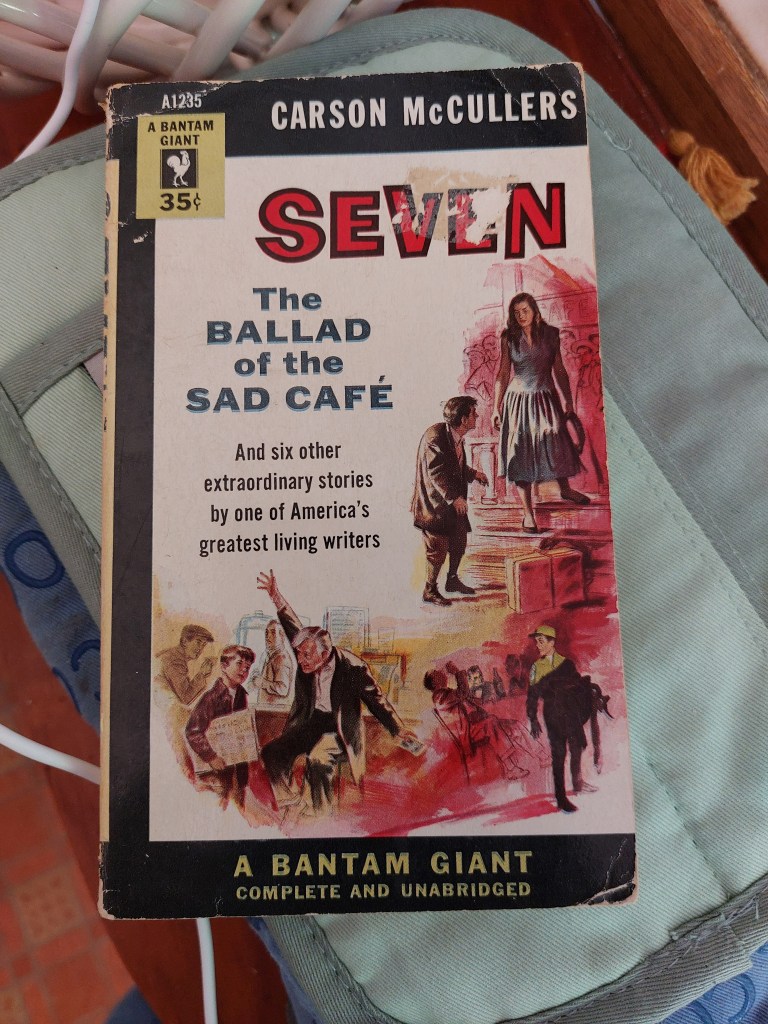
    If you’re looking for Carson McCullers, you won’t find her at the Heart Clinic, where in the waiting room the chairs are a pleasant pastel-green plastic, the color of hope, and comfortable, though the wait is not long, and the streaming station is set to 60’s and 70’s rock ‘n’ roll.

    Carson’s “The Heart is a Lonely Hunter” was published in 1940, when she was just twenty-three. We read it in high school in the mid 1960’s. The title comes from a poem by the Scottish poet William Sharp, published under his pseudonym, Fiona MacLeod. The word green appears in the 24 line poem 10 times. Here is the last stanza:

    O never a green leaf whispers, where the green-gold branches swing:
    O never a song I hear now, where one was wont to sing
    Here in the heart of Summer, sweet is life to me still,
    But my heart is a lonely hunter that hunts on a lonely hill.

    Only a poet would say of the heart it is “a lonely hunter.” But notice MacLeod/Sharp didn’t say “the heart”; he said “my heart.” Carson took his personal reflection and turned it into a universal appeal. Is the heart a lonely hunter? The answer will depend on whom you ask. But meantime we might also play around with Carson’s title:

    The Heart is a Garrulous Scavenger
    The Heart is a Forlorn Blogger
    The Heart is a Red Red Rose
    The Heart is a Hollow Muscle

    The word heart appears in Joyce’s “Ulysses” at least 200 times. Here is Stephen reflecting on one of his students in the “Nestor” episode:

    Ugly and futile: lean neck and tangled hair and a stain of ink, a snail’s bed. Yet someone had loved him, borne him in her arms and in her heart.

    But Joyce’s use of the word includes the real thing, too, as we find when we first meet Bloom:

    Mr Leopold Bloom ate with relish the inner organs of beasts and fowls. He liked thick giblet soup, nutty gizzards, a stuffed roast heart, liverslices fried with crustcrumbs, fried hencods’ roes. Most of all he liked grilled mutton kidneys which gave to his palate a fine tang of faintly scented urine.

    And this, meant to convey patience and forbearance in its context – Bloom thinking:

    Wear the heart out of a stone, that.”

    Of course many of the hearts are at the funeral for Paddy Dignam, but the young girls heart-worded “Nausicaa” episode begins with Gerty on the rocks close to sunset:

    The summer evening had begun to fold the world in its mysterious embrace. Far away in the west the sun was setting and the last glow of all too fleeting day lingered lovingly on sea and strand, on the proud promontory of dear old Howth guarding as ever the waters of the bay, on the weedgrown rocks along Sandymount shore and, last but not least, on the quiet church whence there streamed forth at times upon the stillness the voice of prayer to her who is in her pure radiance a beacon ever to the stormtossed heart of man, Mary, star of the sea.

    There is the sweetheart and the Sacred Heart. And times they might be the same. Or the heart is a flower. This from Molly Bloom:

    I love flowers Id love to have the whole place swimming in roses God of heaven theres nothing like nature the wild mountains then the sea and the waves rushing then the beautiful country with the fields of oats and wheat and all kinds of things and all the fine cattle going about that would do your heart good to see rivers and lakes and flowers all sorts of shapes and smells and colours springing up even out of the ditches primroses and violets nature it is

    And yes Molly Bloom has the last heart at the last of Joyce’s book “Ulysses” says:

    yes and his heart was going like mad and yes I said yes I will Yes

  • Happy Misfortune

    Why do some derive pleasure from some other’s misfortune, a strange joy often described as schadenfreude? The English version is epicaricacy. Now there’s a good word, suggesting epic caricature. A form of sadism, maybe. It’s not one of the seven deadly sins, though it could be related to wrath or envy. Or moral desert.

    Is it a weakness not to feel happy at a bad person’s misfortune? Is it impossible for a bad person to experience misfortune? Is misfortune a precursor to happiness? Can we even recognize true misfortune? What appears to be divine retribution may turn out to be a blessing in disguise. Likewise, do we know luck when we find it? Trina wins a lottery in Frank Norris’s novel “McTeague.” She ends up sleeping on the coins, literally, a bed of coins.

    The blessing in disguise is of course impossible to know. We can’t know what does not happen, only imagine it. But we’re good at imagining things. And our predispositions and assumptions often make no sense. We don’t believe in God, but we think people get what they deserve. We stick to the belief that good deeds are rewarded while bad acts get punished even as the headlines are proof of an alternative reality. Pride, greed, and envy are well-dressed floats in our celebration parades.

    We scan the headlines for signs of redress: the writer whose best seller is found to be plagiarized; the preacher who kept a mistress; the scholar who misspells, mispronounces, misses tenure; the sports hero hooked on drugs; the politician prosecuted. But the schadenfreude feelings these misfortunes stir up are no substitute for kindness and humility. What we seem really to be looking for is vengeance. But our code of disbelief has already struck down any possibility of such a judge.

    We are given then to randoms. We don’t know why things happen the way they do. And no event seems final. The so-called extinction of the dinosaurs is belied by the hummingbird and crocodile. I’ve been thinking of the dinosaurs recently, the ones we once thought now fill the gas tanks of our cars, but that’s a myth. Life doesn’t pass so much as alter – allegro non troppo: fast, but not so fast we can’t see or feel it go; and for the most part happy, though not permeating or permanently so. In any case, and as Slavoj Zizek points out in his segment of the Astra Taylor film “Examined Life,” the catastrophe of one species may be the good fortune of another.

    Is happy misfortune a universal truth, like the constant speed of light or theories of relativity? In the absence of proof of life elsewhere in the universe, is life on Earth a happy misfortune? Or is life elsewhere already over, ended, and not so happily? And would we feel a sense of schadenfreude to find out?

  • Ferrule

    One day, a child sitting in his grammar school classroom, I swallowed a ferrule, the metal eraser-holder cap at the top end of the pencil. I had been chewing the end of my pencil, thinking, I like to think now, was why, or maybe I was just hungry, but, in any case, I had like a beaver at work on a log, bit through, and suddenly the ferrule shot like a pill right through my mouth and down my throat. I hardly felt a thing. It didn’t lodge or get stuck, just down it went, where things go when you swallow them.

    As if chewing the pencil through and swallowing the ferrule wasn’t foolish enough, when I got home, I told my mom. That night, in the hospital bed, after visiting hours, the nurse came in to turn out the light and told me in the morning to use the bedpan so they could check to see if the ferrule had gone all the way through. The ferrule was never found, but I was discharged after the one night’s stay anyway.

    Yesterday, I Googled “Why did I chew on the end of my pencil?” and found this, from a site called “Pen Heaven,” an article titled “Pen Behaviour; Chewer, Clicker, Twiddler…?”: “Those who are in the habit of chewing and/or nibbling on their writing implements are generally nervous souls. Other than not wanting to borrow their pen, this person needs to be handled with care as they are often anxious, thin-skinned and take offence easily.” Nailed it? Not sure, but it was the most interesting answer in between all the more obvious dental hygiene warning posts.

    It’s a neat trick, of course, naming things based on casual observation of ticks and such. You can do it with just about anything, works like astrology. When something is given a name, a certain amount of control is exchanged, and explanations exceed their boundaries. But the trick after time is often exposed. Several recent articles serve to demonstrate.

    In “Why We’re Turning Psychiatric Labels into Identities,” Manvir Singh takes a close look at the Diagnostic and Statistical Manual of Mental Disorders (The New Yorker, May 6, 2024). The DSM is the desktop guide of the American Psychological Association, used to reference diagnoses. Behavior is given a name, and the named one assumes an identity. One problem with the process, as Singh makes clear, comes when the names are changed or deleted and those assumed identities are abandoned: “Revamping the DSM requires destroying kinds of people.”

    In “Who’s Afraid of Judith Butler?” (The New Yorker, April 29, 2024), Parul Sehgal profiles the Berkeley based philosopher. Butler, Sehgal says, “recently adopted they/them pronouns but doesn’t ‘police it.’” Sehgal refers to Butler as an academic celebrity – is that a non-sequitur or oxymoron, I wonder. Certainly Butler had not set out to achieve celebrity: “Butler told me that they had little notion of what was happening at first. ‘Someone from the Village Voice asked, What are you thinking about the new directions in queer theory? I said, What’s queer theory? They thought I was being Socratic.’”

    In grammar school, we were required to have two pencils, one red, the other black, and one pen, blue ink. At the top of each loose folder page we wrote “JMJ,” invoking the Holy Family to bless our work, no matter how messy or failing it might become. The pencil was used for math; in fact, to use ink for math (or arithmetic, as it was then named), cost points. So I must have been involved in some arithmetic function at the time I swallowed the ferrule. I doubt the word ferrule was at the time part of my speaking or even reading vocabulary. Imagine swallowing an iron bracelet.

    Pope Francis may seem by some bound by something like iron bracelets, but he always seems able to break free from them. In “The Pope Goes Prime-Time” (The New Yorker, May 21, 2024), Paul Elie comments on the Pope’s recent appearance on the news show “60 Minutes.” I missed the show, but found Elie’s comment piece noteworthy. The Pope had to respond to questions as if he were running for political office. Elie comments: “In substance, it was something like a highlight reel of topical remarks similar to those the Pope has previously made in interviews, homilies, and blessings. The wars in Ukraine and Gaza; women, children, and migrants; sexual abuse and climate change; the nature of the Church; the need for hope; and the attitude that Francis calls ‘the globalization of indifference’—were all mentioned, if briefly. When Francis was asked about antisemitism, for example, he replied, ‘All ideology is bad, and antisemitism is an ideology, and it is bad. Any ‘anti’ is always bad. You can criticize one government or another, the government of Israel, the Palestinian government. You can criticize all you want, but not ‘anti’ a people. Neither anti-Palestinian nor antisemitic.’”

    Also of special interest, the Pope’s definition of conservative: “A conservative,” the Pope said, “is one who clings to something and does not want to see beyond that. It is a suicidal attitude. Because one thing is to take tradition into account, to consider situations from the past, but quite another is to be closed up inside a dogmatic box.” The Pope seems to be trying to speak without a dogmatic ferrule bound around his neck.

    Dogma may be the practice of naming things. We used pencil for arithmetic because it was assumed in math we make errors, which need erasing (seemingly contrary to that was the requirement to show one’s work). I’m not sure why it was not equally assumed we’d make errors in writing sentences. The red pencil was used for both math and writing, where the lines of a diagrammed sentence would be drawn in red. We named the words diagrammed: noun, verb, adjective, adverb, pronoun, preposition, conjunction, interjection. Grammar became dogma.

    Once you start thinking about ferrules, you might begin to see them everywhere, as, indeed, they are ubiquitous. Without them, things unravel, fall apart, come undone.

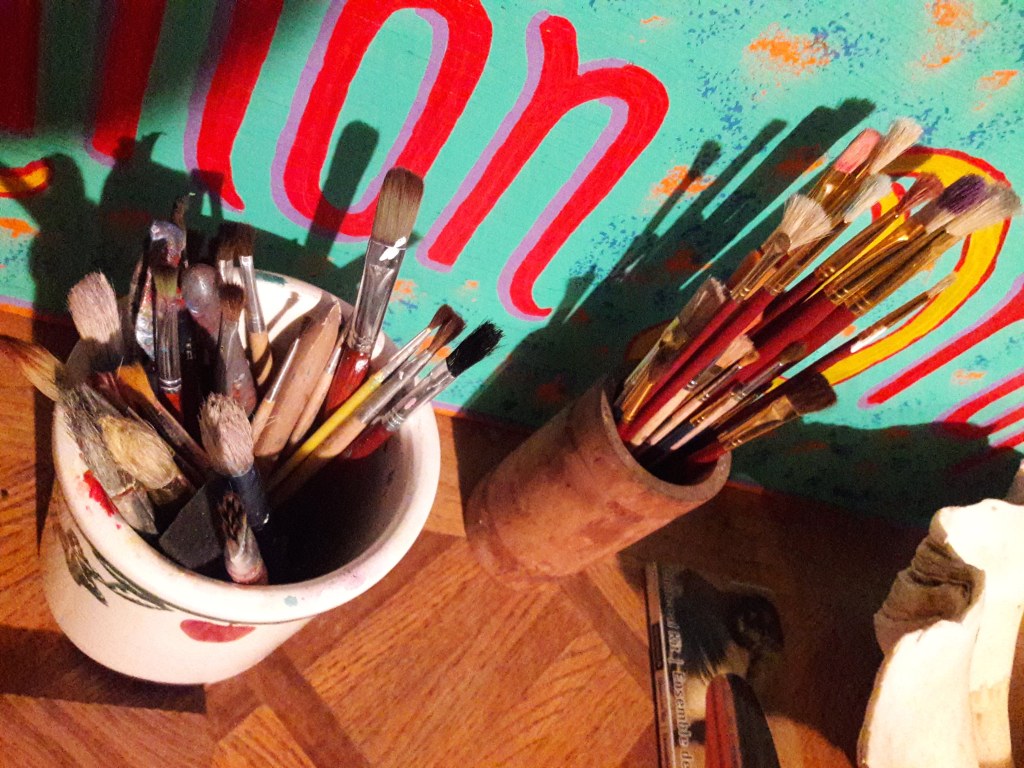
    Paint brushes with ferrules.
  • On Goodreads

    Books. Shelved books. Backs to the world. Musty, dusty, pages that crackle when opened. Do I want to live in a library, surrounded by a labyrinth of shelves of my own making, impossible to find my way out, the books aging and shrinking as things alive, spine colors fading, hairlines receding, skins foxing, books sleeping in their den?

    On-line, books do not sleep. And why not clear the house of the fossilizing, dusty creatures? In 1996, the San Francisco Library started a grand plan to replace its paper books with the new fandangled electronic stuff:

    “In an apparent attempt at secrecy, Dowlin arranged for 200,000 more books to be completely discarded: Over nine months and despite protests and even outright sabotage by the library staff, San Francisco Department of Public Works dump trucks carted away these books to landfills.”

    From Baker, Nicholson. ‘The Author vs. The Librarian,’ The New Yorker 72 (Oct. 14, 1996): 50-62 and Basbanes, Nicholas, Patience and Fortitude. New York: Random House, 2001.

    Organizing, shelving, cataloging books, building cradles, bookcases, shelves to hold them, often an enjoyable if obsessive evening’s occupation. Borges, from “The Library of Babel”:

    “The universe (which others call the Library) is composed of an indefinite and perhaps infinite number of hexagonal galleries, with vast air shafts between, surrounded by very low railings….Twenty shelves, five long shelves per side, cover all the sides except two; their height, which is the distance from floor to ceiling, scarcely exceeds that of a normal bookcase. One of the free sides leads to a narrow hallway which opens onto another gallery, identical to the first and to all the rest.

    “The Library of Babel,” from Labyrinths, Selected Stories & Other Writings, by Jorge Louis Borges, A New Directions Paperbook – NDP186, 1964, p. 51.

    I recently joined Goodreads. No, that isn’t stop the press headline news. I wanted to catalog my library. I tried Libib, but always wondering what I was missing without the “Upgrade,” left for Library Thing, maybe too frantic for a library, but I’m still working with Thing. Finding books on Goodreads is both easy and difficult. Easy to find any book, or any version of the book you might be looking for, difficult, at times, to find an exact match (of the many versions often shown) to the book you have in hand. Still, not a big deal, unless you obsessively want or need to ensure every brick in the wall of your collection is designed in color coded Flemish brickwork, in which case you want your books on course.

    Perusing the various versions though can be a pleasure. Discovering, for example, the bright yellow banana on the cover of an e-book version of Beckett’s “Krapp’s Last Tape.” And pulling books I’ve not looked at for some time from the home shelves, I’ve a chance to reconsider what a particular book has meant to my reading life. Not that I’m a constant reader, one who is going to post hundreds of reviews weekly to Goodreads. Egads! I’m still gobsmacked to see readers doing that. And I think I’m a slow reader, though I’ve never ran a reading marathon – would probably finish somewhere in the middle of the pack.

    Not too long ago, at around 4,000 books in my library, I decided to winnow the bunch down to those books I feel a special affinity for, usually gained from my predicament when first acquired and read. I now have about 1,500 books, and I thought I might use Goodreads to catalog some of those with brief notes and comments, beginning with collections of my favorite authors. Not that any book is not important. To have read even a single book in one’s life is noteworthy. To have discovered a writer and read all their books is to become a fan of literature – without which a writer’s books fade away. And when you pull an old book away from its crusty place, you might find it crystallized like an old bottle of honey lost high on a pantry shelf. But you can warm it up and it’ll come back to flowing.

    On second thought, maybe I’ll just go for a walk.

  • Notes on Percival Everett’s “James”

    In Percival Everett’s “James,” we read Mark Twain’s “Adventures of Huckleberry Finn” overdubbed with newly invented first person narration by Twain’s character Jim, who becomes the protagonist, changing his name to James – “Just James,” he introduces himself at the end, when asked what his last name is. Or maybe, in Everett’s telling, James is his last name, and his first name is Just.

    Huck becomes a secondary main character, a deuteragonist. “James” is not the first book to take a foil character from another book and reverse foils. Mark Twain did it himself when Huck, who first appears in “The Adventures of Tom Sawyer,” becomes the narrator of his own story. The full title of Huck’s work is “Adventures of Huckleberry Finn (Tom Sawyer’s Comrade).”

    The antagonist remains the same as in the Mark Twain book James comes from: slavery in the US mid 19th Century – or more specifically, slave traders or sellers, owners, and others benefiting or attempting to leverage for some advantage from the arrangement. In one of many ironic ideas in “James,” James and his friend Norman come up with a plan: sell James, James escapes, sell James again, repeat again and again as they move north – the idea first suggested to James by the Duke of Duke and Dauphin infame, here presented as far more evil than in Twain. They are brought nearby, and the slapstick is not funny. The early chapters of Everett’s book more closely follow Twain’s narrative than the later chapters, where we find new adventures of James and his reflections on what’s happening to him, why, and what can he possibly do about it as the book spirals into fantastical end chase scenes.

    But Everett might have left James without a surname to underscore the existential adventure James embarks upon when he decides to leave his wife and child when he hears of his owner’s intent to sell him downriver; if sold he fears he’ll be separated from his family never to see his wife or child again. But to be without a surname is to be free from predispositions, assumptions, or any kind of argument about who you are or might be, where you come from or where you might be going. Language is a primary theme of “James,” as is writing and reading, and to give names to people, places, things, is to establish their reality, particularly if named via writing:

    My name is James. I wish I could tell my story with a sense of history as much as industry. I was sold when I was born and then sold again. My mother’s mother was from someplace on the continent of Africa, I had been told or perhaps simply assumed. I cannot claim to any knowledge of that world or those people, whether my people were kings or beggars. I admire those who, at five years of age, like Venture Smith, can remember the clans of their ancestors, their names and the movements of their families through the wrinkles, trenches and chasms of the slave trade. I can tell you that I am a man who is cognizant of his world, a man who has a family, who loves a family, who has been torn from his family, a man who can read and write, a man who will not let his story be self-related, but self-written.

    With my pencil, I wrote myself into being. I wrote myself to here.”

    Percival Everett, “James,” Doubleday, 2024, p. 93 (italics in original).

    What does James mean by “self-related,” and what does it mean to be “self-written“? And how do the two terms differ? He doesn’t mention self-published, or any kind of publishing, and how he might have to rewrite, edit, embellish his story to get it published. But he seems to feel it is published as soon as he writes it down. Self-written. “Adventures of Huckleberry Finn” begins differently. We’re six paragraphs in before we learn Huck’s name, which we get indirectly, from the Widow Douglas. Huck begins by telling us we don’t know about him unless we’ve read “Tom Sawyer,” which contains some lies, Huck says, which doesn’t matter, everyone lies, he says. James presumably will not lie, not to his reader.

    To be a writer is to make choices, to string together those choices. The above quote, from page 93 of “James,” is a rewrite of an earlier draft:

    Then I wrote my first words. I wanted to be certain that they were mine and not some I had read from a book in the judge’s library. I wrote:

    I am called Jim. I have yet to choose a name.
    In the religious preachings of my white captors I am a victim of the Curse of Ham. The white so-called masters cannot embrace their cruelty and greed, but must look to that lying Dominican friar for religious justification. But I will not let this condition define me. I will not let myself, my mind, drown in fear and outrage. I will be outraged as a matter of course. But my interest is in how these marks that I am scratching on this page can mean anything at all. If they have meaning, then life can have meaning, then I can have meaning.”

    p. 55.

    Huck is not much given to such reflections in his book. That’s not why he writes. Maybe he’s too young yet. Why does he write? He simply jumps in and rambles on, telling of things as they happen, his eye for detail and ear for dialog both as acute as an owl’s. He doesn’t recognize or reveal his indebtedness to his creator, but he does mention him:

    “That book [Tom Sawyer] was made by Mark Twain, and he told the truth, mainly.”

    Huck has no need to lie to his reader. He’s enough to relate without lying.

    James’s use of the term self-related could be a reference to the autobiography of Venture Smith, mentioned above in the quote from “James” page 93. Smith’s self-account begins as follows:

    “The following account of the life of VENTURE, is a relation of simple facts, in which nothing is in substance to what he relates himself. Many other interesting and curious passages of his life might have been inserted, but on account of the bulk to which they must necessarily have swelled this narrative, they were omitted. If any should suspect the truth of what is here related, they are referred to people now living who are acquainted with most of the facts mentioned in this narrative.

    The reader is here presented with an account, not of a renowned politician or warrior, but of an untutored African slave, brought into this Christian country at eight years of age, wholly destitute of all education but what he received in common with other domesticated animals, enjoying no advantages that could lead him to suppose himself superior to the beasts, his fellow servants. And if he shall enjoy no other advantage from perusing this narrative, he may experience those sensations of shame and indignation, that will prove him to be not wholly destitute of every noble and generous feeling.

    The subject of the following pages, had he received only a common education, might have been a man of high respectability and usefulness; and had his education been suited to his genius, he might have been an ornament and an honor to human nature. It may perhaps, not be unpleasing to see the efforts of a great mind wholly uncultivated, enfeebled and depressed by slavery, and struggling under every disadvantage. The reader may here see a Franklin and a Washington, in a state of nature, or rather, in a state of slavery. Destitute as he is of all education, he still exhibits striking traces of native ingenuity and good sense.

    This narrative exhibits a pattern of honesty, prudence, and industry, to people of his own colour; and perhaps some white people would not find themselves degraded by imitating such an example.

    The following account is published in compliance with the earnest desire of the subject of it, and likewise a number of respectable persons who are acquainted with him.”

    The Project Gutenberg eBook, A Narrative of the Life and Adventures of Venture, a Native of Africa, But Resident above Sixty Years in the United States of America, Related by Himself, by Venture Smith.

    That is not like the book Percival Everett is helping James to write. In any case, self-related might also refer to concepts or ideas of the self discussed by Kierkegaard. Percival Everett gives his reader homework assignments. James in dream reveries has discussions with Voltaire and Locke. Does the common reader simply gloss over these references? Google them? Do they provide argument for James’s own conclusions and rebuttals regarding economics, ethics, slavery? Are they meant to explain the behavior of Judge Thatcher, who presumably has read these same writers (James gets the books from the judge’s library)?

    “Kierkegaard does not think of the human self predominantly as a kind of metaphysical substance, but rather more like an achievement, a goal to strive for. To be sure, humans are substances of a sort; they exist in the world, as do physical objects. However, what is distinctive about human selves is that the self must become what it is to become, human selves playing an active role in the process by which they come to define themselves.”

    Soren Kierkegaard. 2. Kierkegaard’s Analysis of Human Existence: Despair, Social Critique, and Anxiety. Retrieved 7 Apr 24. Lippitt, John and C. Stephen Evans, “Søren Kierkegaard”, The Stanford Encyclopedia of Philosophy (Summer 2023 Edition), Edward N. Zalta & Uri Nodelman (eds.), URL = <https://plato.stanford.edu/archives/sum2023/entries/kierkegaard/&gt;.

    Language is the great theme of Percival Everett’s book. It’s about writing, what to write about and how. It’s about how people talk, often adopting or adapting a style they might think is suitable to their audience – or what they think their audience might want to hear. Language is marketing. Even when talking to ourselves, we might often feel like we’re selling something, or being sold something. The rhetorical flourishes in “James” both stir the emotions and logically persuade; and who can argue with James’s first hand ethos reliable and credible experience? James is a statement, a claim, to which there can be no rebuttal. His backing is impervious. Percival seems to want to write (as James does) something of both human affairs (history) and economic activity (industry). When James kidnaps Judge Thatcher, the judge asks James three times over the course of several pages, “Why are you talking like that?” – referencing James speaking out of the expected slave-speak language and instead using the judge’s own language. The judge can’t get over it, can’t understand, is utterly confused by James’s ability to speak out of (what the judge believes to be) character. James’s rhetorical skills mean, for one thing, the judge’s view of James has been and remains wrong. The foundation of his excuse for slavery is undermined, and he caves in on himself, though he keeps acting like a judge. In terms of the dual language scenario Everett has created, the judge might just as well be suddenly talking to an alien. He is talking to an alien.

    While language is the great theme of “James,” the pencil is the great symbol. James at one point thinks he’ll adopt the last name of FABER, it being stamped on the stub he’s using:

    “I studied the small stick that had cost so much. I had no way of knowing whether Young George’s beating had stopped short of his death. I knew I owed it to him to write something important. The pencil lead was soft and made a dark mark. I resolved to use it with a light touch to have it last as long as possible. Stamped on it was the name FABER. Perhaps that would be my last name. James Faber. That didn’t sound too bad.”

    p. 102.

    Did Percival Everett consider putting the name THOREAU on the pencil, after Henry David Thoreau’s father’s pencil making company, where Henry worked a good part of his life? The pencil appears again and again during James’s journey, almost always at a cost incommensurate with its size and weight and feel. If symbol, what does the pencil stand for? If you’re going to write, as James wants to, you need an implement, and paper, which James also acquires though not quite at the same cost as the pencil. The pencil is a tool. We would probably discard without thinking twice a pencil already whittled down to the stub size of the one James holds on to almost to the end. The feel of the pencil in his pocket gives him comfort, he says. Later, he notes the pencil has “survived.” Others have not.

    But note how quickly James seems to move from the sacrifice of Young George for the pencil to thinking some more about choosing his name. James has the ego of a writer. Huck had a story to tell, but he had no aspirations of becoming a writer. Ironically, Huck has no use for books, in Twain or in Everett. Can books make you good? Is reading sublime? Is James a good man or a good character or both or neither, or does that matter? He wants out of his birth predicament. What he wants is not arcane: he wants to live in peace and independence and freedom with his family. Notably not included in Everett’s version is the scene in “Adventures of Huckleberry Finn” where Jim scolds his daughter for leaving a door open, asks her to close it, and when she ignores him, he hits her, only to discover she can’t hear. She didn’t hear him telling her to close the door. Twain’s Jim feels the remorse of pathos, and we feel it too as he recalls the event to Huck. Would a similar scene, if included in “James,” come before or after the “Papa, Papa, Papa,” that comes at the end of Everett’s chase? Writers make choices because they have choices. That’s the reason James wants to become a writer. Slavery can’t prevent James from writing.

    “James” is full of sarcasm, wit, irony, satire – but it’s not humor as Twain wrote humor. For example, at the end of “James,” Graham, the evil owner of a slave breeding plantation, upon being rousted out of his house to find his cornfield ablaze and his slaves in revolt and escaping, his overseer dead on the ground, James’s gun in his face, says, “What in tarnation?” Really? Tarnation? Isn’t that a clown’s word, an alteration, euphemism, for damnation? Is tarnation what Graham would have said? But it was a word used circa 1850’s, as indicated by Google’s Ngram analysis:

    Use over time for: tarnation

    And, note, tarnation is making a resurgence.

    Or does Percival have Graham say tarnation to mock him before James shoots and kills him? Is its use in “James” intended as humor? Graham has no idea, as Judge Thatcher did not, not clue one, of what’s happening. Tarnation, indeed.

    I stepped in front of him.
    “Who the hell are you?”
    I pointed my pistol at him. “I am the angel of death, come to offer sweet justice in the night,” I said. “I am a sign. I am your future. I am James.” I pulled back the hammer on my pistol.
    “What in tarnation?” He cocked his weapon.

    p. 302.

    Maybe it’s farce? A pun? It’s a mixture. Depends on how you hear it, not necessarily on how it’s said – not necessarily the same as how it’s said. But James (the word, Biblical) means supplanter. While James professes no interest in the God of his oppressors, he clearly knows the Bible.

  • On Television

    They might be called Smart TVs for their clever capability to befuddle the old fashioned viewer. Long ago and far away are the days you walked up to the television set, turned a knob to On, turned the other knob to Channel 2, 4, 6, or 10, TV Guide in hand, reached over the set to fidget a bit with the rabbit ears antennae, and slid back to the couch to watch a recorded picture version of what your parents when young had listened to on live radio.

    Television has grown, if not matured; still, we haven’t quite reached the television walls Ray Bradbury predicted in “Fahrenheit 451,” where the entire wall is a television, and keeping up with the Joneses means adding additional TV walls until your room is entirely enclosed in TV, the effect being that you are part of the television show you are watching. But the new virtual reality headsets are probably skipping over Bradbury’s wall sets.

    One advantage of old television was that at the end of the broadcast day, TV rested – it went off, off the air. A sign off screen appeared. The station transmitters shut down, the Star-Spangled Banner played (absurdly, no game following), then a test pattern with a shrill hum signal, a high E organ note. Nothing more to watch. Midnight. You either went to bed or read a book. Or went out walking, nothing on television.

    Not that it matters what’s on television. Whether you’re watching “Masterpiece Theatre” or “All in the Family,” the “Red Skelton Show” or the “Andy Griffith Show,” “The Colgate Comedy Hour” or “Arthur Godfrey and His Friends,” you have to fill in the dots. Television is a DIY proposition.

    “The structural qualities of the print and woodcut obtain, also, in the cartoon, all of which share a participational and do-it-yourself character that pervades a wide variety of media experiences today. The print is clue to the comic cartoon, just as the cartoon is clue to understanding the TV image.”

    Marshall McLuhan, Understanding Media, 1964, p. 151, Signet Mentor
  • The Best of the Toads

    The gravity of social media at times it seems profoundly influences our every move. By gravity I mean that mutual attraction force that pulls us under and down, down rabbit holes, sink holes, the vortex created by following. By social media I mean to refer here to the sites that are for the most part vertically inclined, up and down, the newest appearing at the top, the oldest nudged down to an endless bottom where they are forgotten relics or remaindered in the fossil record. These social media sites are not formatted as mosaics, like newspapers, but like scrolls – though scrolls, even the most ancient, were often formatted horizontally as well as vertically. And the newspaper could be taken apart and shared: “Who has the funnies?” By profoundly I mean the unlimited hours an addiction to social media at any site soaks up the dark energy of our otherwise beachcombing days.

    There are the followers and the following, not always the same, and often as not unknown to one another. How many and how often seen or read? And there’s the rub. I’ve been working on a formula. What number of followers or following beyond which to say one is actually following in any meaningful sense of seeing and responding to even if only to think about without comment or response – beyond which any significant number of posts, tweets, pics, etc., is no longer possible?

    In other words, for example, the Instagramer I might follow who posts daily several pics multiplied by 100 other Instagramers I also follow equals hours of staring at Instagram until I can no longer honestly say I’m following all the number of individuals my account accounts for. Something like that. I could say, attending a live football game in the huge arena where sit 80,000 fans, that I’m following them all. Likewise, the social media follower who says they are following me back but who also follows say 5,000 others can’t possibly be paying much attention to me. Thus Instagram, recognizing we’ve a problem here, initiates a feature like close friends. Close friends, good neighbors, faithful followers, on the same team, family (though of course this latter often may come fraught with unfollowing in biblical proportions).

    What has all this to do with “The Best of the Toads”? Just this: Here too the posts have been falling, a long way down, since my first post in December of 2007, and at least monthly since. There are now 1,463 posts. Where did they all go? And which ones might a reader most enjoy, find interesting, not to mention well written? The latest post is not necessarily the best.

    So, I’ve made a Best of the Toads page, that visitors to the blog might be able at a glance to view the most successful posts since the beginning of the blog in 2007, successful as defined by number of views, but also including some posts that are my favorites no matter the number of views. You can view the new page here, or click on it in the blog menu. Happy falling!