Category: Reading

  • A word of one’s own

    Comfortably ensconced in our reading lair, hidden behind the arras of the Dec. 8 New Yorker, perusing the cartoons, time passing easily, and find our Eric has been at work on his French, annotating the Mankoff cartoon caption “A la Recherche des Cheveux Perdus” (p. 68) with the translation “Remember Hair Lost.”

    What is past is lost, but still we recall – writing is a lure; reading, a way of walking.

    Menand, Jan. 5: “Feiffer’s strips are about borrowed ways of talking, about the lack of fit between people and words, about the way that clichés take over” (p. 43).

    Blake: “No bird soars too high, if he soars with his own wings” (The Marriage of Heaven and Hell, “Proverbs of Hell”).

    Nabokov: “…minor readers like to recognize their own ideas in a pleasing disguise” (Lectures on Literature, “Good Writers and Good Readers,” p. 2).

    In Nabokov’s teaching copies, his annotations include his own translations; in his copy of  “The Metamorphosis,” for example, he substitutes the Muirs’s “uneasy dreams” with “a troubled dream,” and “a gigantic insect” with “a monstrous insect” (p. 250). Monstrous means marvelous and strange, and Nabokov starts his students off with a different view of Gregor, beginning with Kafka’s first sentence.

    Woody Allen: “Honey, there’s a spider in your bathroom the size of a Buick” (Annie Hall).

    For Nabokov, reading meant rereading in excruciating detail, never straying from the text, bringing to exact light and color the watermarks of the text, like working a coloring book.

    As for the uneasy, or troubled, dreams, Kafka reveals in the second paragraph that “It was no dream.”

    But one’s own words? Where does one find them? Sometimes a word of one’s own seems no more possible than a room of one’s own. For some answers, we might turn again to E. B. White’s Elements of Style, where we are warned to “Write in a way that comes naturally”; “Avoid fancy words”; and “Avoid foreign languages” (Chapter V).

    As for using words of one’s own to find lost time, Nabokov says: “…to recreate the past something other than the operation of memory must happen: there must be a combination of a present sensation (especially taste, smell, touch, sound) with a recollection, a remembrance, of the sensuous past” (p. 249). It took Proust 1.5 million words to illustrate that we are “…not free…to choose memories from the past for scrutiny” (Nabokov, p. 248).

  • Walt Whitman and a Letter of Ourself

    letter-of-11-dec-19691

    Thirty-nine years ago this month, I sat on a bunk in a barracks in Fort Bliss, Texas, writing letters. This week, one came back. I wrote dozens of letters during my stay at Fort Bliss; alas, all are lost – to time’s sometimes worrisome and weary but always wealthy passing and tossing. But no, wait, here’s one returned, to tell a tale.

    The letter came wrapped in a Christmas card sent by my oldest niece, whose mother, my oldest sister, passed away a few years ago. “I’m going through boxes of pictures, albums and letters & cards of my parents,” my niece wrote, “and thought it would be fun to return to the sender.”

    Today’s Fort Bliss soldiers are no doubt writing emails home. The Internet intoxicates, and perhaps the future return of an email forty years old will be as remarkable as the forgotten letter is now. But later today I’ll walk down to the Bipartisan Café and sit at a window and write some letters, on paper, with pen and ink.

    Walt Whitman said, in “Song of Myself,”

    Houses and rooms are full of perfumes….the shelves are crowded with perfumes,

    I breathe the fragrance myself, and know it and like it,

    The distillation would intoxicate me also, but I shall not let it.

    It’s difficult to think of Whitman composing Leaves of Grass on his computer. We can save emails with a click, without much thought or sentiment, but saving letters requires something more, a deeper commitment, perhaps, a foreshadowing of snow and love, of blank beaches and empty waves.

  • Our 2008 Believer Book Award Choices

    believer-postcard-blankThe 2008 Believer Book Award Reader Survey postcard came this year in the Fifty-Eighth issue: “Aroma Prom,” an art issue (including a somewhat cantankerous interview with Frank Stella; an engaging interview with cartoonist Keith Knight; Weschler interesting on Hockney and Irwin; very much enjoyed the “This is Corporate America” article).

    Our postcard choices this year (following the postcard instructions to name “three works of fiction, each published in 2008, to be the finest of the year. By ‘finest’ I mean the most affecting and the best-written”) are as follows:

    The City and the Mountains by Eca de Queiros: A break from high tech city wealth of 1895 to the mountains of Portugal.

    On A Day Like This by Peter Stamm: A sense of self-impending doom that begins and ends in the enormity of the ordinary.

    A Fraction of the Whole by Steve Toltz: The numerator is 530.

    sailboat-face

    We have this year again added a bit of drawing to the poor featureless face of the mid-60’s student on the cover of the postcard (this year, using acrylic paints, giving her a sailboat face).

  • Reading Roland Barthes’s Writing Degree Zero on Line 15

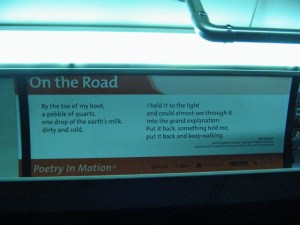
    What would Roland Barthes have said about the snippets of poetry published among the ad displays, public service announcements, and caution notes headlining the interior of local bus Line 15?

    The poetry placards please riders through a program called, somewhat fancifully, Poetry in Motion, though the poems move relative only to someone off the bus. For the rider/reader, the poems move at the same speed as everything else on the bus, with the exception of the rider just boarding, stumbling down the aisle in the opposite direction of the bus lurching forward. It’s a good idea to wait until seated before trying to read the poetry. In any case, why not call the poems, simply, “Bus Poems”?   

    But what’s remarkable is the number of riders and therefore potential readers of the poetry, “reaching an estimated 15 million daily [countrywide],” according to the Tri-Met site. Poetry never had it so good.

    Readers may be reminded of Johnny Tillotson’s 1961 hit song “Poetry in Motion.” The refrain of Tillotson’s song seems particularly apt to the riders on Line 15: “…For all the world to see.

    a-woe woe woe woe woe woe.” Find out more about Poetry in Motion at the Poetry Society, or at the Tri-Met site: Selections for 2007, or check out the British original Poems on the Underground, including Autumn/Winter 2008 selections, which celebrate the 1918 Armistice.

    A random search adds to the randomness of the entire enterprise with this from Charles Bukowski, the bard of beer, on poetry and motion– locomotively, as Bukowski is seen displaying his full critical license (not for the poetically squeamish). We’ve not seen any Bukowski poems on the bus – though there are times on the bus when we feel we are in his company.

    Which brings us back to Barthes, who found deconstructing poetry difficult, since the pieces already cover the floor in various stages of disassembly: “…what is attempted [in modern poetry] is to eliminate the intention to establish relationships and to produce instead an explosion of words…since…modern poetry…destroys the spontaneously functional nature of language, and leaves standing only its lexical basis” (p. 46). This sounds like a bus ride. “The Hunger of the Word, common to the whole of modern poetry, makes poetic speech terrible and inhuman. It initiates a discourse full of gaps and full of lights, filled with absences and over-nourishing signs, without foresight or stability of intention, and thereby so opposed to the social function of language…” (p. 48). “…modern poetry destroyed relationships in language and reduced discourse to words as static things” (p. 49). Maybe that’s why they decided to put some on the buses.

    The audience on the Line 15 bus shifts slightly at every stop, and every bus ride is already a poem in motion, riders hopping on, hopping off, each a word, or a line, some a full verse, the bus curtsying occasionally, its caution bell bleeping, as it leans down to pick up a rider unable to hop, poems and riders waiting patiently motionless, the big scurrilous bus a measure of notes transpiring.

    "On the Road," a Bus Poem by Ted Kooser on Line 15
    “On the Road,” a Bus Poem by Ted Kooser on Line 15
  • Gaston Bachelard’s book as shell

    In Gaston Bachelard’s the Poetics of Space, a philosophical study of the spaces we inhabit, open, and close, our houses, chests, nests, and more, in the chapter titled “Shells,” we find this quote from Gaston Puel:

    “This morning I shall tell the simple happiness of a man
    stretched out in the hollow of a boat.
    The oblong shell of a skiff has closed over him.
    He is sleeping. An almond. The boat, like a bed, espouses sleep.”

    But we are reminded of Hamlet’s “Oh, God, I could be bounded in a nutshell and count myself a king of infinite space were it not that I have bad dreams” (Act II, sc. ii).

    Reflecting on the “capacity of shells” to both protect and trap, Bachelard arrives at a “suitable moral” to the habits of the inhabitants of shells, found in da Vinci’s Notebooks: “Like the mouth that, in telling its secret, places itself at the mercy of an indiscreet listener.”

    Hamlet, in the space and bad dreams line, is talking to Rosencrantz and Guildenstern, a pair of hermit crabs, old friends “sent for” by the king to sneak into and inhabit Hamlet’s shell, but it will not be easy to crack the nut of Hamlet’s loneliness.

  • Harold Bloom’s How to Read and Why

    Harold Bloom prefers his literature neat, and not served with a twist. Adverse to literary criticism that substitutes a doctrinaire reading for the actual text, Bloom’s approach to reading is summed up in his epigraph, from the Wallace Stevens poem “The House was Quiet and the World was Calm”: “The reader became the book; and summer night / Was like the conscious being of the book.” 

    Bloom’s book on reading consists of a short introduction, which sets the stage for the kind of reading he prefers, followed by sections devoted to short stories, poems, novels, plays, more novels, and an epilogue.

    Bloom’s favorite writers are Shakespeare and Samuel Johnson. But it’s Francis Bacon who provides the prose equivalent for Stevens’s poem: “Read not to contradict and confute, nor to believe and take for granted, nor to find talk and discourse, but to weigh and consider.”

    Bloom augments Bacon: “I urge you to find what truly comes near to you, that can be used for weighing and for considering. Read deeply, not to believe, not to accept, not to contradict, but to learn to share in that one nature that writes and reads.”

    Bloom hopes to inspire an “authentic reader.” Yet, “It is not the function of reading to cheer us up, or to console us prematurely.” 

    “You are more than an ideology,” Bloom says.

    “Chekhov and Beckett were the kindest human beings,” Bloom says. Reading Bloom, here and elsewhere, one wants to add his name to the list of the kindest readers, writers, and teachers.

    Bloom, H. (2000). How to read and why. New York: Scribner.

  • Annie Dillard’s The Writing Life

    Maybe Higgins wanting to read aloud is explained by Annie Dillard’s claim that “The written word is weak” (p. 17). Yet for Dillard writing is a trade, like carpentry, or plumbing, hard work. The writer is a day laborer, digging a ditch, head down, not looking at anything, the ditch caving in, dirt falling back in with every shovelful pulled out. Dillard’s book is more lyrical than the books on writing by Higgins and Stegner, figurative, full of metaphorical explanations. But she affirms that writing is hard work. Here’s an example that illustrates how hard, in her figurative style: “Half naked, with your two bare hands, you hold and fight a sentence’s head while its tail tries to knock you over” (p. 75).

    “Writing is hard, even for authors who do it all the time,” Roger Angell tells us in the foreword to the fourth edition of The Elements of Style, the E. B. White classic. Stegner politely offered that writing is hard work; Higgins gave the sentiment a powerful place in his book. 

    And Annie Dillard agrees: “It takes years to write a book – between two and ten years” (p. 13). She points out a few exceptions, Faulkner’s As I Lay Dying: “…in six weeks; he claimed he knocked it off in his spare time from a twelve-hour-a-day job performing manual labor” (p. 13). We get the point; Faulkner embodied the idea of the exception. But like Higgins, Annie doesn’t want us paddling out short of wax, so she repeats and clarifies: “Writing a book, full time, takes between two and ten years…On plenty of days the writer can write three or four pages, and on plenty of other days he concludes he must throw them away” (p. 14).

    But hard how? “Appealing workplaces are to be avoided. One wants a room with no view, so imagination can meet memory in the dark” (p. 26). We see Annie in some of her writing hideaways, and while the locations look like vacation spots, she convinces us that writing is hard mainly because of the isolation, the solitude, the boring act of sitting. “I write this in the most recent of my many studies – a pine shed on Cape Cod. The pine lumber is unfinished inside the study…” an 8 by 10 shed, “Like a plane’s cockpit…” (p. 25). The plane motif introduced here foreshadows the last chapter, devoted to a stunt flying ace Annie met and went up with but who later crashes – and flying solo in a small plane performing tricks above the heads of an audience becomes an extended metaphor for writing. Then she’s in another cabin, this time on Haro Strait, in Puget Sound, where “The cabin was a single small room near the water” (p. 41). 

    In fact, “It should surprise no one that the life of the writer – such as it is – is colorless to the point of sensory deprivation. Many writers do little else but sit in small rooms recalling the real world” (p. 44). No doubt, yet it’s still somehow difficult to square this writing is hard, lonely work business with “During some of the long, empty months at work on the book, I was living in a one-room log cabin on an empty beach” (48). Add a little sun and a few waves and what’s the problem? Of course, we wouldn’t get much writing down.  

    Dillard knew “a joyful painter” who became a painter because “He said, ‘I liked the smell of the paint’” (p. 70). It’s apparently not as easy to like the smell of sentences, and this also makes writing hard work: “…I said I hated to write. I said I would rather do anything else” (p. 53). But, “It is no less difficult to write sentences in a recipe than sentences in Moby-Dick. So you might as well write Moby-Dick” (p. 71). 

    Dillard, A. (1989). The writing life. New York: Harper & Row. (111 pages)

  • George V. Higgins’s On Writing

    Unlike Stegner’s, Higgins’s On Writing is unexpected, full of convoluted sentences (the kind lawyers reputedly cast) and five dollar vocabulary. Higgins values readers, but they are a dime a dozen, and critics, penny each, and, as it turns out, editors are the true friends of Eddie Coyle.

    Higgins emphasizes repeatedly what he considers his most sage advice for writers: “…read good prose aloud” (p. 8), and, to stick the point in your gut, inserts samples of some of his favorite writers, in some cases entire stories, and asks you to read them aloud. So you get to read, interspersed throughout the chapters, the prose of Dickens, Hemingway, Gay Talese, William Manchester, Irwin Shaw, John O’Hara, James Thurber. Then Higgins explains how their writing works, from a street level viewpoint, and that’s the value in this book. 

    Not a bad idea, the inserts; takes the attention off of Higgins for a spell. Higgins opens his book calling Edmund Wilson, the august critic of most of the 20th Century (see his Twenties; Thirties; Forties; Fifties; and Sixties), a professional torturer (p. 1). Speaking of torture, try this Higgins sentence on for fit: “Conformably to that presumption, this manual includes numerous selections by writers whose work I consider exemplary” (p. 9).

    Like Stegner, and others, Higgins thinks “Writing is hard work” (p. 6). In part, perhaps, that’s because you may “Never tell your reader what your story is about” (p. 82).

    George V. Higgins’s On Writing is worth reading, for its prose personality, and for how he shows how writing works. 

    Higgins, G. V. (1990). On writing: Advice for those who write to publish (or would like to). New York: Henry Holt.

  • Wallace Stegner’s On Teaching and Writing Fiction

    Picked up this Wallace Stegner book at a local used bookstore, and what a treat it turned out to be. For readers who value clarity and linear writing, humor amid serious topics, sound advice for writers, readers, and teachers, delivered with challenging claims in aphoristic style, Stegner’s your man. Published posthumously, this short book of 121 pages collects all of Stegner’s writings on writing, proportionately small compared to his total output, some pieces previously unpublished.

    So what’s he have to say?

    “It is a common misconception that an image invariably involves a figure of speech” (p. 19)…. “…comparison is a sort of judgment” (p. 20).

    “In spite of the exercise books and the negative approach of our schools, language stays alive; it is often more alive in the mouths of truck drivers than in the correct mouths of people who feel that there is a single proper or correct way to say everything” (p. 24).

    “…a playful way with language is always better than a solemn one” (p. 27).

    “The words that fit are the words to choose, and it does not matter whether they come to us from the Greeks or from a singing commercial” (p. 28).

    “Every book that anyone sets out on is a voyage of discovery that may discover nothing” (p. 34).

    “…good writing is an end in itself…” (p. 35).

    “…many people don’t know their own potential…some misread their potential…different kinds of writers display very different stigmata of gift” (p. 36).

    “Any life will provide the material for writing, if it is attended to…Any experience, looked at steadily, is likely to be strange enough for fiction or poetry” (p. 41).

    “Writers teach other writers how to see and hear” (p. 43).

    “It is fairly easy for teachers of writing to become ex-writers” (p. 51).

    “Fiction always moves toward one or another of its poles, toward drama at one end or philosophy at the other” (p. 76).

    “They [critics] tend to run in packs…we ought to have pluralist literature and pluralist literary criticism” (p. 88).

    “…reality is not fully reality until it has been fictionized” (p. 98).

    The little book closes with a short story illustrating Stegner’s values: “…I believe in fiction, not only in its do-ability but in its importance. For the writer, whose life is as often as not a mess, it can clean up a murky and littered mind as snails clean up a fish tank” (p. 97).

    Stegner, W. (2002). On teaching and writing fiction. New York: Penguin Books. Edited and with a foreword by Lynn Stegner.

  • Every day is moving day on the Internet streets

    In Love’s Body, Norman O. Brown places the origins and evolution of thought in and from the body. Everything outside the body, in the social world created by humans, is metaphor, the secondary term an externalization of the body. Brown resurrects the dead metaphors to illustrate his thesis, “The fall is into language” (p. 257). Brown worked on Love’s Body from 1958 to 1965, so there is no discussion of how the Internet might be changing our thinking.

    Gaston Bachelard, in his The Poetics of Space (1958), did for the house what Brown did for the body: “…the house is one of the greatest powers of integration for the thoughts, memories and dreams of mankind” (p. 6). “A house constitutes a body of images that give mankind proofs or illusions of stability” (p. 17).

    Bachelard, writing in the late 1950’s, does not discuss the Internet, yet says, “In this activity of poetic spatiality that goes from deep intimacy to infinite extent, united in an identical expansion, one feels grandeur welling up. As Rilke said: ‘Through every human being, unique space, intimate space, opens up to the world…’” (p. 202).

    On the Internet streets, one is essentially homeless, houseless, curiously wired yet wireless, and every day is moving day.   

    Bachelard, G. (1969). The poetics of space. (Maria Jolas, Trans.). Boston: Beacon Press. Foreword by Etienne Gilson. First published in French under the title La poetiquie de l’espace, Presses Universitaires de France, 1958.

  • Strangers to the future

    When Nicholas Carr tries to walk a straight line in the web, he’s a different kind of stranger in a strange land. Google’s goal is not to make us smart, but rich, a goal it has surpassed. What passes for smart in the land of Carr is linear and vertical, long and deep, but what is it? Here’s a clue: deep dives like War and Peace can’t be comfortably experienced on the web, where readers value clarity, conciseness, and the ability to jump around with the speed of a photon.

    Carr complains about blogging and bloggers, but his real lament may be for the adulteration of the professional writer’s medium, for the paid writer is accustomed to being compensated a spot in the box, but now has to sit in the general admission seats behind the center field fence with the blue-collar fans.

    McLuhan said each new medium fills with the content of the old (e.g. vaudeville > radio > TV), before it develops its own content, and that every technology is an extension of the senses. He thought electronic media an extension of our central nervous system; no wonder we feel wired and jittery sitting at the computer surfing the web. And we prefer our posts short, with a picture or two; for what’s a book without pictures and conversations? Go ask Alice.

    Blogs are not usually filled with essays. When they are they surely get skimmed by surfer-readers, one of Carr’s complaints; but isn’t that the way we read newspapers (mosaics) and most periodicals (mosaic-hybrid-newspapers)?

    Carr claims that internet reading distracts us from linear and deep thinking, thus making us dumb. Linearity and “deep-reading,” the ability to read in a straight line for a long time, holding one’s intellectual breath long enough to absorb the view deep down, are capabilities Carr values, but he can’t prove that without them we grow stupid. Moreover, he’s filling the new medium with old content, which can only last temporarily, according to McLuhan. 

    McLuhan, paraphrasing David Hume, said in Understanding Media: The Extensions of Man, “…there is no principle of causality in a mere sequence. That one thing follows another accounts for nothing. Nothing follows from following, except change. So the greatest of all reversals occurred with electricity, that ended sequence by making things instant” (p. 27). In choosing War and Peace to reason his claim, Carr signifies his value, for why didn’t he choose Finnegans Wake? “In other words, cubism, by giving the inside and outside, the top, bottom, back, and front and the rest, in two dimensions, drops the illusion of perspective in favor of instant sensory awareness of the whole. Cubism, by seizing on instant total awareness, suddenly announced that the medium is the message. Is it not evident that the moment that sequence yields to the simultaneous, one is in the world of the structure and of configuration? Is that not what has happened in physics as in painting, poetry, and in communication? Specialized segments of attention have shifted to total field, and we can now say, ‘The medium is the message’ quite naturally” (p. 28).

    It’s not clear that Carr wants people to think as much as he wants them to think like him, not what he thinks, necessarily, but the way he thinks. The issue in controversy asks if the internet is changing the way we think (of course it is), and then asks a question related to the quality of thinking, but a different way of thinking is not automatically a worse way of thinking. The brain adapting yet again is not proven a bad change. Carr’s argument, that internet reading is making us stupid, suggests we were smart, but there’s unfortunately inadequate evidence to support that claim also. In any event, by the time we can determine if the change was for the better or worse, it’s likely that the written word as we now enjoy it will be a relic or fossil of some earlier culture. We are all strangers to the future.