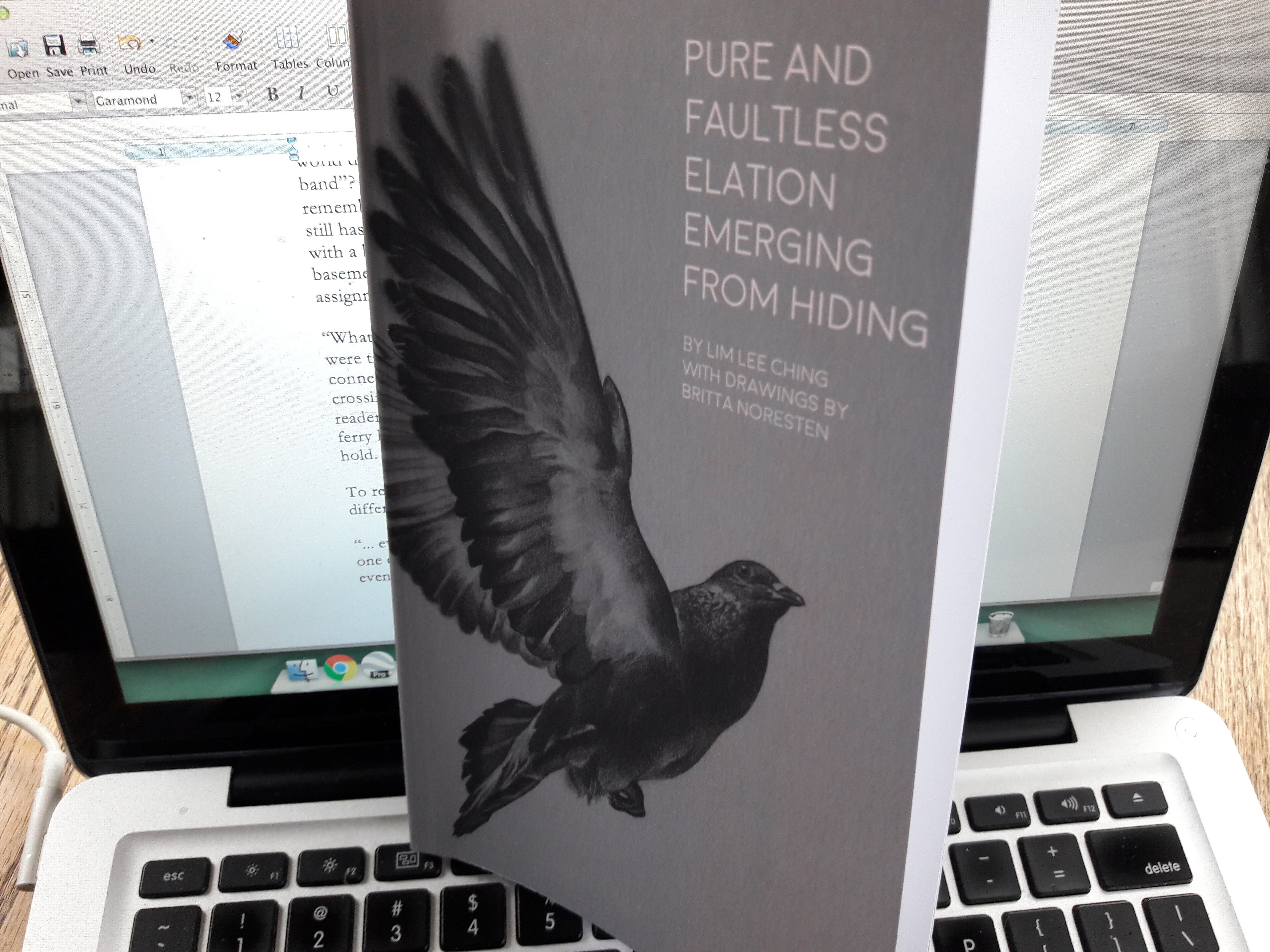
 Pure and Faultless Elation Emerging From Hiding, by Lim Lee Ching, with Drawings by Britta Noresten. Introduction by Neil Murphy and Afterword by Jeremy Fernando. Poems Sequenced by Mary Ann Lim. Layout by Yanyun Chen. Paperback edition first published 2017 by Delere Press, Singapore.
In a December, 2014 interview with Sara Lau for Obscured, Jeremy Fernando talks about his vision for Delere Press: “We didn’t see the need to have a prescribed look for all our books – we recognize that we are a small boutique press, and we are probably going to remain that way in the foreseeable future. In the end, all we want to do is to create and publish something that shows the artists and the writers’ work in the most beautiful way possible.” “Pure and Faultless Elation Emerging From Hiding” is my second experience reading with notes intended for the Toads in response to a Delere Press work. Of particular note is the press’s intent “to provide a home for text and images that may not have a home otherwise, no matter what its geographical origins.” That the press attempts to do so with hard copy, illustrated texts, choreographed by literary troupe in our digital age is remarkable.
“Pure and Faultless Elation Emerging From Hiding,” is a collaborative effort to book a collection of poems by a particular writer that becomes more than a sum of its parts. We have, maybe, become too familiar with books of hidden poetry. They line the shelves like butterflies pinned under glass. A poem does not begin like a fallen leaf pressed between pages of a book for bibliographical preservation. A poem begins as a particle, a photon, a piece of light that lands in the reader’s hands, a single note that enters the ears with a breeze, something that bugs the skin with an itch, as in, “something just bit me!” A book cannot preserve that piece of light except in fossilized memory. We may never hear that note again; it has joined the sound ocean waves make. The bug has lit, and we are left the proof of a small rash of the bed bug or lice visit. We jump into a bath of prose to escape the itching.
When I say “to book,” I mean that pinned collection of specimens organized for study. To book is to create a model to look. The helpless reader must imagine the specimen fluttering in a heat of flowers. A poem may try to evade its predators (its digital critics) by hiding in the book:
“Even as it might be chuckling, perhaps always
laughing
le rire du poeme
A laughter from elsewhere,
one that we perhaps cannot yet hear.
Much like the silence of the sirens. Always perhaps
already there,
awaiting us.”
That is from Jeremy Fernando’s “Et tu…A Prayer for Lim Lee Ching,” an afterword to “Pure and Faultless Elation Emerging from Hiding.” Other parts of Lim Lee Ching’s book of poetry include an introduction by Neil Murphy (“Lim Lee Ching: Bounded by Beauty”) and eight drawings of birds, spread throughout the book, by Britta Noresten. We are told the poems were sequenced by Mary Ann Lim and the layout composed by Yanyun Chen. All of those collaborators are called “contributors,” and they are given end-space so they too might become familiar to the reader. What becomes larger than the sum of the parts is that collaborative effort that creates emergence. What emerges is poetry from hiding, raising elation, poetry unshackled, flown like paper birds from the garret into a community, a society. Poetry is a question of community more important than mere self-expression.
“The path is not tongue-tied,” Lim Lee Ching says. The path is there and people will walk it. The invitation, the invocation, is clear. But who are these people, these walkers (readers) of the path? “That perhaps is not so much the question, but quite certainly a question,” Fernando says, and “Keeping in mind Paul Celan’s beautiful, haunting, reminder that la poesie ne s’impose plus, elle s’expose. One might even say it opens itself” (93). Opens itself to itself, it’s self-same intuitions, which are its conventions, if you need “criteria” to read by, if mere light proves insufficient. We are on a path.
When I first read “Quick Guide” (48), I thought I was to pick words from the text box on page 48 and insert them into one of the blank lines in the text on pages 49 through 51. I thought the path had come upon a Mad Lib.
“Sometimes a show can be too new for its own good” (49), I suggested to myself, my choices being “first blue dark ripe new fast.” “Mad” is a choice farther down the list, and “sad,” and “bad,” if you want to rhyme. But now I’m not so sure. All the words in the text box are one syllable. There are 78 words in the text box, and there are 60 blank spaces in the text on pages 49 through 51. This is analysis. Am I analyzing a joke here? Is this humor? Of course it is! Let’s get the reader really involved!
“It quickly becomes clear that part of the idea is to use humour to send up some of the ____________ attitudes still dominant in the art world. So, the pleasures of discipline are extolled, the players get their turn and pretentiousness gets a ____________ kicking” (50).
Poetry comes without directions, or it should. Critics may provide some directions, using a kind of rear view mirror to describe the path now behind them. The critic’s notes may prove useful maps; then again, the reader may feel just as lost.
The Poems:
Beginning with “Ode to Everman” [sic], we hear repetition and a counting (accounting of things): cadence, marching, peace and piece, music piece, measured. Every man [who has ever marched, marching in a line, in a poem, to a tune, attuned]. Circumstance, the silence of Beckett (a ringing in the ears). Military “boom time,” “armed,” “beating” (12:13).
Warren Beatty? How’s that for a surprise? Repetitions (‘One at a time”), words connected by sound: “cravat advocate” (14).
“Unloading pomposity one at a time” (14), and again “…your / Penchant for pomposity” (22). Where “Iowa” is monosyllabic: “Impossibility of authenticity” (22).
Numbers as poetic concern, things counted, measured, “Halved too far” (15).
“Cull” illustrates the poet’s task. The poet fishes, on a perch, for a perch. But who are the “armed men”? Look how quickly we can move from river to city:
“Waiting and baiting on the narrowing perch,
The centre holds them still.
A trunk, a branch – of streets and lanes,
Of skinny legs and weathered shoulders” (17).
Suggesting weathered soldiers, readers. Again, a military, a line: “Of fight, of fright, / And frenzied feeding against stained walls” (17). Desire is impotent. Who will teach that?
Then we turn the page to a drawing of a bird, not quite but almost black and white, but more, the feeling of a bird in flight, perhaps in the night, or a fog, or over a grey sea. We resist the impulse to anthropomorphize. But it’s clinging to a small branch. Building a nest? Very few birds fly solo. What a world this must be, to a bird. In any case, to cull is to pick, peck, at words.
“Only the facts remain” of Ryan White, who picked up a “Contagion.” Only our germs remain. You build yourself a bomb shelter against the fallout, but you are yourself a germ, a bug, rising, falling. So much fear. “Only the facts remain” (20). Facts survive. If we’ve lived for any length of time in a refugee camp, we have germs. If we’ve lived any length of time in a bungalow in Des Moines, we have the same germs. We are emergent, emerging – emergence, as writer merges with reader, something more. Is that pompous? Is poetry a contagion? After the poem, what remains?
“Bookmarks” is a longer poem, of which there are several in the book, prose blocks, not non-lyrical, but not lyrics. But not prose, and not blocks, scrolls. We keep to the first word of each line capitalized, giving the line that authority accustomed poetry, but the lines are not necessarily sentences, not in the usual sense:
“Only the words remain to be spoken, the writing to be sung
Of happinesses witnessed and tongues tied
In full contemplation of the idea of ideas” (24).
Who inhabits the space of an idea? “…not…king, colonel or clown, / Nor the realm of whisperers seeking to please” (24).
An idea (ideology is not ideas, Trilling said: Ideas malleable, suitable for poetry; ideology fixed). Idea of order in things (Key West shells, beaches, cocktails, dandy diamond Wallace Stevens). “Not ideas about the thing, but the thing itself,” Stevens said. No idea except in things (Williams, Paterson, Book I):
“—Say it, no ideas but in things—
nothing but the blank faces of the houses
and cylindrical trees
bent, forked by preconception and accident—
split, furrowed, creased, mottled, stained—
secret—into the body of the light!”
I’m in “Bookmarks,” and I’m reminded of Blake (where I left plenty of bookmarks), “Proverbs of Hell.” “Adagia”? Erasmus’s collection of proverbs. In any case, Lim Lee Ching says:
“The source of ignorance may well be reluctant pursuit.”
…
“The cult of stability and singular meaning
Diminishes ascendant beauty, delight and breath-hope.”
…
“Persistent therefores are fallacious,
They bind while unleashing the gateward push” (25).
Prayer, cadence, repetition. Whose tongue is tied praying, writing, reading poems? The scat of the song ruins the stutter, but the poet’s many tools are not obtrusive:
“Whispery songs of woven trances,
Of ancient wisemen oozing” (27).
Cadence as old steps (“the fragrance of remembrance”) might lead to disappointment, even depression: “Accord each a place in abjection” (27).
But isn’t time directionless? What does it matter if we are moving forward (in desire, in anxiety) or backward (in memory, in loss). For-word. Back-word. The poet spends time in a backworld, where the citizens speak backward.
“Penance is the province of princes, not poor men” (28), which brings us to T. S. Eliot:
“Here lies the awakening
Of the dispensation of an age,
Dismissing the certainty as one in many
[where]
The faces put on meet the faces within” (29).
Ideology is a “contagion.” Is poetry the antidote?
And again birds, before a song breaks the spell of the litany. Something lonely about the bird drawings. The birds are not in nature, or even in the city, but alone, each its own poem, each drawing its own poem, saying the same thing, but in different expressions. Where do we see these birds? In sky that is like a sea: grey-green; blue-grey; slate; cliff chalk white.
“Song” (34): Blake of the Songs – song, rhyme, cadence, hope, safe, heart, metaphor for what? Can the reader, too, be one of the “players of the heart”? (35).
“faithful” (37), religious or spiritual, sound but abstract images, nothing of the kitchen full of dirty dishes or the toilet in the bathroom in need of cleaning. Not Bukowski here. And I’m still hearing Blake of the Songs. Which is lovely, lyrical, song. I try to remain a faithful reader.
We’ve had our song, now the “Road Rises” as the reader falls. Mix of pop culture with “village.” The “tenderizing songs” of Elvis. And “Plastic Jesus” – the perfect image on the dashboard desires deconstruction, a theory to explain its presence, or disappearance.
Then again I’m reminded of Frank O’Hara, Kenneth Koch, but not Stevie Smith or Marianne Moore. Not a statistician. Enjoys punctuation that helps, not simply follows some rule. Writing as accretion, addition. I find something interesting, a two word form, in “Shallowbreath”: “ribboned arches…winded depths…cobbled many…meddled few…celebrated warmth…allayed smokememory…displaced upon…hounded the highroad… …warmed eyes.” We could be in London or Singapore or Dublin. Joycean, that “smokememory.”
A short, lyrical, litany ends, “And then there is you.” Do birds prepare for flight? Always at the ready, never slack, like cats, never napping in clear sight. Are birds keen to fly? “On the station platform prayer beads change hands” (57). Partnerships.
“A Gazal” (58). What gets rhymed, and why, and what gets repeated, and why? For song, for the sake of song in which we have something to keen. Poetry gives form to the broken. What is unbound cannot be broken again.
The poems seem to call on a kind of philosophical muse, hard thought. Yet that thought’s softness comes through in poetic style, the form and shapes, the lines, the breath, the flows repeated and measured. The writing seems logical, in the same way that Kafka may appear logical, or Borges, without dismissing the nonlogical. The first person is not paramount. Others are. And when I appears, it’s Meng Jiang (61). If we continue to break what is broken what do we become? Minerals? Salts?
Little poems of “love and faith” (65). What more can a reader ask for? The reader comprehends the poetry without necessarily every line understanding it.
Nijinsky appears (66). The last time I saw Nijinsky in a poem was at El Camino, around 1969. Stephen Jama passed out a poem he had written, typewriter print on colored paper. Some students got a green sheet, others a yellow, others blue or grey. Never white. “And the world dies, Adonis on its lips,” I think I recall, at the top. And Nijinsky was “dancing a band”? No, dancing I forget what. And there was a “tousled laugh.” I wish I could remember that poem. It’s lost now. I don’t think it ever made it into a book. I wonder who still has their copy. I kept mine for years, then one day without reason tossed them all, along with a box of my own stuff. I was knee deep in the red dust by then, cleaning out the basement, lost in the dust. Maybe it’s poems “belong only to the night” (67). Jama’s assignment was for us to read the poem and then to write a response. Birds in flight.
“What I have written, I have written,” Jeremy Fernando says in his afterword. Would that were true of what I have written. But what I have read, I have read. Fernando attempts to connect writer to reader: where does poetry, that space of water we seem to want to cross, a crossing, from the shore of sleep to the loading docks of day – poetry the ferry full of readers unbound from one shore, paddling for the opposite – what path leads down to the ferry launch? When the poem laughs, is it the reader laughed at? That is a cynical view many hold.
To read is to experience. Any attempt to make some other sense of that experience is a different matter:
“… every try, any trying, perhaps even trial, is not just haunted by misreadings, over-writings, one cannot even underwrite it with the certainty that reading has taken place, that one has even read” (77).


 She came from around the sun




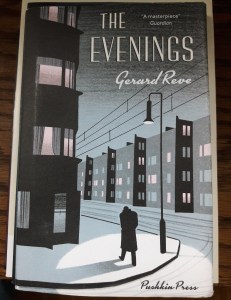 Day job workers share in common evenings. Time off, free time, leisure time, time-wasting, occupy the evenings. What to do? The question often haunts office and factory workers (workers clutching daytimer calendars are bothered by another version of the question). The evening absorbs the question of what to do like a fountain swallows wish thrown coins. The equity of time off beggars everyone. Free time hours can’t be saved, must be spent. On what?
 The Coming of the Toads