Snow and ice week beats desire, a cold game victory, the spoils spoiled despoiled as even the oils freeze on the street beneath freezing rain, snow, sleet, silver saxophone east three day blow, again with uncertainty freezing rain, then maybe greater snow, the icy home burial, the grave diacritical signal code, the skein stripe heated bellows, below freezing, icicle phase. He’s now showing kinesics of hypothermia, that fellow, up in the trees. Snow shapes blanket the trees, in the wood where wooed we Saint Valentine’s Day, nestling the soft sounds of love, the warmth of feathers. What birds want out, let them fly. Herein we stay with wise advice, waiting for Spring.
Cold, clear morning. Just below freezing. Frost riffs across roofs and grass the sun has not yet touched. The hoary, grey-silver stubble of winter blades, stiff. The skinny, rigid jogger skips by again, down the road, round and round she goes. A squirrel. No birds. Quiet. Clarity. Wind nil. Across the street on the sidewalk guy wearing black beard pulling red wagon up the hill in the wagon a child sitting holding the rails.
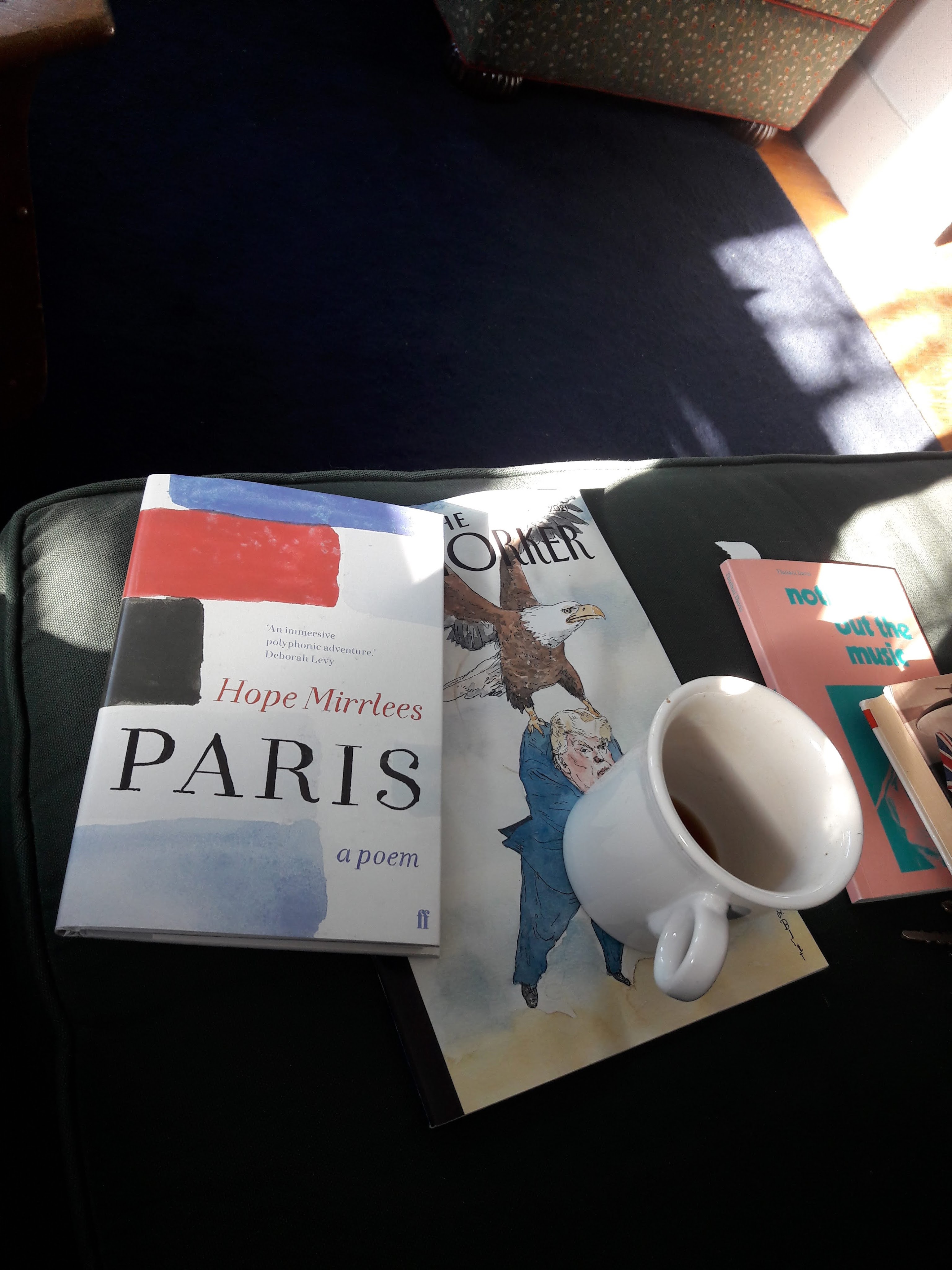
Back inside, a couple of books: “nothing but the music: Documentaries from nightclubs, dance halls & a tailor’s shop in Dakar, 1974-1992” (Thulani Davis, Blank Forms Editions, Brooklyn, 2020, but just out, pre-ordered & in snail mail about a week ago, January 2021, 63 pages); and “Paris: a poem” (Hope Mirrlees, first published in 1920 by the Hogarth Press, 175 copies, handsewn, this edition in 2020, also recently received, Bloomsbury House, London, 59 pages).
In an Afterword (long after, 100 years after), of “Paris: a poem,” Sandeep Parmar shares the setting: “Spring 1919 was quiet and cold….The weather put a dampener on the First of May demonstrations,” and she quotes from a letter, “Riots were expected but all fell flat and it was like an English Sunday – traffic stopped shops shut and nothing doing” (56-57). Sounds a bit like the morning here described above I just came from back inside to read and write. That’s not as easy as it might sound, at least not the reading part, not reading “Paris: a poem.” The poem itself runs from page 3 to page 23. The remainder of the book is Foreword (Deborah Levy), the aforementioned Afterword, and Commentary (by Julia Briggs, 2007, reworked to fit this edition), this last running from pages 25 thru 51, including Works Cited and an Addendum by Parmar. There’s also a page of notes apparently part of the first edition. For the aficionado of the obscure, this little book is a goldmine. And here I am, panning for gold:
The sun is rising, Soon les Halles will open, The sky is saffron behind the two towers of Notre-Dame (22).
The close of Parmar’s Afterword wants quoting in this little review just wanting to share what resources might be extracted:
“But it also startlingly brings to life a city lost to the past: the voice of an old nun chanting masses, American servicemen at jazz clubs, hawkers on the street, the sounds of newly opened metro trains and the glare of advertisements for exotic colonial products, the famous and nameless dead, as well as the living who have endured tragedy and survived, who must now inhabit this great metropolis side by side with those they mourn.”
(59)
Which might bring us back to today, what we began our little review with, still a cold, clear morning, now with cup of coffee, a couch, and “Paris: a poem” to carry us through to a sun low in the south noon and another early evening of thanks for the “nothing doing” of the moment. For we are doing as little as possible, still stuck in our own tragedy and attempts to survive, masked and not famous, inhabitants of this Earth, these cities, constantly renewing, so frequently we often miss what’s passing as it passes. And perhaps that’s the purpose of poetry – to still the passing for recording and reflection and renewal.
Tomorrow, or the day after, I’ll talk about the other little book recently acquired: “nothing but the music.”
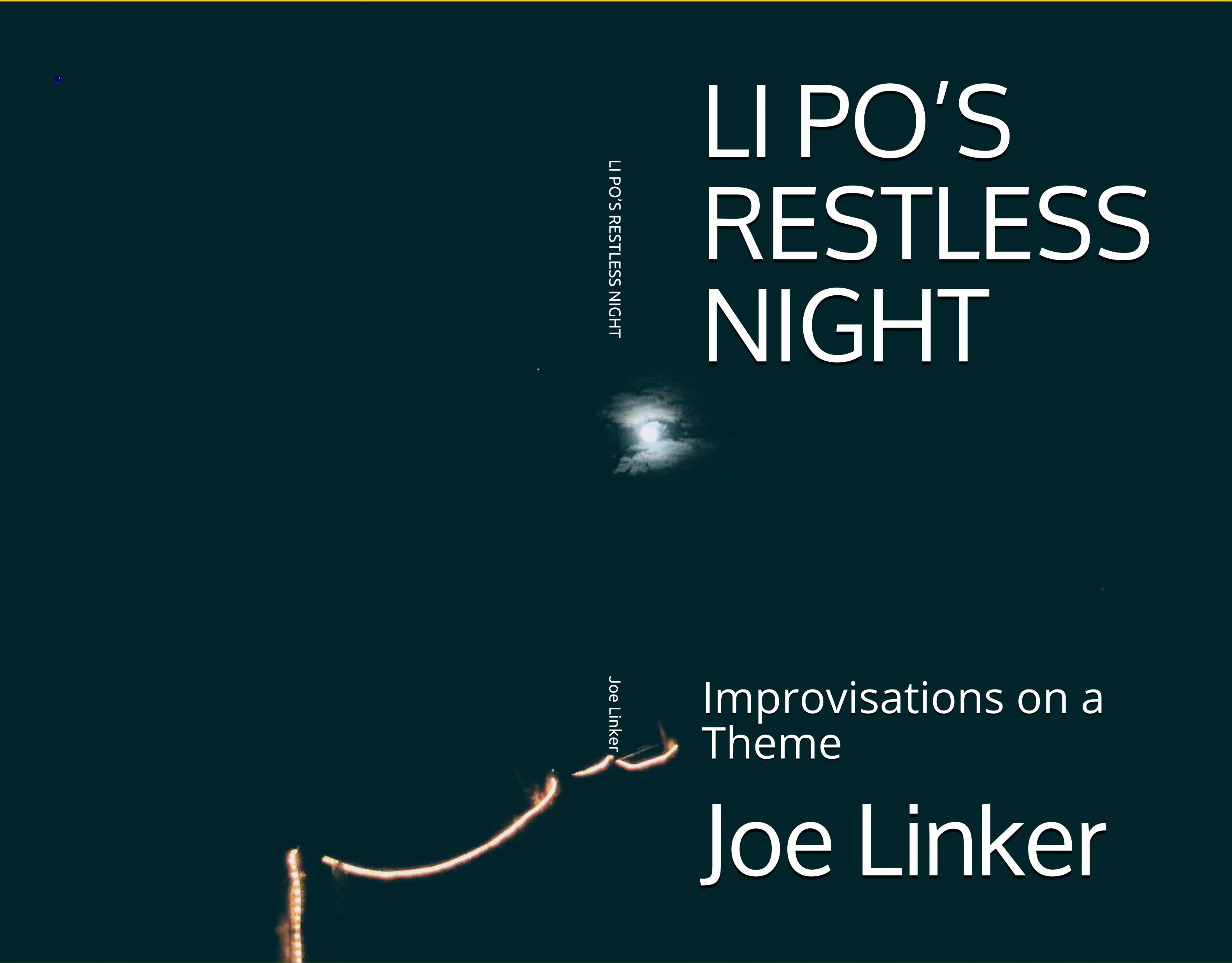
“Li Po’s Restless Night: Improvisations on a Theme” is now available in e-Book and paperback formats. Ideal reading for those with restless nights in quarantine, “Li Po’s Restless Night” includes 101 original variations on a theme of Chinese poet Li Po, with an explanatory personal essay, “Florence and Li Po,” though the essay may make better daytime reading. There was a time when I was able to close my eyes and not open them again for eight hours. Then the moon rose.
No point in pointing to made one’s way each momentous breath passes coming in spaces between arriving & leaving you learn to breathe with the tummy.
To breathe is to fall loose into mattresses of surf full of air bubbles drifting to shore with a slow tide as light as moon goes in the sky and on the sea.
Sitting on the wooden bench under the lilac, while Chloe plays in the age-old schoolyard, Papa awaits the second coming, not knowing what to expect, unable to recall the first coming.
I will write you flowers every morning to read with your bitter coffee a bright yellow squirt of sun oily blue green froth on top.
You sleep with a cat whose soft purr gives you pleasure all the joy of color impressions for the day.
You are soft like warm butter barely melting down a scone topped with a couple of gummy candy raspberries.
The butter wets the real fruit jelly rounds to light pigment an open place for lips to play and tongue – wait you didn’t think this was really about flowers, did you?
Here are two flowers the one calls a honey bee the other falls asleep petals open softly fictile.
There is so much silence hear the rustle of ants hustling across the counter for sugar and sweet stuffs, see the apple blossoms opening feel the bees approach touch the molten lava freeze it you can but no matter.
Once we admired multiple uses of one another of the now tossed cast off laugh tassels flipping flopping bouncing from rear view mirrors windows all rolled down.
Now we adhere to this new silence deafens touch asks for something that is nothing blends with the wall wearing night caps and socks to bed.
Outside cold winds blow bare branches whip the rain’s violence pours mercifully out a kindness allows for sleep and sleep.
The rain falls and falls all night long soaks through the ground walls fills the basement rises up the stairs floods the living room wicks up the wallpaper and pours out the windows.
Mid-June we sat out exposed to one another’s musical ups and downers, refusals, kissing eye dews until the moon falls down, waves turned around, and the air like steam foam swept in drafts up the beach and over the hot strand.
We walk down 42nd to the water rolling papers, smoking, and you toss back a couple of star-crossed pills, peace a far-fetched potion. You look for signs. I read a few poor poems by Hanshan on ways of being beyond need and want,
the beach our Cold Mountain. Make-ready teens for war learn early love is not free, our children’s prayers said on red plastic rosary yo-yo beads, putty explosives, headbands turned into tourniquets, floral wreaths
into olive drab steel pots. It takes courage to work out the hackneyed stereotypes future fighters might come to know. What is written is artificial intelligence. We might still be surfing were we better swimmers.
We would be one were we better lovers, more open to fall and quail, but Summer of Love, a stone wall around my heart built, inscribed with three names: Kevin Mulhern, Gary Grubbs, Robert Shea – mistaken.
To sand a page of flat board, one abrades first metallico then brushes dolce, as the piece turns to canvas. That is a music lesson learned in the woodshop. On the guitar, metallico is played near the bridge, where the strings are tight and unbending and sound like the steel wheels of a train or fingernails on edge across a chalkboard – both sounds rarely heard these days as trains recede farther into the industrial inner city or disappear through the countryside, and chalkboards fill landfills. In the middle of nowhere one learns to listen. Dolce on guitar is sounded where the strings loosen, up the neck from the soundhole. Sweet is dolce, but the hard, long ē of sweet sounds more metallico, so soft is dolce, not sour, but balmy. Metallico, that steel rail sound, harsh and disagreeable, straightens the spine and tingles the neck hairs. For some listeners, dolce raises goosebumps; for others, metallico does the trick. Dolce is the sound of the short, soft vowel, metallico the sound of the long, hard vowel. Thus the meaning of a musical note changes with its vowel length. A bent line over the vowel illustrates the soft sound (ă, ĕ, ĭ, ŏ, and ŭ), a straight line the hard (ā, ē, ī, ō, ū). Often, the meaning of a poem rests within its sounds, not seen in its definitions. One must listen to a poem like one listens to a piece of music. The reading question is often not what a poem means but how it feels when read or heard, what its sounds suggest. Some poems sand wood; others cut stone.
In other words, a mushroom. Every poem is a mushroom, a fruit body arising from its poetic fungus, often popping up overnight. Harold Bloom might have said that. What Bloom actually said was, “Poetry lives always under the shadow of poetry.” Some poems, of course, are not edible, but all have stems and caps and gills, just like mushrooms. The stinkhorn poem is distributed worldwide, and its horrid smell attracts flies and insects no matter where it calls home. Poets are very much like the toads who sit atop the stools the easier to snag flies with their tongue. Some mushrooms are said to be magical and to possess psychic healing qualities, though just as often eaters of these mushrooms become delirious. The same is true of some poems. There are many similarities of mushrooms and poems, but one should probably not confuse one for the other, but if you treat a book properly, it will over time produce mushrooms, if not poems.
The use of metaphor is not pretentious. Most folks use metaphor, most of the time, in ordinary circumstances – metaphor is hardly limited to poems or wordsmiths. When we look at something familiar but see something different – the metaphorical mind engages. Advertising is grounded in metaphor, where images are often used to counterpoise logic (vintage cigarette ads will provide examples), and we seldom ask ads to explain themselves. Advertising traffics in pathos, which, while it appeals to the emotions, does so in logical ways. The Spanish poet Federico Lorca suggested other forms of logic (words used to reason) are available and frequently used to understand or make sense of persons, places, and things – and of events and experience. Lorca named one other kind of logic Hecho Poético. Poems are not puzzles to solve. They are facts. Poems are modes of experience grounded in common sense, mother wit, connected to mood: indicative, ordering, questioning, wishful, conditional.
 The Coming of the Toads