Category: Poetry

  • The Great Text Awakening

    These days, there is no bugle call. I don’t have to set the alarm for 4 am across the room to ensure I get out of bed now and hat up for a drive north to Seattle rather than hit the snooze button evermore. And these days, days will pass without my getting a single legitimate call. When I do get a call, the ringtone plays a bit of Dvorak’s “Songs My Mother Taught Me,” and I’m inclined not to pick up but to dwell in the sound of the violin reminding me my mother’s tears no longer flow.

    These days, I’m not sure why I still bother to maintain a phone, one that no longer rings till the cows come home. The cows don’t leave home anymore. Indeed, like Hamlet, “I could be bounded in a nutshell and count myself king of infinite space” were it not that I get text messages.

    These days, the text messages I get are usually automatic. For example, my phone provider will text my bill, usually at an absurdly early hour on a weekend morning, as if a dozen or more cows were restlessly mooing to be milked. Or there’s an urgent message from some pollster who can’t take another breath until he has my opinion on who should be the next President. Or the local pharmacy is alerting me that once again my doctor is in denial.

    Yet this morning, deep in some recurring dream reconstituting an old commute and the reasons whyfor, at not, it might be argued, an unreasonable hour for someone departing the docks for an adventure, but arguably still a bit early for someone who has no call to wake up let alone get out of bed for a walk along some deserted slipway, I received the following headline-worthy news item of personal note from an old friend who I might add has I think never before texted me any message whatsoever and who indeed calls less frequently than my poor mother used to:

    “We are on our way
    to Texas. I am
    enjoying the book
    you sent: Three
    Men in a Boat.
    Thanks.”

    8:20 AM

    I picked up the phone, read said message with interest, got out of bed, made some coffee, bringing a cup to Susan and taking mine out for a yard walkabout where I decided I really should cut at least the back grass today, came back in for a second cup, and sat down to put up this post, thinking, I hope he’s not texting while driving. I hesitate however to discourage text messages from, say, a reststop. I remember Kerouac’s general advice not to use the phone, because, he argued, people are never ready to talk, and he advised using poetry instead. And, indeed, “We are on our way” is a perfect poem written evermuch in the Kerouac style.
  • A Soul Astray

    A drunken wind tonight
    wild with whiskey delight
    bloviator off the sea.

    I was sitting on a whitecap
    when the Angel Whale surfaced
    lifting me in a spew of salt.

    Gin and it shall blow for three
    days the weatherman foretold
    and the audience grew cold.

    To each their own way
    wandering opinions
    like birds molting feathers.

    Until naked a soul astray
    thy neck a tower of ivory
    thy ears porcelain shells

    eyes periwinkles hair oily
    seawrack washed ashore
    an animal bush or tree.

  • War On (later)

    I’ve been reading Edward Hirsch’s new book, The Heart of American Poetry. It’s very good, and I’m glad I decided to splurge for it, though I continue to think the industry’s continued use of “hardbacks” is wasteful, overly costly, but mainly, the hardback with paper cover is not as pleasant to hold and read as, say, the Penguin Classics, quality paperbacks not nearly as costly as the hardback with its really useless Victorian-like jacket cover. The size of the Hirsch book though is conducive to poetry lines, and the Library of America copy is a sound book production. Anyway, Hirsch makes a comment about Theodore Roethke, essentially that Rothke thought each line of a poem should stand alone, work as if a poem on its own; thus Roethke’s sparing use of enjambment.

    As an exercise, I’ve reproduced the last post, a poem titled War On, to eliminate enjambments in favor of the possibility of stand alone lines (a few other changes too, one might discover):

    War On (later)

    Somewhere usually a war on near or far
    I’m on watch in an audience of silence
    in a theatre or church reminded darkly
    sacrifice need not be so bloody violent
    those preoccupied by their own war know
    the maps the open fields the rivers and farms
    i remember watching one of the wars on TV
    donald rumsfeld mumbled something known
    his Iraq he said the first war of the new century
    and unknown from the announcer’s booth
    a new statistic the fans could not deny
    his hysterical perspective born in me
    between WWII and Korea boom destined
    in line for boot camp for the Vietnam Error
    at 18 already sick of this phony war business
    how quickly young boys on a beach bathing
    become old men in dress greens that drab color
    pollutes the wettest shades of nature’s grasses
    leaves ferns of fields and waves of oceans.

    The murderer attends Mass fills the pew
    the fakery has achieved so much so little
    frivolity yet the beauty of this war seems
    no one remains who believes in war
    the reasons for
    not the hand
    that signs the paper
    not that hand
    covered in oil and blood
    does not cry like the hands of a working man
    tears seeping over the banks of blue
    rivers coursing through a field of skin.

    War is the natural order of things human
    authority comes down as heavy as a tank
    made with human hands
    made to crawl along tracks of its own
    making through the green fields
    somebody’s home tornado torn
    the outdoor clothesline scatters
    the chickens and dogs bark
    the baby barely crawling sees
    the tanks for what they are inhuman
    monsters driven by human machines
    men made to march made to doom
    demented torches lighting one
    step ahead sinking into the dulce
    earth the metallico wheels slogging
    over the homeland where the pitter
    patter of the patria played on accordion
    in the rain waiting for the flood of time
    to wash a new century’s wars away.

  • War On

    Somewhere usually a war on near or far but
    most of the world watches war as audience
    in a theatre or in a church reminded darkly
    sacrifice need not be so bloody violent some
    of course preoccupied by their own war know
    the maps the open fields the rivers and farms
    i remember watching one of the wars on TV
    donald rumsfeld mumbled something about
    Iraq being the first war of the new century
    as if announcing a baseball game turned in
    a new statistic i couldn’t deny his hysterical
    perspective myself having been born quickly
    between WWII and Korea boom destined to get
    in line for boot camp for the Vietnam Error
    at 18 already sick of this phony war business
    how quickly young boys on a beach in bathing
    suits become old men in dress greens that color
    they use so pollutes the wettest shades of nature
    of grasses and leaves of fields and ocean waves.

    The murderer attends Mass fills the pew
    the fakery has achieved that much
    frivolity yet the beauty of this war
    seems to be no one left who believes
    in war the reasons for not the hand
    that signs the paper not that hand
    covered in oil and blood but does not
    cry like the hands of a working man
    tears seeping over the banks of blue
    rivers coursing through a field of skin.

    In the natural order of things human
    when some authority comes down heavy
    as a tank made with human hands
    made to crawl along tracks of its own
    making through the green fields
    of somebody’s home tearing through
    the outdoor clothesline scattering
    the chickens and dogs barking and
    babies barely crawling who see
    the tanks for what they are inhuman
    monsters driven by human machines
    men made to march made to doom
    demented torches lighting but one
    step ahead sinking into the dulce
    earth the metallico wheels slogging
    over the homeland where the pitter
    patter of the patria played on an
    accordion in the rain waiting for a
    flood to wash this war away.

  • Read-in

    Still working (leisurely) on cataloging the books into Libib (pronounced, btw, from Libib’s FAQs: “luh-bib. For you IPA people, relish the schwa: ləbib”). At first I thought they were talking about India Pale Ale.

    Categories and Tags – this is where things get swiftly tricky, like getting caught in a riptide. Libib recommends not using genres as categories, but something more personally identifiable, so that I might put one collection into a category called basement books, a collection being a subset of the library, and where to find a book of paramount concern. Or green bookcase. This might make sense for my library, since the books are spread throughout the house with little to no regard for genre or author. Though there is some organization, a row of paperbacks I’ve had since high school, for example. The green bookcase holds primarily poetry and plays. Nevertheless, I’ve decided upon genres as categories. But how many? Is biography considered non-fiction, or should it have its own collection (a collection and category being at this point synonymous)? Most of my books are literary by nature, so a single category of literary would hold them all, which would not be all that helpful in terms of organization and inventory. But less the whole enterprise get subsumed in some sort of biblio neurosis, I’ve decided to go with the following categories of genre: Fiction, Non-fiction, Music, Philosophy, Plays, Poetry. Libib provides a tool to filter: “Not Begun, In Progress, Completed, Abandoned, No Status.” I was thinking I might put all the Samuel Beckett books under Abandoned. In any event, the organization of the library will be in reality only virtual – I’ve no intention of actually physically moving all the books about trying to get them organized by genre or author or whatever. It’s enough to take them down, dust them off, peruse, catalog into Libib, put back – or leave out for further consideration. The library is, after all, not so large that I can’t find something wandering about and searching manually, which is what the hobby, if not the passion, is all about. A library should be a quiet and also unhurried experience.

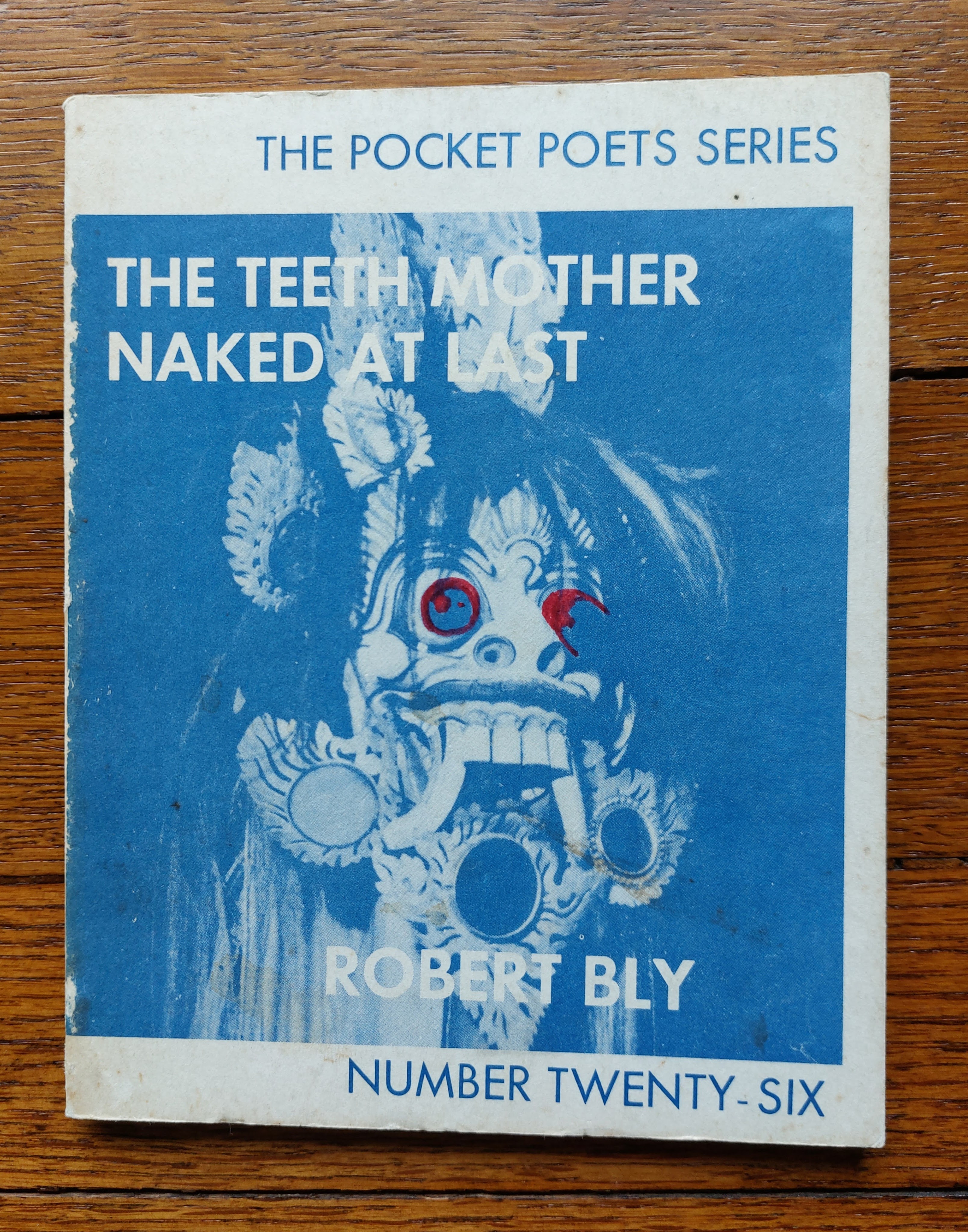
    Tags will be useful and helpful, for example: beat, pocket poets series – which I’ve for the last few days been working on. This morning I came to Robert Bly’s “The Teeth Mother Naked at Last,” Number Twenty-Six in the City Lights Series. Bly, born in 1926, passed away last November at the age of 94. Teeth Mother (hyphenated on the title page but not on the cover) is a single poem, 22 pages in this edition (Library of Congress No. 73-11121), 1970 by City Lights Books. Parts of the poem were printed earlier in the Nation and New American Review magazines. In my copy, which I think is a first edition (original cost $1.00), the pages are as thick as the covers of other Pocket Poems books, thick and unbending. I was struck by several things (historical, foreboding, ironic) in the Kenneth Rexroth quote on the back cover:

    “For a good many years now in his magazine The Sixties, and its accompanying book publishing Robert Bly has been struggling manfully to return American poetry to the mainstream of international literature from which it was diverted into the sultry provincial bayous of the Pillowcase Headdress School a generation ago. He started out completely surrounded by enemies . . It’s a wonder he’s alive. When he first started to wean away the puling young of America’s heartland from the seventy-seven tits of ambiguity, I thought he didn’t have a Chinaman’s chance. Robert Bly is today [i.e. 1970] one of the leaders of a poetic revival which has returned American literature to the world community . . A wide grasp of experience, an octave or more in each hand, is not just a sign of energy, it is a cause of responsibility. This is what gives the poems their great moral impact.”

    Kenneth Rexroth
  • Machines

    for Bill Currey, after Joyce Kilmer

    I think that I shall never see
    a poem lovely as a machine.

    A machine whose mouth is closed for good
    and holds no metaphor under its hood.

    A machine whose words number the stars
    infinite yet for talk has no reason for.

    Can’t remember when it was young
    was never drunk won’t grow old.

    A machine with no laughs or cries
    but all night long creaks and moans.

    Out of oil the machine starts to rust
    like pages of a book turned to dust.

  • Below the Snow

    Below the snow
    we stay warm
    and cozy away
    of falling limbs.

    Silent at bay
    we gape as
    shadows drift
    ghosts above us.

    The snow melts
    and we awake
    cold and wet
    like all the rest.


  • The Symbolists

    The golden goblets
    the silver symbols
    crashed down on us
    brazen stars falling
    into a sea of flowers.

    The good news was
    there’d be no more
    dinosaurs.

    A few of us
    we survived
    underground
    with the littles.

    We dug tunnels
    to a comfort zone
    not exactly Paradise
    but warm and moist
    plenty of bugs to eat.

    And we drew signs
    on the walls waiting
    for the dust to clear
    above in the Dear
    One’s celestial home.

    We tilled the new land
    built boats and bridges
    peopled the prairies
    where ran the rivers
    down to the sea.

    In church we celebrated
    the symbols of the dinos
    and prayed they’d never
    return even their stories
    in time seemed surreal.

  • Gashapon

    All the words buried
    in the weedy turf
    as the reader aerates
    the pages put down
    as sheet mulching.

    Again, the words detach
    from the action
    figure, or, twisted
    about, change shape
    into a device useful.

    The whole contraption
    comes apart, piece
    by piece, word
    by word, the garden
    gone to seed.

    The poem is a blind
    box, surprise hidden
    within, issued, usually
    in sets, for collectors
    of poetry.

    It sits on a shelf
    like a music box
    you have to pull
    it down and crank
    the handle.

  • The Ritual

    To writ in stone did
    those two crows
    alone appear each
    morn to renew
    our sacred vows.

    Fell from the commute
    of the daily murderous
    drive we awake with
    black oily coffee
    the dew steaming

    after the frost faced
    nest broken open
    hatching of bugs
    flies about they
    can’t be counted.

    Good mates in
    the end make
    good poems
    where hide
    birds in trees.

    What and where
    thru displacement
    here during the moon
    of words dressed
    in black feathers

    this crow types
    last night’s notes
    its mate never far
    emits the occasional
    caw clawed to signify

    I am here you there
    in and out of our
    respective shifting
    stances first you
    then me to gather.

  • A Missing Sock

    The best means to address
    a missing sock is found
    in a poem, the home
    of rhyme schemes.

    For, in the first place,
    socks need not match,
    as we now know a poem
    need not end in a plan.

    But if not for mates
    we won’t know when
    one goes missing
    or another is lost.

    Then again, in this
    morning’s laundry,
    alas, two socks
    in a mismatched

    duo, and, instead
    of looking around
    for their mates,
    decide to pair off.