Where in white flats over hills and dales live snowy creatures in snowy hills overcast the sky a white veil covers a frozen forest of fairies in fallen fate telling tawny tales and this winter’s rest one rare bird flew west into the sun passage over the ocean and caught waves and played with the dolphins improving her endorphins.
“Over hill, over dale, Thorough bush, thorough brier, Over park, over pale, Thorough flood, thorough fire; I do wander everywhere, Swifter than the moon’s sphere.”
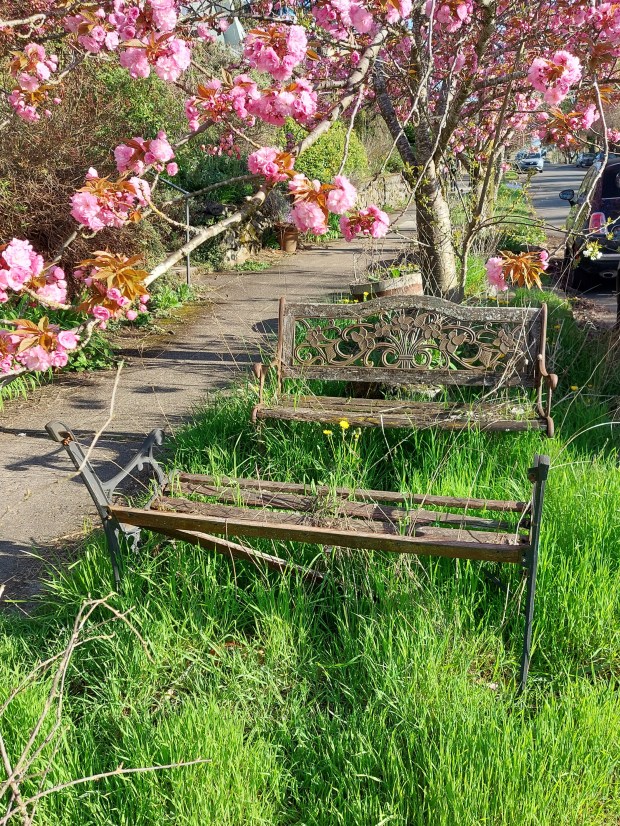
Winter passes when the cherry trees blossom. Passersby frequently pause to view the blooms from various angles and take photos with their phones. I wonder what the viewers feel or if they make a note to come back summer to pick some cherries. Of course these street trees across from our place are ornamental flowering cherry trees that don’t bear fruit. Some consider the ornamental a waste; others think it’s art. Here’s a photo of flowering cherry branches across the street, above a set of nonfunctional benches – some consider those art, too:
Just before leaving England for France, where he would die in the Battle of Arras (1917), the British writer Edward Thomas turned from prose to poetry. Here is his short poem titled “The Cherry Trees”:
“The cherry trees bend over and are shedding On the old road where all that passed are dead, Their petals, strewing the grass as for a wedding This early May morn when there is none to wed.”
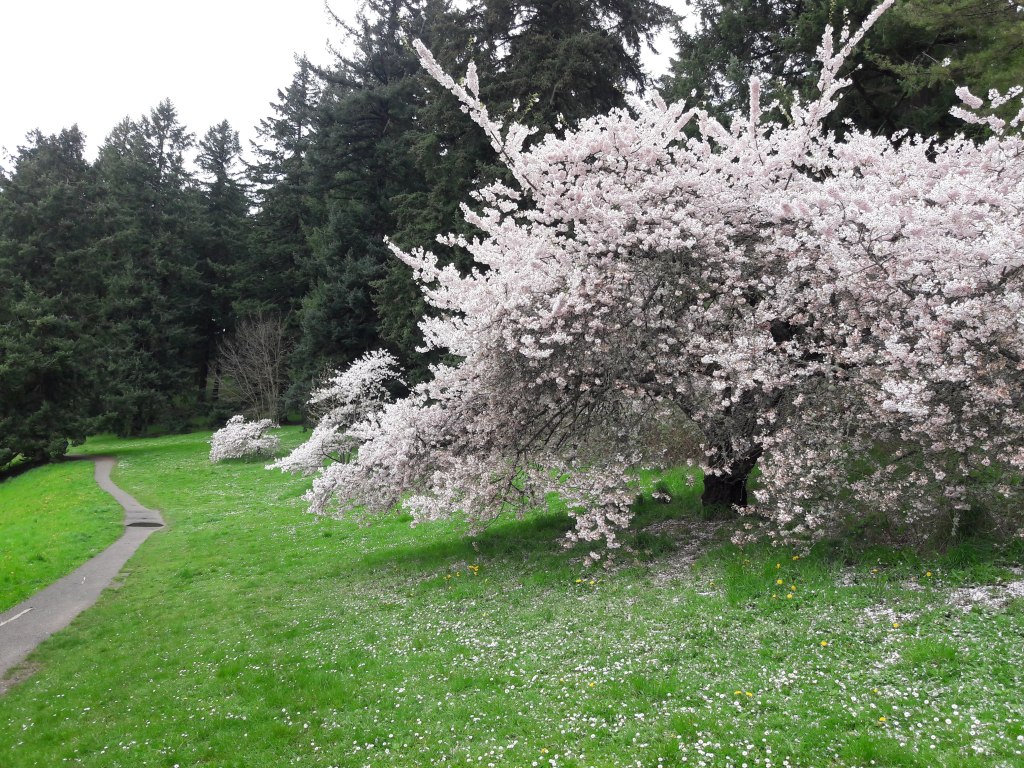
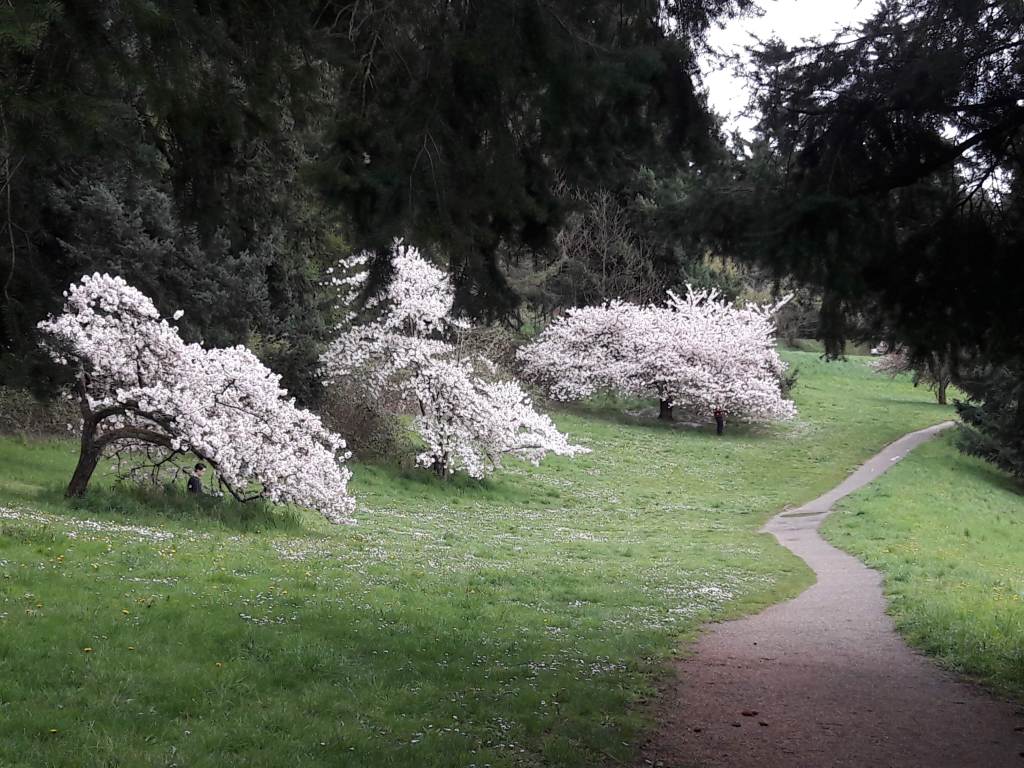
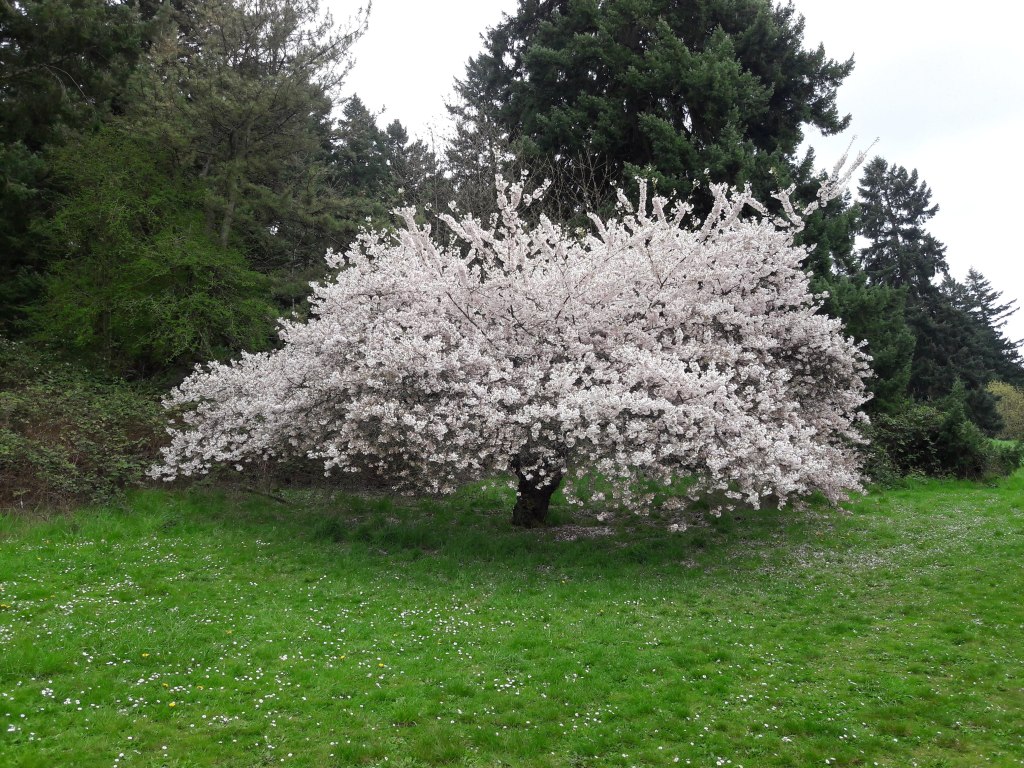
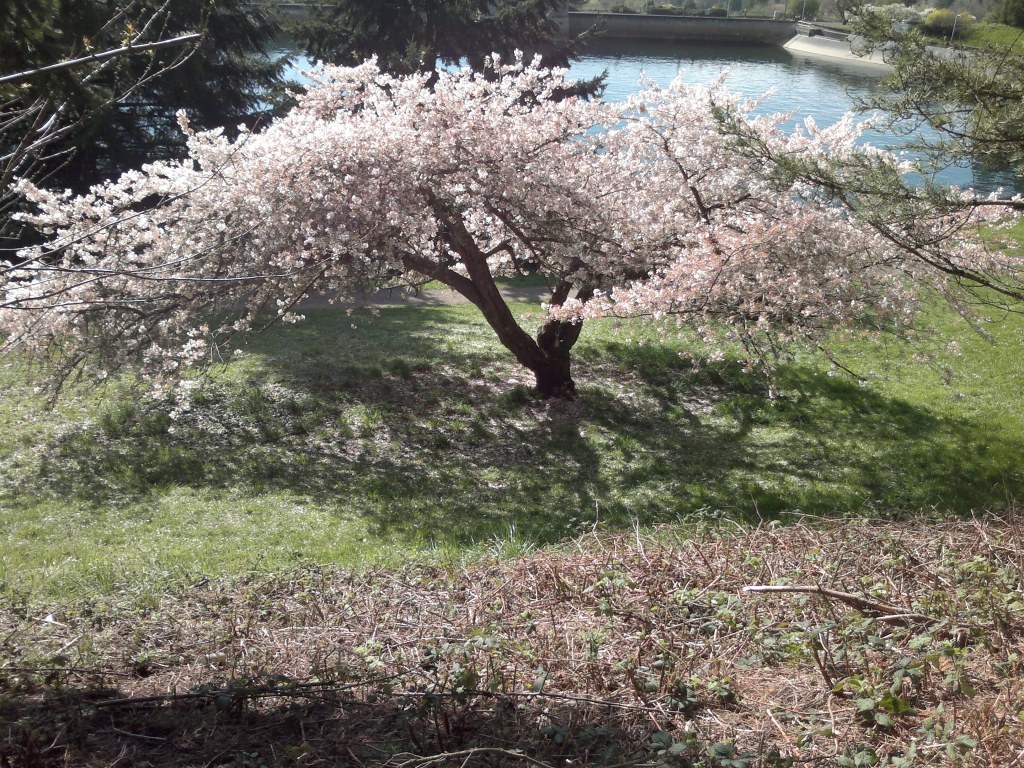
Here are two photos of cherry trees near an old path in Mt Tabor Park:
The Minnesota poet Robert Bly talked about nature’s capacity to send and receive images in transference from object to subject back and forth. The cherry tree in blossom might leave its image resonant in focus in the viewer’s consciousness. Not only the image, but what it felt like in the moment of sending and receiving, and Bly talked about how poetry might reconvey that image and feeling.
“Descartes’ ideas act so as to withdraw consciousness from the non-human area, isolating the human being in his house, until, seen from the window, rocks, sky, trees, crows seem empty of energy, but especially of divine energy….
As people begin again to invest some of their trust in objects, handmade or wild, and physicists begin to suspect that objects, even down to the tiniest molecular particles, may have awareness of each other as well as ‘intention,’ things once more become interesting.”
“News of the Universe: poems of twofold consciousness,” 1980, Sierra Club Books, San Francisco, pp 4-5.
Bly referred to the transference of consciousness idea using the poetic term deep image. Some might consider the ability to so access such images an affliction of the imagination. However it works, the cherry trees in spring seem to attract more than bees, and the pollinators are certainly responsible for more than honey. Here is another photo of one of the cherry trees in Mt Tabor Park, this one accentuated by the surrounding shades of green:
Walter de la Mare chipped in on the cherry tree theme with his poem “The Three Cherry Trees.” He reflects on the passing of both blossoms and viewers. Here is the last stanza:
“Moss and lichen the green branches deck; Weeds nod in its paths green and shady: Yet a light footstep seems there to wander in dreams, The ghost of that beautiful lady, That happy and beautiful lady.”
Cherry Tree above Reservoir #5 in Mt Tabor Park
A. E. Housman seemed to conclude waiting for a tree to blossom one might miss the ongoing opportunity to catch other images of that tree. From his poem about the cherry tree titled “Loveliest of Trees”:
“And since to look at things in bloom Fifty springs are little room, About the woodlands I will go To see the cherry hung with snow.”
Images don’t always come with sound. Here is a four second video of cherry blossoms in a wind:
Human imagination is part of nature, turning light into food, like photosynthesis in plants. Imagination is a natural process that needs no teacher or school, theory or method. Thus poetry should not become a profession, nor should a poem profess anything, nor should poets become professors. Most formal education activity turns subjects into sports and competition. Imagination is not competitive.
We might see that William Blake, in his “The Marriage of Heaven and Hell” (1790), explains the imagination as a natural means of protecting the human from an onslaught of reality:
“1. Man has no Body distinct from his Soul. For that called Body is a portion of Soul discerned by the five senses, the chief inlets of Soul in this age.
2. Energy is the only life, and is from the Body; and Reason is the bound or outward circumference of Energy.
3. Energy is Eternal Delight.”
William Carlos Williams associated the season of Spring with the imagination. It’s in his short book titled “Spring and All” that we find his now famous poem called “The Red Wheelbarrow.” But we’ve been reading that short piece sort of “à la carte,” or slightly out of context. It appears in “Spring and All” as a numbered poem in a series of poems interrupted in several places by Williams’s prose discussion about what he is doing and why in the way of poetry. There are a total of 27 poems in “Spring and All,” and “The Red Wheelbarrow” is number:
XXII
so much depends upon
a red wheel barrow
glazed with rain water
beside the white chickens
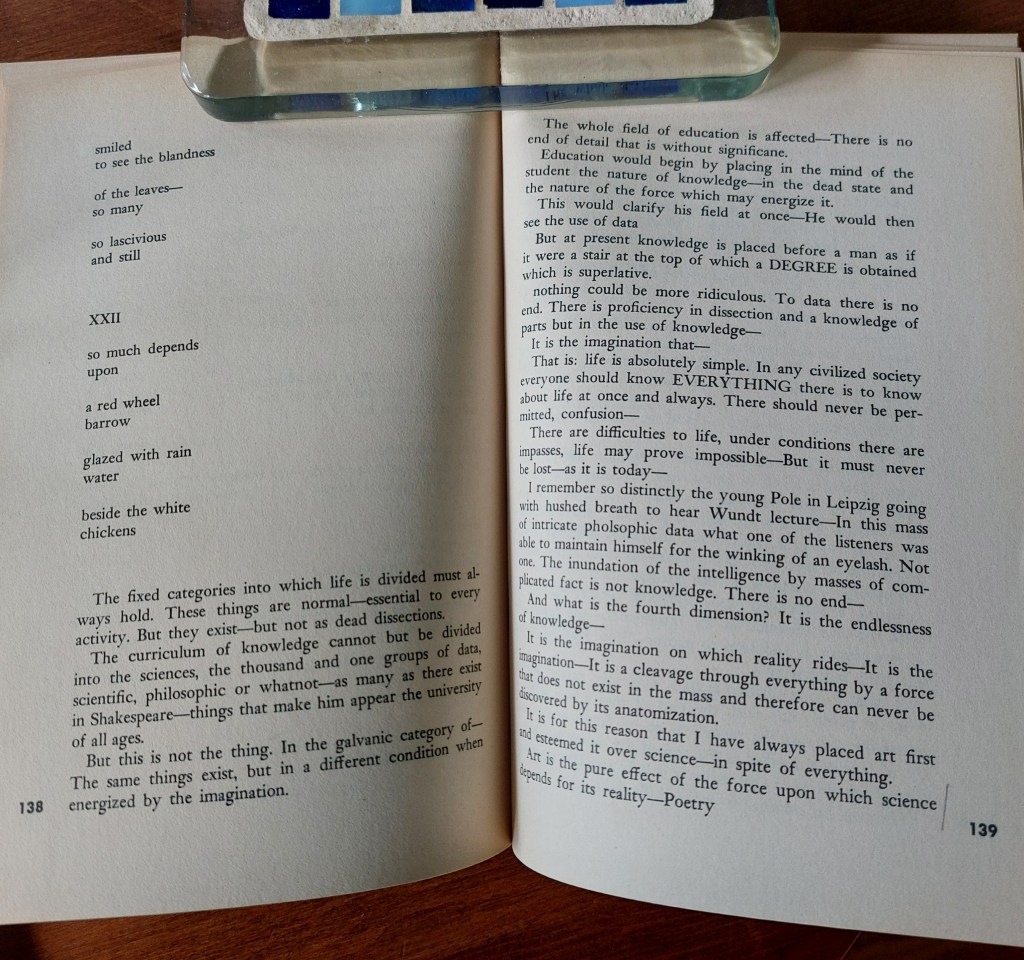
“The Red Wheelbarrow” appears in “Spring and All” on page 138 (Part II: pp 88:151) of my copy of Imaginations (New Directions Paperbook 329, 1971):
pp. 138-139 from “Spring and All” (1923) in Imaginations (NDP329, 1971)
Reading “The Red Wheelbarrow” in the context of “Spring and All” we begin to see how Williams invites the reader’s imagination to absorb the image. It is a well-lit poem. A painting is suggested, and the imagination creates the image (food) from the juxtapositions of color and light and things placed as if by hands (red, white, wheelbarrow, water, chickens, glaze), but will the chickens sit still? Probably not.
A few mornings ago, I walked into the kitchen, set about making coffee, and noticed a line of tiny ants climbing up and down a corner edge, starting from a small gap behind a molding where the wall meets the floor, and when the ants reached the countertop, they went meandering to and fro, around the toaster and coffee maker and compost bucket. And two nights ago, out walking, we came across a nest of what appeared to be the same ant species emerging from a crack in the sidewalk, a line of scouts working their way into a neighboring yard. And early yesterday, the weather still clement, in spite of thunderstorms and tornadoes forecasted for the later afternoon hours, I had taken a morning break with my coffee outside in the fine Spring morning, and when I swung the door open to come back in, a fly the size of Rodan nearly knocked me over as she flew into the house and proceeded to spin around and around near the ceilings, cavorting from room to room.
Spring begins with a pile of chores, and one recalls T. S. Eliot’s seemingly anti-intuitive start to his disillusionist poem titled “The Waste Land”:
“April is the cruellest month, breeding Lilacs out of the dead land, mixing Memory and desire, stirring Dull roots with spring rain.”
Not to mention the appearance of ants awaking from their winter diapause.
“Winter kept us warm, covering Earth in forgetful snow, feeding A little life with dried tubers.”
Soon April, and signs of spring are breeding and mixing in the kitchen and in the air, inside and out. Across the grass, dandelions are sprouting and even flowering already, and the turf at the edge of the sidewalk needs edging. The list goes on, but never mind – I discovered this week Ruth Stout, whose practice of gardening is summed up in the titles to her mid-century books, notably: “Gardening Without Work: For the Aging, the Busy & the Indolent” (1963); and “The Ruth Stout No-Work Garden Book: Secrets of the year-round mulch method” (1971); and her first, “How to have a Green Thumb without an Aching Back: A New Method of Mulch Gardening” (1955).
It was in a New Yorker article of March 17 that I discovered Ruth Stout, sister, as I learned, of the famous detective fiction writer Rex Stout, best known for his protagonist Nero Wolfe. The subtitle to Jill Lepore’s article tells all: “Ruth Stout didn’t plow, dig, water, or weed.” Suddenly, Spring seemed a happier time than how T. S. Eliot described it.
Still, I had ants in the kitchen to deal with, for I learned to my dismay they had nested inside the coffee maker. I surrounded the coffee maker with a moat of vinegar, and when the ants appeared between the moat and the coffee maker, I knew they had to be coming from within the coffee maker, where they must have set up a new nest. Never one to rush for the can of spray that “kills bugs dead” (ad line attributed to Beat poet Lew Welch, by the way), after a bit of research, I decided to try Dr. Bronner’s peppermint soap, having read that ants don’t like peppermint oil. The soap certainly stops ants on contact, and it seems to slow new scouts from returning to the scene.
Meantime, our kitchen counter is cleaner than ever before. I had to retire the electronic coffee maker. I read ants like water and warmth (who doesn’t?), and they can also detect electric currents, including vibes from computers and cell phones and such – so we won’t be able to charge our devices on the kitchen counter anymore, for fear of ants. Imagine ants in your Chromebook, crawling in and out of the keyboard. And we’ve returned to a French press coffee maker, and while it takes a bit longer with more steps to brew, the coffee is robust. And immediately employing the Ruth Stout method, the yard work is quickly done, leaving more time for writing pieces, well, like this one.
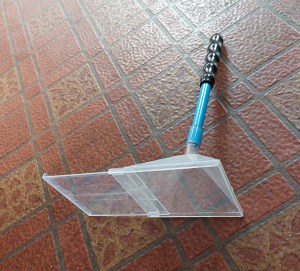
But what of the fly the size of Rodan, the deep reader will be wondering? Advocating a catch and release policy toward all living but unwelcome things, I grabbed the fly catcher and went dancing around the house with the fly. I trapped it in the bathroom, where it had landed on the window screen. To catch a fly with the fly catcher, you have to wait until it lands, approach quickly but stealthily, cover it with the catch door open, then slide the catch door closed with the fly inside the trap. Might sound easy, but it’s often a cat and mouse game as the fly inevitably flickers away at the last second. After several attempts banging around the small bathroom, I caught the fly, then released it into Spring and all wilderness where all Earth life mingles half awake and half asleep.
“The Coming of the Toads” is the title of a short poem by E. L. Mayo:
“‘The very rich are not like you and me,’ Sad Fitzgerald said, who could not guess The coming of the vast and gleaming toads With precious heads which, at a button’s press, The flick of a switch, hop only to convey To you and me and even the very rich The perfect jewel of equality.”
E. L. Mayo. Summer Unbound and Other Poems, the University of Minnesota Press, 1958 (58-7929). Also, E. L. Mayo. Collected Poems. New Letters, University of Missouri – Kansas City. Volume 47, Nos. 2 & 3, Winter-Spring, 1980-81.
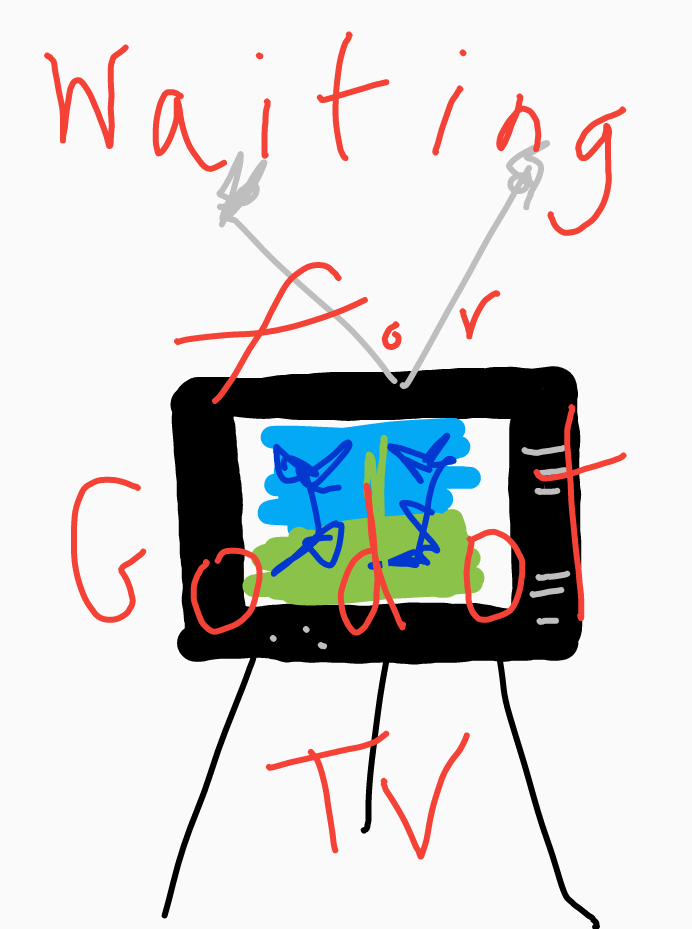
The young toads were ugly televisions, but those eerily glowing tubes contained a lovely irony. The toads invaded indiscriminately. The bluish-green light emitted from the eyes of the toads emerged from every class of home, all experiencing the same medium for their evening massage. Mayo’s poem is a figurative evaluation of the effects of media on class and culture.
In Fitzgerald’s short story “The Rich Boy” (1926), the narrator says, “Let me tell you about the very rich. They are different from you and me.” But Mayo doesn’t seem to be quoting from Fitzgerald’s story. He seems to be referencing the famous, rumored exchange by the two rich-obsessed, repartee aficionados Hemingway and Fitzgerald. Hemingway wrote, in his short story “The Snows of Kilimanjaro” (1936):
“He remembered poor Julian and his romantic awe of them and how he had started a story once that began, ‘The very rich are different from you and me.’ And how some one had said to Julian, Yes, they have more money. But that was not humorous to Julian. He thought they were a special glamourous race and when he found they weren’t it wrecked him just as much as any other thing that wrecked him.”
Did TV have a democratizing effect, or are its effects numbing? In Act 2, Scene 1, of Shakespeare’s “As You Like It,” Duke Senior, just sent to the woods without TV, mentions the toad’s jewel:
“Now, my co-mates and brothers in exile, hath not old custom made this life more sweet than that of painted pomp? Are not these woods more free from peril than the envious court? Here feel we but the penalty of Adam, the seasons’ difference, as the icy fang and churlish chiding of the winter’s wind, which, when it bites and blows upon my body, even till I shrink with cold, I smile and say ‘This is no flattery: these are counselors that feelingly persuade me what I am.’ Sweet are the uses of adversity, which, like the toad, ugly and venomous, wears yet a precious jewel in his head; and this our life exempt from public haunt finds tongues in trees, books in the running brooks, sermons in stones and good in every thing. I would not change it.”
Fitzgerald didn’t embrace television, but today he might cradle a metamorph tadpole in his lap. What would it convey? The toad’s jewel is more than a metaphor; the churlish shows of television are today the Duke’s counselors. We enter the space of the light box, and the toad’s jewel poisons us to the paradox of staying put, to electronic exile, but does it contain its own antidote, the toadstone?
Not hunter nor hunted be but swimmer in this long sea the fishes your community though of course fish eat each to each but rarely one’s own the point eat what’s available then go a fish out of the sea not the long or short of it but lost in the long run of the sea pages uncut written while working in a customs house dabbler dabbled in dawns of coffee and commutes and cubbied desks no time for more than doodles while the prof makes a living off an ever changing starting line the long market to market to market with a self-published book now out of print on demand there being no press and came to fancy Penelope the late bloomer and Barbara an excellent one and the two Elizabeths and Henry and Patty and Ray but of any poems composed in an alcove suffice to say what a waste yet this, and this is why one longs for the long sea:
“No, she thought, putting together some of the pictures he had cut out – a refrigerator, a mowing machine, a gentleman in evening dress – children never forget. For this reason, it was so important what one said, and what one did, and it was a relief when they went to bed. For now she need not think about anybody. She could be herself, by herself. And that was why now she often felt the need of – to think; well not even to think. To be silent; to be alone. All the being and the doing, expansive, glittering, vocal, evaporated; and one shrunk, with a sense of solemnity, to being oneself, a wedge-shaped core of darkness, something invisible to others. Although she continued to knit, and sat upright, it was thus that she felt herself; and this self having shed its attachments was free for the strangest adventures. When life sank down for a moment, the range of experiences seemed limitless. And to everybody there was always this sense of unlimited resources, she supposed; one after another, she, Lily, Augustus Carmichael, must feel, our apparitions, the things you know us by, are simply childish. Beneath it is all dark, it is all spreading, it is unfathomably deep; but now and again we rise to the surface and that is what you see us by. Her horizon seemed to her limitless….There was freedom, there was peace, there was, most welcome of all, a summoning together, a resting platform of stability” (54).
From “To the Lighthouse” (1927) by Virginia Woolf, Penguin Books edition 2023.
should these times seem like old times old vinyl player tunes spinning warmly can’t recall an old acquaintance’s name for the sake of old times comes to mind
a face full of kindness and smiles awhile for the days gone by spent in odd places when in our pint cups yours and mine picture between us and a bowl of nuts
on the radio windows down seawrack night out on the town and we run about up and around the steep butterfly hills wandering waves of sun bleached hair
lol we post these pics of ours and send for tags with names from old contacts up into the cloud we’ll see how many hearts we’ll catch nevertheless now
take my hand we’ll cross the stream I can’t hear the ocean’s roar anymore we’ve been up all night old forgotten the moon also falls down the tracks
Twas the proverbial night before Christmas When all through the house oboes wobbled And bells drummed twas Nick at his sticks While the children blew bellows in burrows Asleep how through all this babbled version One could hear their little tin horns bleep All sugar tipped up and fat ball hobbled Achoo in me hat and mamma in her ache The babe at her breast for a milk rich bowl When out on the street the leaf blowers Blowered at this hour a rout and I tripped Nary tipped mind you but a blob had sat On my head nevertheless rose to deal With the matter the moon yes the rain Drips deep below when then did I spy The eight petite reindeer and their poser Whose echo touted tomatoes and fruit Dressed as they were in greens and reds But I’ll spare you here the royal roll call Suffice to say yes they did fly at his whip Peeble, Hooch, Boop, Bloob and the others Then came the dashes – – – – – – – – one After another like leaves when they fall He knocked politely at the door a mere Echo of past years his smile an arrow Soon up the street in his branded vest Stopped here and there with boxed goods For the goodies then turned signalled left Leaving me to pick up my package Empty my stockings of my two tired Feet and return blue to my windy sleep.
I’ve been reading aloud evenings to Susan, “Excellent Women,” by Penelope Pym. First published in 1952, the setting is London after the war. Soldiers are coming home, rentals are hard to find, some foods are still being rationed. The narrator is the understated, astute Mildred Lathbury, a bit over 30, who has a flat of her own, but must share a bathroom with the lodgers downstairs. She attends church regularly, helps with the jumble sales and flowers for the altar, and is drawn into relationships involving a cast of characters requiring her free and easy to come by assistance. Every character’s name seems effectively thought out. Not my favorite character, but certainly my favorite name, is Everard Bone, an anthropologist:
“I crept quietly up to my flat and began to prepare supper. The house seemed to be empty. Saturday night . . . perhaps it was right that it should be and I sitting alone eating a very small chop. After I had washed up I would listen to Saturday Night Theatre and do my knitting. I wondered where the Napiers were, if they were out together, or if Helena was with Everard Bone” (57).
It’s my third time reading “Excellent Women,” but just the first time reading it aloud. A few nights ago, a chapter began with this:
“A list of furniture is not a good beginning to a letter, though I dare say a clever person with a fantastic turn of mind could transform even a laundry list into a poem.
I sat for a long time at my desk, unable to put pen to paper, idly turning the pages of a notebook in which I kept accounts and made shopping lists. How fascinating they would have been, had they been mediaeval shopping lists! I thought. But perhaps there was matter for poetry in them, with their many uncertainties and question marks” (164).
And I have been sitting this morning at my writing table wondering if I have time for some writing that might make for a good post for this here Hear ye blog. The electric folks are on the block this week replacing utility poles, and we’ve been told they will shut our power off for most of the day today, likely around 8 to 3, though it’s now 9 and the coffee is still hot and the temperature inside stable. The big inconvenience, once the power goes off, comes from it being only around 40 degrees out, and our old place does not hold heat any longer than a tee shirt and swim trunks in a dunk at Refugio.
A few weeks ago, I bought a digital subscription to the New York Times for $4.00 a month. Little did I know at the time that I would spend as much time on their Games page as on their news. Like most things pocket phone related, the games are addictive. My favorite is Spelling Bee. Every day, a new circle of 7 letters is posted for you to type as many words over 3 letters long as you can find – all using the center letter. Today’s letters amount to a difficult episode: b c d y t e o. So far, I’ve found only 8 words: Body, Booty, Byte, Dotty, Eddy, Teddy, Toddy, and Toyed. My score at this point is “Nice,” the rankings ranging from Beginner to Good Start, Moving Up, Good, Solid, Nice, Great, Amazing, and Genius. A four letter word is worth only 1 point, longer words worth more, a pangram scores high. The longest word I’ve logged so far is Ineffective. Statistics are maintained in the game file. I’ve worked 35 puzzles, finding 755 words, including 16 pangrams, but only 4 times have I scored Genius.
I doubt Barbara Pym succumbing to digital games, but maybe Mildred Lathbury would play along. Here’s a short poem I made using the words from the Spelling Bee mentioned above:
Waiting for a Cold Spell Teddy swimming in the spilling morning waves Dotty over having this morning scored Amazing In the New York Times oft ToyedToddy in hand Testing word Bytes but Eddy and Bill stay away For the Booty is holy Body alone and cold here Unlike marbles in a warm dust of green Spring.
“Excellent Women,” by Barbara Pym, was first published in Great Britain by Jonathan Cape in 1952, in the US by E. P. Dutton in 1978, and my edition by Penguin Books in 2006.

 The Coming of the Toads