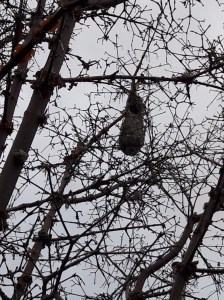
• Coast Road Trip: Up Through Some Redwoods and Down to Open Toe Beach

    Maps can’t find Open Toe Beach. No sign points the way. Likewise, one doesn’t feel any different having crossed the border from Oregon into California. Nature’s borders are difficult to see, to define, to mark:

    “The immense sea, the ocean sea, which runs infinitely beyond all sight, the huge omnipotent sea – there is a point where it ends, and an instant – the immense sea, the tiniest place and a split second.”

    from “Ocean Sea” by Alessandro Baricco

    South from Crescent City, Highway 101 turns away from the ocean and climbs up into Del Norte Coast Redwoods State Park. Parts of the road narrow through the giant trees and begin to switch back and forth like a steep trail through woods. The trees have grown so close on some curves that the trunks have been trimmed back with flat scraping saw cuts to allow for cars and the big trucks to pass. Traffic slows, or should slow, to no more than 20 miles per hour, and even that seems here and there too fast as the curves rise sharply and fall swerving like a ride in an amusement park. You are in a massive forest at the end of the continent, climbing above the ocean, now out of reach. The dappled light coming through the branches thins then goes dark and you need your headlights on to continue. You are an oily steely slug crawling along the floor bed of an emerald rust forest. Here the sea continues too, in the form of high and thick fogs that water the redwood trees from the top down.

    But we fall quickly to an elevation of about 30 feet, where the road crosses a bridge on the approach to False Klamath and again touches the water at DeMartin Beach, which we renamed Open Toe Beach for the various abandoned sandals we came across as we parked and walked down to the water barefoot and open toed. Where were the people belonging to all these sandals? The tide was out, and we walked along the cove, the beach covered with small pieces of driftwood. The water was cold but not burning cold. The surf was not big but it was loud as the swells broke on the big scattered rocks out in the cove. It felt good to be back in the open and on the beach and out of the forest. There is a boundary between redwood forest and ocean beach that can be measured or felt in scent and smell. The forest is loamy, quiet, the scent pungent like a snorted mint, the floor softer than sand. The beach is breezy, salty, and your tinnitus becomes more than mere suggestion. It disappears as the surf does in the sand.

    “…you see there, where the water arrives…runs up the beach, then stops…there, precisely that point, where it stops…it really lasts no more than an instant, look there, there, for example, there…you see that it lasts only an instant, then it disappears, but if one were to succeed in suspending that instant…when the water stops, precisely that point, that curve…this is what I am studying. Where the water stops.”

    from “Ocean Sea” by Alessandro Baricco

    to be continued: this is part three of a series covering our June 2019 coastal road trip.
  • Coast Road Trip: A Body on the Beach

    From our motel room, looking south/southwest, I could see Crescent Beach. A few surfers were out, but the waves looked very small, 1 or 2 feet. The water was glassy. There was no fog, the sun was coming up, and I went down to the lobby where I filled a paper cup with coffee and water and headed out for an early morning walk on the beach. We were staying at the Anchor Beach Inn, located on the west side of 101, at the southeast edge of the harbor. Tommy and Barbara were in the room next to us. I knew Tom would be awake, and from the street I tried to yell up through his open window to come down and join me. I didn’t want to sound an alarm, though, and he didn’t hear me. I walked on alone and crossed the street where a path led through the deep sand out to the beach area. I had thought the beach empty, but at the far end of the path a young woman came walking toward me.

    “Are you staying in the motel?” she asked, as we approached one another on the path.
    “Yeah. Good morning.”
    “Oh, I’m sorry. I don’t want to ruin your morning.”
    “What’s the matter?” She was wearing beach combing clothes, barefoot, looked like she had just awoken. I thought maybe she was about to ask for a handout or some coffee.
    “Well, I’m sorry, I don’t know if I should say anything, but, I don’t know, you know, but there is a body on the beach. I almost stepped on it. And I don’t know if its alive or do they need help. I don’t know, maybe we should just leave them be. I don’t want to ruin your day.”
    “No, that’s fine, if they need help we should try to help. Where?”
    “Over there,” she turned and pointed.

    We were at the end of the beach, where the sand is deep and windblown into small dunes and strewn with driftwood and beached logs and trees of all twisted shapes and sizes washed ashore in storms, beach debris people like to comb through. Here and there smaller pieces of wood and log had been stacked or piled into fire pits. Long, thinner pieces were stood up into teepee shapes but with no covering. There were a few of these built along the outer beach edge. I didn’t know if they were meant to be works of art or something practical, shelter or bonfire starts.

    “Where is it?” I asked.
    “Right there,” she pointed.

    I had thought we would find the body out on the open beach, washed in maybe, but there it was, against a big log, covered with a thin blanket, stretched out but elbows and knees and feet pointing this way and that as happens when people move about in their sleep. The head was covered. The feet stuck out. It was right there, maybe five feet away from where we had stopped short. There had been a sign at the entrance to the path. A city ordinance prohibited camping on the beach.

    We were both watching the body for the same thing. We watched and stood staring for about a half minute.

    “Oh,” she said, breaking our silent watch. “There.”
    “Yeah. He’s breathing. Probably just someone spent the night on the beach.”
    “You think he’s ok?”

    The tide was very low, the edge of the water over a hundred yards out. A small creek flowed from out of the beachgrass and meandering stained the beach like a tiny river all the way out to the water’s edge. The beachgrass and sedge stuff held quickly and piled up and across a kind of no man’s land up to the highway, which took off at a southeast angle away from the beach. But there were few cars and trucks and you could hear the waves as small as they were and I walked on down to the water and the girl walked off back up to the road. I spent maybe half an hour walking at the water’s edge, rolling my pants up to my knees, walking out into the thin soup. The water was cold, but not so cold it stung like bees. The sand was smooth and worn fairly hard. There were no shells or agates or rocks or driftwood down at the water’s edge. The beach was all wet sand and low tide and shallow water for a long ways out.

    I walked back up the beach and had another look at the body sleeping in among the driftwood piles before climbing the path back up to the road.

    Later, before leaving Crescent City, we drove back up through town around the harbor and out to Battery Point, about a mile and a half diagonally across the harbor as the crow flies from where we had spent the night and in the morning I had encountered the body on the beach. At the point, the tide was still low enough that we were able to walk across the tide pools and out to visit the Battery Point Lighthouse, located on a small, rocky island at the end of the breakwater structure built up to protect the harbor from the open sea. We walked and climbed the trails up and down all around the lighthouse on the island, watching the water, the small swells breaking up on the rocks, listening to the sea birds, their open air market rife with the shrill economy of their language, calling out finds and deals and steals, calling off and calling to, calling, calling.

    to be continued: this is part two of a series covering our June 2019 coastal road trip.

  • Coast Road Trip: Unpacking the Pacific Northwest

    For most of my life, I’ve lived near the Pacific Ocean. Nothing special about that. A lotta people live near the water, all around the Earth, some, arguably, too close. At least that’s the opinion of The New Yorker’s Kathryn Schulz, whose latest piece, “Oregon’s Tsunami Risk: Between the Devil and the Deep Blue Sea,” takes aim at the new Oregon law that will allow further building development in tsunami zones along the Oregon coast.

    One Oregon state senator, Brian Boquist (R 12), opposed the bill. His district runs parallel to but east of the I-5 from south of Hillsboro (which is just west of Portland) to south of Corvallis, an area covering a significant part of the Willamette Valley, and includes much of Oregon’s wine country, and, situated on the east side of the coast range, is not in a tsunami zone. Schulz mentions Boquist in her article as one of the state’s problematic republicans, but Boquist opposed HB 3309, the bill now signed into law allowing more tsunami zone development on the Oregon coast, with the following explanation:

    Secretary: Vote Explanation. Thanks, Sen Boquist

    HB 3309 is simply wrong. It allows local government to build unsafe facilities in tsunami zones to save them money. The deaths that will result by building new emergency services facilities that will be destroyed, with deaths, will and should make the city, county and state liable for the deaths. This started two sessions ago allowing OSU to build on liquified Newport Bay so future students will die in a future tsunami. It is clear, the State of Oregon really does not care about tsunami preparation nor the lives of its citizens. Bad policy.

    Vote explanation, Senator Brian Boquist, June 17, 2019

    The “catchline/summary” of HB 3309 reads as follows:

    Directs State Department of Geology and Mineral Industries to study and make recommendations on provisions of state law related to geological and mineral resources of state. Requires department to submit report on findings to Legislative Assembly by January 1, 2021.Removes State Department of Geology and Mineral Industries’ authority to prohibit certain construction within tsunami inundation zone.

    Overview, HB 3309

    The complete bill, which is only 5 pages in length (“The hand that signed the paper felled a city,” as Dylan Thomas put it, in a different context) can be read here.

    According to the Office for Coastal Management: National Oceanic and Atmospheric Administration, the coastal counties of the United States fund multiple economies: “Annually, coastal counties produce more than $8.3 trillion in goods and services, employ 55.8 million people, and pay $3.4 trillion in wages.” This helps explain why about half of the US population lives somewhere near the water. But for many, where one lives isn’t a viable choice one makes: “Approximately 40 percent of Americans living in coastal counties fall into an elevated coastal hazard risk category. These include children, the elderly, households where English isn’t the primary language, and those in poverty.” These people the OCM calls “vulnerable populations.” But Oregon’s coastal human population accounts for only about 5% of Oregon’s total population of just over 4 million. Of course that population increases somewhat in the summer tourist season. But for people living on the Oregon coast, life is rural and poor, with local economies largely dependent on tourism – which generates mostly service type jobs.

    There are other reasons that might help explain Oregon’s sparse coastal population: the coast mountain range, which makes travel to and from the coast problematic; the weather, wet and wild for most of the year; very cold ocean water temperatures; a rugged coastline marked by cliffs, river estuaries, unnavigable headlands, and north south traffic limited to a single, two lane highway (US 101) with few bypasses and parts of which are washed away or closed by flood and landslide or tree fall nearly every winter.

    In June, I spent nine days on the coast. We drove down to Sonoma County, spending a few nights in wine country Healdsburg, to attend a family reunion surrounding a 60th birthday celebration. We spent two nights in Crescent City, which this Slate article calls “Tsunami City, USA.” We walked along the big beach crescent out into the harbor area and ate fish and chips at “The Chart Room,” a local and tourist favorite. We shared our table with a couple of guys, one older even that us, a 90 year old gentleman celebrating his birthday month with a trip up the coast. We talked about the coast, places to stop and see, compared notes. No one mentioned the fact that we were drinking beer and eating fish and chips deep within a tsunami inundation zone. In fact, we were in what DOGAMI calls an XXL zone. That’s a tsunami t-shirt so big it will swallow a whale. From the Crescent City Harbor District History page:

    The Inner Boat Basin at the Crescent City Harbor District was damaged by a 2006 tsunami, but was totally destroyed by the tsunami that struck the harbor on March 11, 2011.  The damage from both events required three years to rebuild.  (The word tsunami in Japanese translates literally as “harbor wave.”)

    Crescent City Harbor District

    I’m going to stop here for today. But for now I’ll leave you with this: between the devil and the deep blue sea, for most of my life, I’ve taken the sea.

    to be continued: this is part one of a series that will cover our June 2019 coastal road trip.
  • Theatrical

    Older then, one more yesterday notched
    into this haggard wasted belt, tight about,
    turning in the widening gut, but must
    be the clothes, despondent, I seem,
    up the block quirky bobber says,
    and I think he’s talking shit on
    my writing, but no, he says, your mien,
    like a traveler lost his way,
    fearful forged face, luggage jowls,
    over needy and under taken.

    Ate too much, talking to self,
    I don’t travel well, I say, when
    he tells me, Go to Hell, but
    let’s go for a beer sometime.
    Drank to gorge, piss like a glacier
    melting, violating the graces,
    not a single work of mercy,
    no incense in my crucible,
    my feet leave a trace of beach tar
    on the pavement parchment.

    As the third and final act ends,
    the boards weathered smooth,
    the audience awakes to the smell  
    of coffee and petrichor coming
    down the aisles, the ushers throw open  
    the great doors of the hall.
    But what’s this, another act?
    The players pretend nothing really
    happens backstage dressing room sweat
    when I present sweet flowers to the star.

  • Paintings and Poems: City on a Hill

    “You are the light
    of the world.
    A city
    set upon a hill
    cannot be hidden” (Matthew 5:14).

    Not to mention something you’ve put up online. What’s posted online can’t be deleted or hidden. That is the poet’s dilemma, who craves publication but still has changes, or will have. But that is only a matter or problem of print. Oral poetry, or song, allows, invites, indeed wants variations. Covers. Over time, cities get covered up. The earth rises, and falls.

    I assumed the Queen Mob’s Teahouse poetry editor position back in April, taking over from Erik Kennedy, Queen Mob’s second poetry editor, from May, 2015, who followed Laura A. Warman. The gig is volunteer work, of course, as befits any true poetic enterprise.

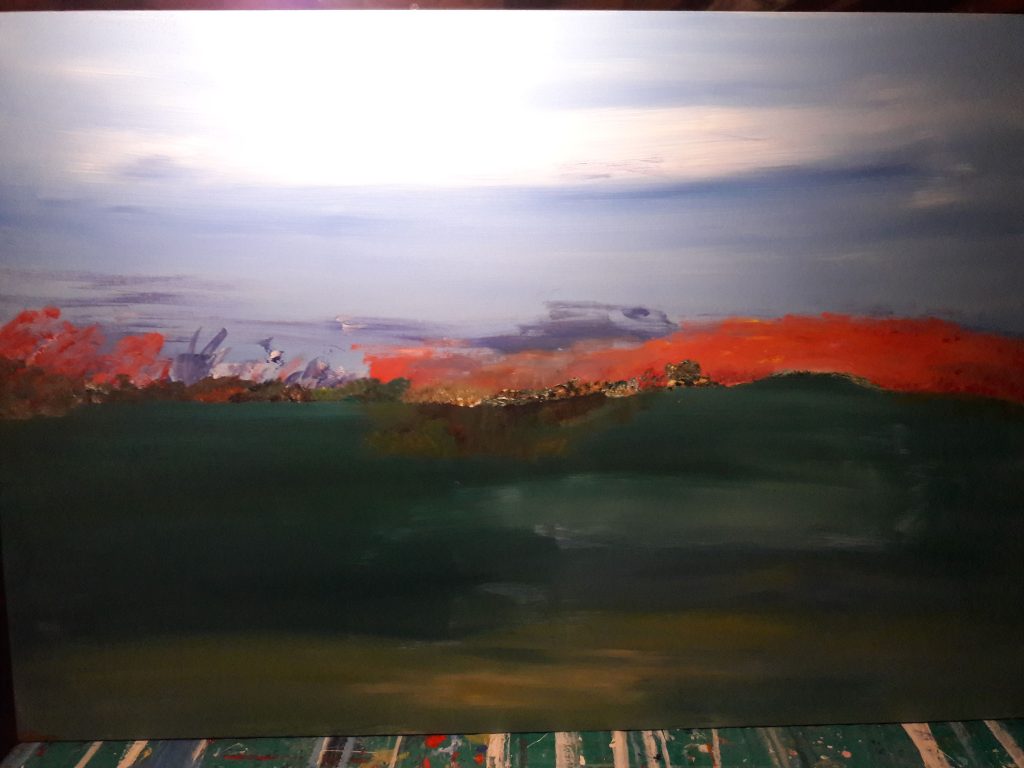
    I first put up, on April 19, three poems by Jax NTP. It was then the idea came to me to use my own paintings as the header images over the poet’s work. I was struck by Jax NTP’s atmospheric, impressionistic poetry. The poems are packed with energetic images changing with the speed of “Highway 61 Revisited”:

    “there’s a giant temple on hazard and new hope street
    blue reptile and green mazing skeletons, keepers of time
    how long can you sit there with the pain before you try to fix it?”

    from “how to pivot when you’re paralyzed,” by Jax NTP

    And I had just finished a painting, the impressions of which, the symbols within, the colors, the shapes, I thought might complement Jax NTP’s poetry. I don’t mean to suggest any of the paintings necessarily align with the poetry in any literal way. In any case, I continued to look for images within my collection of painting pic selfies for complementary impressions.

    Reading and reflecting on Jessica Sequeira’s poems, and later looking for a painting to go with the posting on QMT, I again felt the suggestion with impressions that seems the essence of poetry, particularly of poetical delight:

    “The heavens have promised rain for so many days.
    I think of waiting for torrents from the white sky.
    But it might be a long time. Or this could be a dream.
    Taking your hand, I guide it below, to my cloud.”

    from “Eastern Variations, style of Ikkyū Sōjun,” by Jessica Sequeira

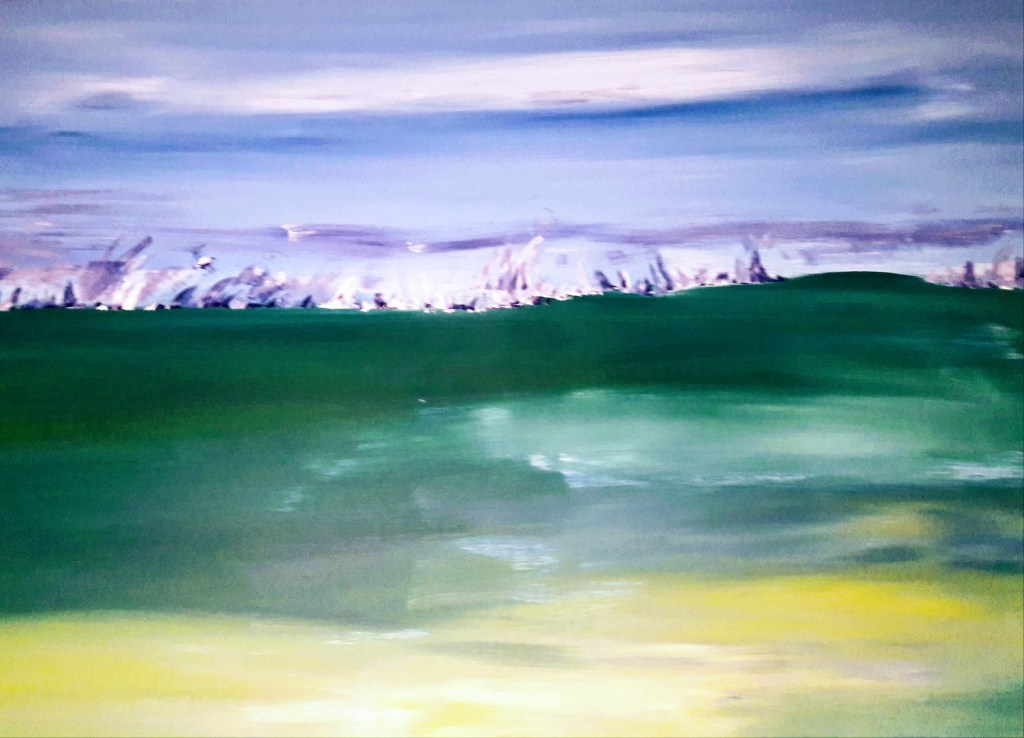
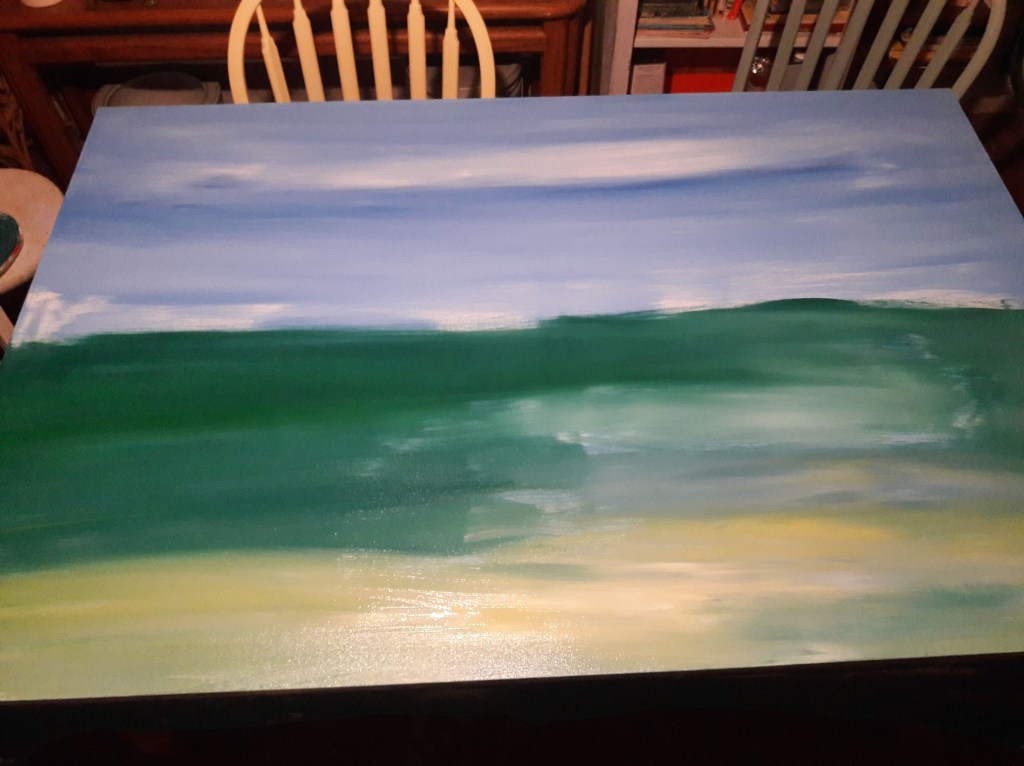
    I selected for Jessica’s poems a painting from last year, “City on a Hill,” a large painting that had taken some time to complete. Again, the setting of the poems and the painting seemed harmonious:

    “lakes shine like mirrors
    reflecting tall mountains

    rainfalls are unpredictable
    innocent changes in the divine mood

    birds sing into great holy spaces
    the wind whistles its reply

    icy glaciers plunge towards sky
    green valleys dive into earth”

    from “My South,” by Jessica Sequeira

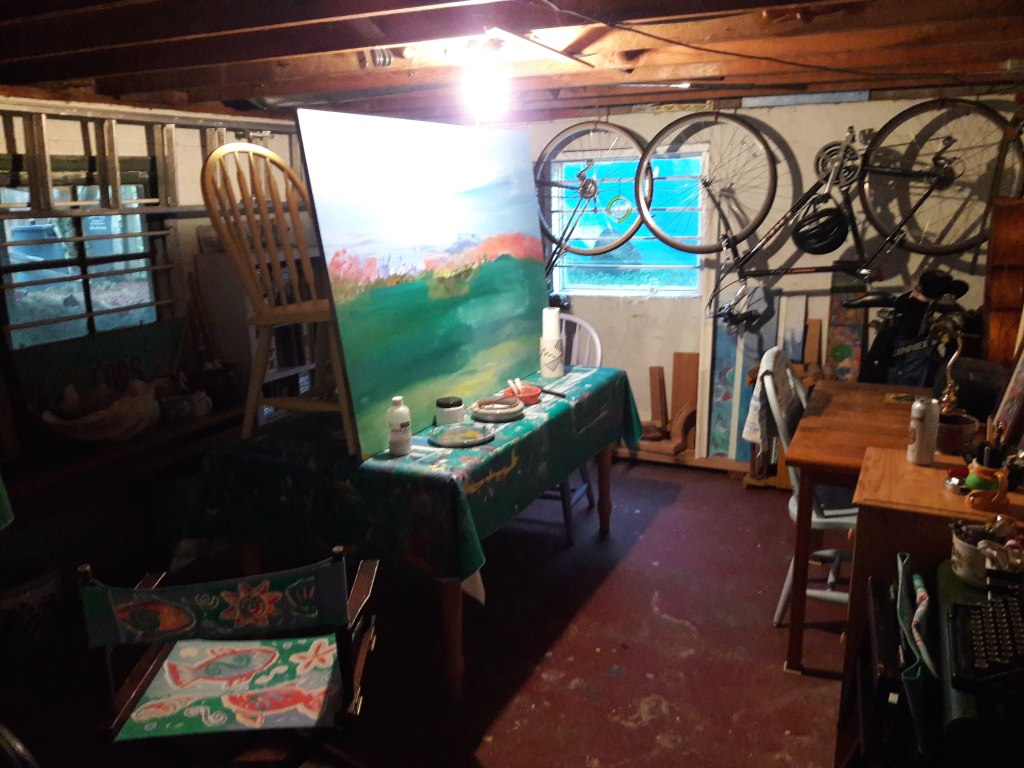
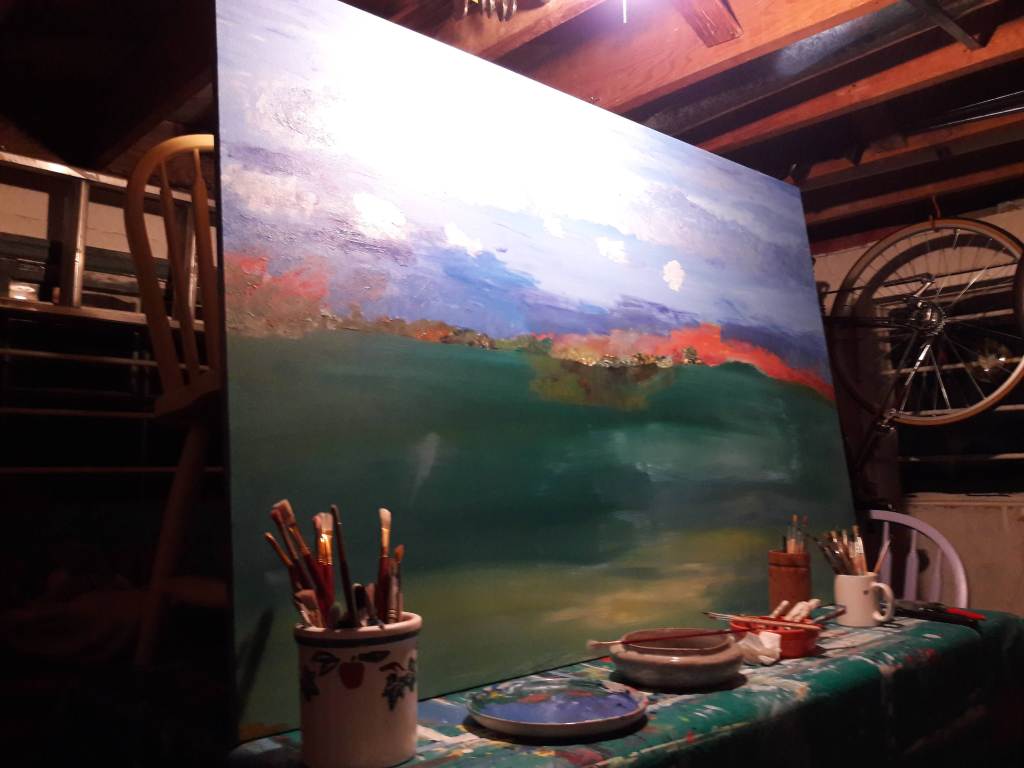
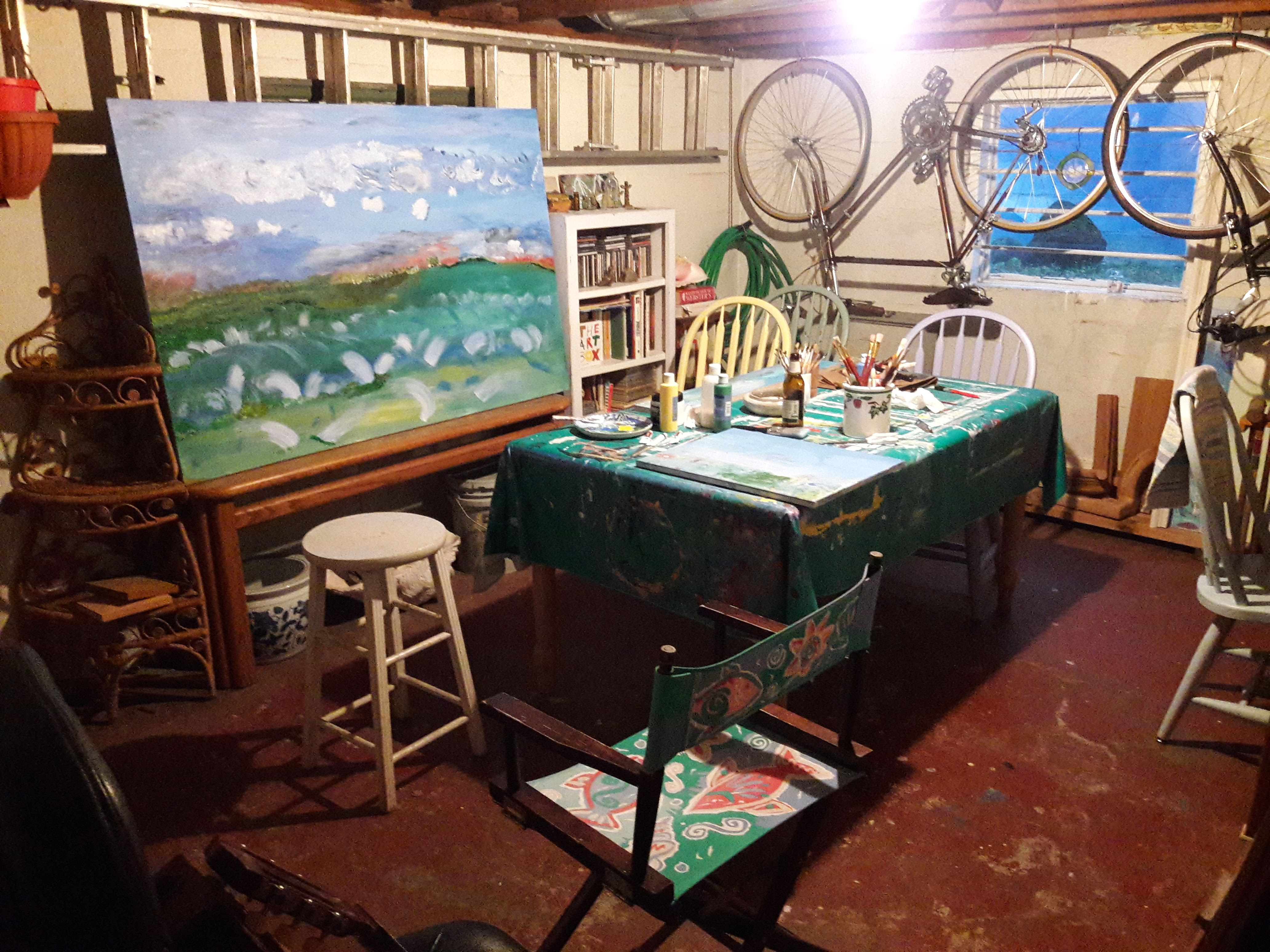
    I had taken numerous pics of “City on a Hill” when a work in progress in the basement studio:

    And I used an early draft of “City on a Hill” to go with Ashen Venema’s poetry:

    I sit still, watch him thin the oil
    and restore his long gone love
    on canvas, standing in
    as the young skin
    by the window, sunlit among
    lilies, fresh cut, and Persian rugs
    casually flung across seats.

    from “My Painter,” by Ashen Venema

    Well, the setting of Ashen’s “My Painter,” “sunlit among / lilies,” doesn’t quite align with the basement studio, though things are there too “casually flung.”

    All my paintings I eventually give away, to family, friends, colleagues, who show an interest and enthusiasm. “City on a Hill” is hanging in my daughter’s den, looking out upon the backyard. The light in the room is perfect. I just want or hope the paintings have a life outside my basement, where, as Ashen puts it in “My Painter”:

    “A blaze of light rims his white hair
    from under his thick swirl of brows
    black humour hides, and surprise”

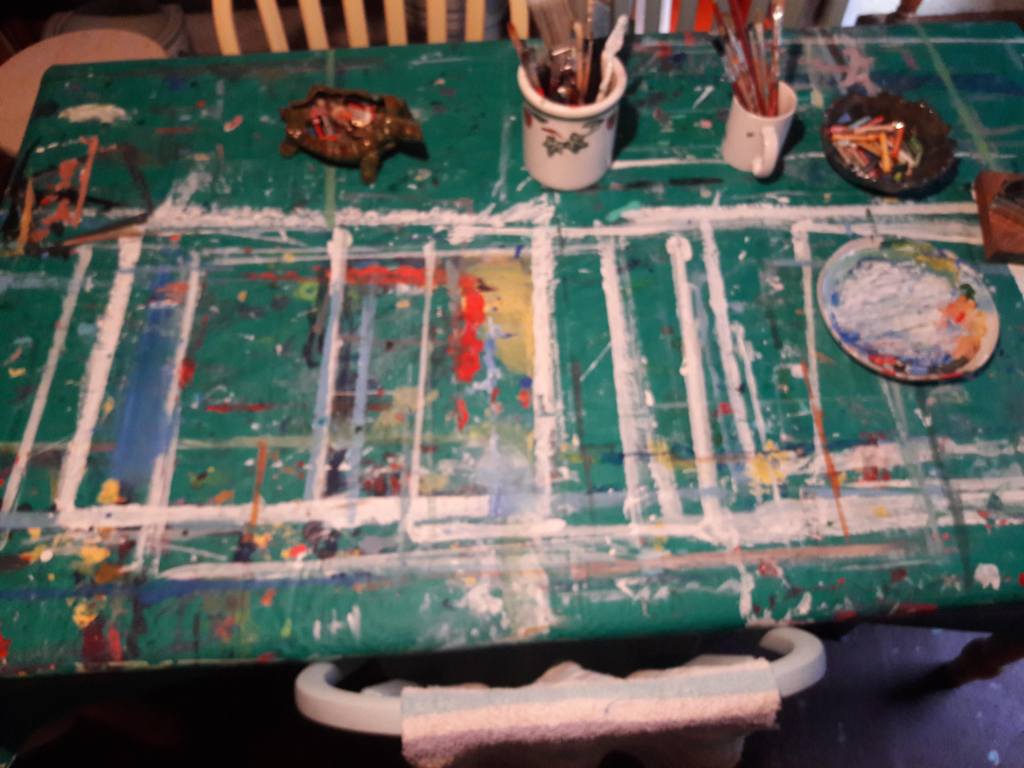
    After all the work on a painting, which isn’t really work, of course, but play, like the work of much poetry, we just might find a true work of art in what we’ve mostly ignored, in the mess we left behind. That tablecloth, for example, now that’s a work of art!

  • Cliff Notes

    ands all sitting
    Angst I a T
    hangs silently
    a long ways down
    High Flyer Falls
    rip rap cliff walk
    Do Not Look Down
    Set All Alarms
    Valuables
    tosses bought stuff
    lands rock pine tree
    calmly waiting
    sea craggy end.

  • The Noir Hack

    Met a hack on her back in the sack lovely but no ears
    lugged a sack of socks as winter uncoiled into spring
    all summer long rolled up socks & stuffed her bag
    till full it was wool tossed socks fool me going barefoot
    sandaled sock-less the warm early grasses of summer
    by the sidewalks along the seashore in a summer
    the weather news said would never end the waves
    the summer the ocean beaches & solid gold weekends.

    Noir fall & fell fall hard that year markets failed
    & on socks tariffs hit feet cold wet & sore toenail
    fungus infestation & the wooly cooly hack kneed
    trumpet ear tinkered her socks along the esplanade
    & came the coldest winter lemonade stands closed
    nary a beer at the end of the year she was rich
    & to boot boasted the warmest toes so near
    impressed in silk slippers she was when I left her.

  • Trees

    Some poems speak of love
    others hate.
    If you’re like me
    you like poems about trees.

    Trees are lovely and cool
    because they make shade
    which is nice to sit in
    with a mint tea in summer.

    A tree will grow hot
    turn crisp and line
    into stone menhir
    not even booklice will like.

    This poem is not about trees.
    Would somebody please
    send me a leafy poem?
    The shade here is thin, the sun so near.

  • Horny Theology

    A rufous whistled
    and hummed
    at my open door.

    She flew at my heart
    picked and snatched
    hairs from my chest
    for her nest.

    Me flat on my back on the floor
    while she sits on my face
    hooked to my lips
    slicing my eyes
    like an ophthalmologist.

    Her every winged flush
    as sweet and powerful
    as a rush of butterflies

    falling
    filling
    my coughing joy.

    To and fro
    true and from
    until

    ‘harumph’! 

    she blurted out
    and bolted off
    as quickly as she came.

    I thought she was a unicorn
    or a rhinoceros with wings.

    She left me
    without a prayer.

  • Ode to Joy

    Old monk drunk walk garden
    olive way moon path nude
    blue light strain powder pouring
    bare feet stains red muscatel.

    On his rock sits Jesus eyes clear
    tell him of your life sans joy
    brave Brother Anhidonus oh
    fun monk too but without joy.

    Hung over herbs your Jesus praying
    not an only child was he
    resting for the weak of passion
    who find no joy in silent being

    feel no peace no happiness
    no light of joy no sound of joy
    for the ears no touch of joy no
    raised goosebumps on the skin

    no taste of joy sweet salty bitter
    no sour bites teeth the tongue
    no smell of joy stirs memories
    no prayer saturates the temperate.

    No joy found in going silent
    sing for your soup of certitude
    what has brought you not to
    here certainly cannot help now.

    “The cut worm forgives the plow”
    Blake sang now you at least may
    forgive yourself and drink to joy
    lost to joy abstained all these years.

    Walk out of this garden leave
    transcend all plants and animals
    there above where the angels sing
    awaits the turn of your perfect being.

  • This bud was for you

    Across the street from the Estate Sale,
    there’s talk if it’s a teardown,
    while a couple of bushtits build
    a hanging nest in a paperbark maple,
    coming and going through the perfect
    hole at the top of the sack woven
    with string, spider web, tiny twigs
    and grassy strands yarned around.

    “Go easy,” she yearned. “Go around.”
    Then came the night she won’t spring back.
    Some do not come back,
    even as the buds rise in the rows
    heatly lubricated by the bees;
    not all the plants pull through
    that inscrutable winter stare.

    But to turn under? Finished now.
    Not to worry, the sun is the poshest one.
    His light goes shallow, into the soil,
    as easily as through fish water,
    a clean singing glow.
    The days are gone
    this bud was for you.

    20190402_183653