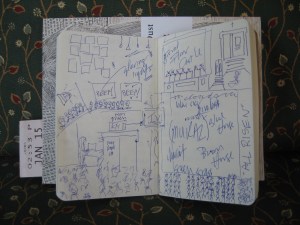
Month: January 2014

  • The Tooth, the Whole Tooth, and Nothing but the Tooth

    The Tooth IMG_0055The tooth was an expert, a specialist. He knew one thing, inside and out, and kept to his own. He seemed happy with his place, his lot, but he could be very exacting. He took peer review extremely seriously. He didn’t like being pushed around. He met his opponent squarely. He was polished; he was bald. He didn’t like stray hairs in his face. He thought all teeth should share his tastes.

    In his last article, the tooth articulated a taste, a feeling, really, testing for hardness and size an assortment of round hard candy. He usually preferred chances for the soft stuff, but he could pass off a lollipop like a soccer striker. He knew just when to bite down hard. He waited. He had tasted tongue and cheek.

    I remember the time he reduced my 1,000-page novel to a single tweet. Hilarity. I knew something was up. Then there was the time he reduced my grand slam dream to a sacrifice bunt. And then he squished my perfect wave to something like backwash out the Hyperion Treatment Plant outside El Segundo. The tooth was a master of the sedate.

    The tooth knew the end was near. He slinked back and waited. I thought he was sedated. Bad idea, eating the ice from the iced tea. That ice was the beginning of the end, that and the peanuts, the peanuts and corn nuts and sunflower seeds. I’d have been better off chewing tobacco or bubblegum. Baseball is bad for the teeth. Anyhow, the tooth did not chew. He stole and hoarded and hid his spoils.

    I called in McTeague, who shushed the tooth, his vice grip fingers grasping the truth. My tongue seemed to come unattached as I rubbed it softly one last time over the top of the tooth, like walking barefoot over a tide pool barnacled in black plaque.

    And where is the tooth now? Reduced to the cliché of a gaping hole and the source of a bad pun. How stealthily love deteriorates into a source of pus and infection (Yuch!).

    That gap the tongue now feels, a place apologists go to investigate past cultures.

  • On Boredom

    Today we gaze into the Abyss of Ennui. What is boredom?

    “Excess of sorrow laughs, excess of joy weeps”: In “The Marriage of Heaven and Hell,” Blake understood the Abyss, and sought to correct our assumptions and expectations. “The busy bee has no time for sorrow,” Blake said. But commuting home through an hour of plodding, plowing traffic, loaded down with work we’ve taken home for the weekend, we feel not the lightness nor the fickle flightiness of the bee. “The cut worm forgives the plough,” Blake said. Maybe, come Saturday night and he just got paid.

    Some tasks seem intrinsically boring. But we often confuse boredom with irritation, frustration, or addiction. Is boredom addictive? We say we are bored with what we don’t want. Tasks too bureaucratically procedural or repetitive lend themselves to boredom, not to mention carpal tunnel syndrome. What we don’t want to do, we put off, some of us; others, we jump in and get it done, so we can get on to something we find more interesting, those things we are passionate about. The former are the procrastinators, we are told, the latter the achievers. Both, though, we suspect, are susceptible to boredom.

    We often gravitate voluntarily to intrinsically boring tasks. What could be more repetitive than typing out another post? Physically repetitive: mentally, spiritually, and emotionally, the blogger flies with the bees of the cosmos! Really? I should try blogging.

    When we open the laptop or cell phone, we are not met with the organic breath of the compostable paper page of the book or newspaper. Someone should invent an app for smells, so that when we open the laptop, we are met with roses or the must of an old book. Maude had a similar idea in the film “Harold and Maude.” Harold is a bored rich boy, until he meets and falls in love with Maude. The protagonist is age; Harold is young, and Maude is old. Still, love alleviates Harold’s boredom, and after Maude, and after Harold sends his old life in a makeshift hearse over a cliff, the banjo.

    We hear of solutions that would alleviate boredom, suggesting boredom is a heavy and dark load that might be lifted from the bearer. Boredom begins to resemble depression. And boredom blends easily with guilt, for in a world saturated with pain and suffering at one end and glitz and shazam at the other end, who dare the chutzpah to turn the cheek of boredom outward? Quit your bitching and get back to your widgets.

    Does Superman ever get bored? Batman, bored? Spiderman? The specialist, it would seem, would be the first to suffer from boredom.

    In “Only Disconnect: Two cheers for boredom” (New Yorker, 28 Oct 2013, 33-37), about the relationship between boredom and distraction, Evgeny Morozov maintains that “to recognize oneself as bored, one must know how to differentiate between moments – if only to see that they are essentially the same” (34). When we’re bored, we want to be distracted, to take our minds off the monotony. We look down the assembly line of our lives and see nothing but more of the same, the same terrain, and unless we’ve been able to sustain an endless summer of surfing, we start to crave a fifth season, and we understand the winter and every other season of our discontent. The ability to click off one app and on to another is ongoing, but the solution creates another problem – call it the William Blake challenge: Excess of distraction bores, and we crave more and more distraction.

    On Boredom
    “What are you doing?”
    “Nothing.”
    “I’m bored! Let’s do something!”
    “I am doing something.”
    “You just said you are not doing anything.”
    “I did not say I am not doing anything. I said I am doing nothing.”
    “Oh, wow! You’re not going on another John Cage binge, are you?”

    What is boredom? John Cage provided what we might call a working definition: “It is not irritating to be where one is. It is only irritating to think one would like to be somewhere else” (Silence, 1961, “Lecture on Nothing”).

    If the specialist is the least equipped to stave off boredom, the artist is the best equipped. Because artists are generalists, they are able to turn their attention in different directions, outward or inward (whether at will or forced change does not matter) without the quality of disinterest or distraction. A true artist cannot know boredom in the act of art. Artists don’t require passion; passion is for amateurs. This is true for the painter or poet, gardener or dancer, musician or chef, surfer or clown, sailor or walker, potter or plumber.

    Got boredom? Get art. At the bottom of the Abyss sits art, doing nothing.

  • On Jury Duty, Poetry Gaze, and Yu Xiang’s “I Can Almost See the Clouds of Dust”

    In the Jury Assembly RoomAre you wearing metallic hairspray, metal flake rouge, wire under bra?

    A beep enlivens the line. Boots is told to back up and come through again, but again the beep, and she’s told to take the boots off, the line alert to its slowness, more prospective jurors wanting into the foyer and out of the fog, the enormous oak door squeaking and letting in whisks of cold announcing a newcomer.

    Are you wearing a hidden watch, steel mesh underpants?

    No, no, but again the beep.

    Boots takes off a vest and sends it through the scanner and walks silently though the screener.

    Impolite beeps like embarrassing burps, almost everyone is caught surprised.

    In orientation we learn a body of ennui weeps from the citizen soul, exudes from the body politic’s pores, but so far, the only claim supporting boredom comes from the introductory video. Still, one of the jury assembly room supervisors wittingly promises us boredom. But isn’t that what poetry is for, I wonder, a theory I soon begin to test.

    The jury assembly room is now nearly full, around 150 prospective jurors; what are we doing? No one is chatting. Sleep impossible under the surgical lights. The long, narrow room is like the sundeck of an ocean liner sitting in port.

    On the south wall of the room, facing the audience, is a large mural, bookended by flat-screen televisions, small and effete by comparison, the mural a colorful painting of a two-horse drawn chariot, one horse brown, the other blue, whip driven by a jester wearing a mask, and riding in the carriage, a kid playing violin, women looking up at trapeze artists swinging in the sky, a trumpet player, on the tailgate another jester – a tuba player in striped motley. An American flag blows from the rear bumper. Above and left of the chariot, a merry-go-round spins, to the right, a lighthouse stands at the end of a long, winding jetty, candy-cane red and white striped. On the horizon, white clouds whip along a deep blue, chatoyant, turning turquoise where the sea comes close to shore, the chariot hurling along a beach road, a border of green grass at bottom.

    At break I take a closer look at the mural, signed “Arvie”: a panel painting, a pentaptych, three large middle sections and two smaller end sections. An information label reads, Arvie Smith, Youth in Detention, “There Are No Impossible Dreams,” 2010.

    On the two television sets, almost no one seems to be watching, plays a morning cooking show, muted but with captions. What are we prospective jurors doing? Laptop computing, earphones plugged into cell phones, listening devices, reading, writing, trying to sleep, drinking coffee, eating snacks. No one is knitting (needles are disallowed).

    I get up and take a little walk. We are five rows deep times 30 or so seats to a section, about five sections, a few couches and tables at the far west end, then the bathrooms, a row of laptop stations at the east end, a small kitchen area with a microwave, filtered water, a pop machine, a candy machine, a bulletin board. Outside the kitchen are four, wall-size bookshelves courtesy the County Library.

    I reach in my bag and pull out Yu Xiang’s book of poems titled “I Can Almost See the Clouds of Dust” (Zephyr Press, 2013, 151 pages). There are ten sections, 44 poems, most confined to one page, with several longer poems, five notes, with an introduction by the translator, Fiona Sze-Lorrain, “Paris, France – July 2011.”

    I look at the first poem, titled “My House,” and enjoy the Chinese original on the facing page. Unable to read the Chinese, I look for characters that repeat, a stranger in a strange land. The English version is also 25 lines, a single, narrow, column-like stanza. The lines don’t rhyme. Words bounce down the page like an oblong stone kicked down a sidewalk. The images are clear. There’s a reference to “Pedro Paramo,” and the last line, in French, repeats the title of the poem. So that’s how it is, a you and an I. Who is you, and who is I, and who is Pedro Paramo? And whose house is this, yours or mine? Yet this poem does not ask questions; it gives answers, as a home speaks, even to a stranger.

    The next poem is titled “Street.” So we move from the house to the street. There are three stanzas: 5 lines, 6 lines, 3 lines, one that sings:

    “we drink beer, peel edamame”

    “Street” ends on a note of love.

    Most cases settle before juries are called. Court is expensive.

    It’s a wonderful mural, full of color moving across the wall like a screen in a movie theatre, the jury assembly audience as still as popcorn in a cardboard box. Suddenly, though not entirely unexpectedly, we are dismissed for the day.

    Jury Duty, Day Two. The mental note I made yesterday to bring a pair of sunglasses today failed. The library-bright lighting hums from the courthouse-high ceiling. I read an essay in the Philip Lopate book, discussing the rhetorical basis of the personal essay. Every text is an argument, Trilling argued. I’m ready for a break already; arguments about argument have lost their allure. I look around at my jury peers. One of my neighbors, Ursula, is eating a banana. Another, Penelope, appears asleep behind sunglasses. I don’t really know their names, nor have I spoken to them. I give them names suggested by the books they are reading. I think of getting up and walking about, but I don’t. I’m sleepy. At break, I go into the hall and buy a cup of coffee from the busy kiosk.

    I’m sitting in the back row again, mural right. None of these chairs is anchored to the deck. Hopefully the seas will stay calm. The television plays a piece on the Portland Bridal Show, a silent movie. I put the Lopate back in my bag and take out the Yu Xiang, which I’m now reading for the third time in a week. A young woman a few seats away is reading sheet music, a musician, it seems fair to conclude, as I warm up for a case. I return to my Yu Xiang book of poems. But somehow seeing the girl with the sheet music has made Yu Xiang seem so distant, and China and poetry so complicated. I text Susan, no answer. The jury room supervisors call a break. Good, I’m exhausted from the Lopate. I get up and move about. No one is talking in the jury waiting room, no conversations, more quiet than a library, an odd silence, given the size of the waiting crowd. I remember another jury duty I served, some years ago, when the room bustled with games and conversations. Citizens today are electronically put to sleep.

    My name is called and suddenly I’m on a case. I finish the orange I brought from home. The adrenalin kicks in, from the orange or from being called, I’m not sure, but I feel awake, alert, refreshed, and healthy.

    I make it through the selection process with 14 of my peers (12 + three alternates). The case begins. Judge Franklin Mahon Coughca provides an overview and instructions. The prosecutor explains the dispute: a poet is accused of writing wrong poems.

    The defense doesn’t take long, in essence, “so what?” I’m inclined to agree, but I remember my duty and try to be impartial and unbiased and all that. I want to hear what the jury of my peers thinks.

    The jury deliberates:

    The twelve jurors: a Waitress; a Plumber; a Bassoonist; a Car Wash Attendant; Penelope; a Receptionist; a Care Giver; a Hairdresser and Masseuse; an Architect’s Assistant; a Bank Teller; a Computer Programmer; a Street Sweeper – plus three alternate jurors, a gas station attendant, a financial analyst, and a blogger.

    As it turned out, I’m only an alternate juror, but on the strength of my being a blogger, I’m asked to volunteer to take notes.

    from my Notes:

    Yu: Are there any dogs in his poems, apartments and balconies, flies? These things are all elements of an engaging poem.

    Ursula: Some of these words appear to be spelled backwards. What’s that called?

    Care Giver: Is there a woman converging the real with the imagined?

    Penelope: Is there a water closet?

    Computer Programer: Is there a business side?

    Bassoonist: Is there music?

    Receptionist: I hate poetry, always have. What’s the point? If you have something to say, say it, in as few words as possible, and clear, so everyone can understand exactly what you mean, and then shut the hell up.

    Hairdresser and Masseuse: Well, but poetry is like art, I mean, isn’t it? Isn’t there always like some secret message, some code, like a moral to the story?

    Car Wash Attendant: This one looks like a sign of some kind, like telling people which way to go, you know?

    Computer Programmer: If you think about it, there’s only letters and spaces. That’s it, that’s all there is to it. Case closed.

    Waitress: But they’re not all the same size.

    Architect: I think all of these poems are wrong. I say he’s guilty and let’s go home.

    Plumber: Maybe we should read some of these poems out loud.

    Computer Programmer: I always thought poems were supposed to rhyme until I met my wife.

    Architect: Poems can rhyme or not rhyme. That’s what I don’t get. How do you know if it’s even a poem? Could be some sort of laundry list or grocery list or something. You know what the problem with poets is? They don’t make anything.

    Yu: We must look for keys and keyholes, and personal pronouns strewn in shredded syntax.

    Street Sweeper: Did the poetry police not violate his rights?

    Yu: This is my body.

    Penelope: These appear to be poems of procedural polity.

    Ursula: There’s a bit of rhyme, punctuality, is that what it’s called? The words have sound.

    Bassoonist: They look ritually safe to me.

    Penelope: A poet should be culturally accountable.

    Waitress: I knew a poet once. He was one of these guys always taking pictures of his food with his cell phone. I guess he published the pictures online or something like that. And the poems were like captions or something, you know? Like subtitles. To the photos. I don’t know. He seemed like a nice guy.

    Yu: Do you take this wolf to be your wife?

    Plumber: I do. I mean, I would, if I could.

    Ursula: One might as well ask about law and order on a different planet. I don’t understand how they could not have resolved this dispute out of court.

    Bassoonist: But that’s neither a question nor an answer, not much of an argument.

    Yu: That’s an interesting sentence.

    The Verdict: The jury finds the poet innocent, but nevertheless he’s sentenced by Judge Coughca to 1,000 years of community service, to be served as an adjunct instructor of the research paper, with no hope for tenure.

    The judge thanks the jury for its service, and we walk back down to the silence and security of the jury assembly room.

    I take the Yu Xiang from my bag. I’m thinking of poetry gaze. In a land where poetry has been devalued beyond zero, isn’t every poem a sigh of dissentire? What is poetry gaze? I feel like Yu Xiang is watching me reading her poems. But she does not care what I think, nor even what I might be feeling. Then again, her poems are like

    …a door that says:
    Be careful! You might lose your way”

    (Yu Xiang, from “I Have, 2002,” p. 67)

    +++

    Eleanor Goodman interviews Yu Xiang.

    Yu Xiang talks about her writing in a dialog (In Search of a Transient Eternity: Chinese Poet Yu Xiang BY Fiona Sze-Lorrain & Yu Xiang) at Cerise Press.

  • The Feng Shui of Car Chit Chat

    I say I’m thinking of a book She tells me where to turn.
    on lost practices to places. There’s a space, she says,
    She offers or a poem about expecting me to pull into it
    true and correct directions, and park, and when I don’t,
    and tells me to hang a right she hums a bit vexatiously
    at the light that turns green. at our dual needs to control.
    The real question is how to We’re in the car a long time
    enter a poem without hurt, to and from, back and forth.
    and once in, to sweep clean She prefers driving modus,
    the wrecked words of glass handling the stick so softly,
    littering from here to there not to foreshadow distance
    the streets of conversation. the clutch to engage slowly.
    We unload the grocery bags. The winds tipped over a pot.
    She holds the milk and wine. A couple of chairs blew over.
    There are flowers for a vase. The clocks tell the electrical.
    The car off cackles and cools. I map a plan from the guitar
    The house is an ancient map to the kitchen, avoiding trills,
    in a bottle tossed must ocean. my socks stilled in tambour.
  • Notes on John Fante’s “Ask the Dust”

    John Fante’s “Ask the Dust” is a conservative and cynical, short poetic novel. It’s poetic because its episodic movement is tense and packed, its diction deliberate, satisfying Ezra Pound’s definition of poetry. It’s cynical because of its unrelenting brutality posing as reality. Must one always suppose that to live in seediness and squalor means to live unhappily? The antonym climb from the seedy leads too often to the high-class, which breeds its own pot of seed. And it’s cynical because it views unrequited love a mean and debasing disease; it’s cynical as Nietzsche is cynical – it’s nihilistic. It’s conservative because the characters are portrayed as hypocrites who get what they deserve, base characters whose tasteless origins explain their bad decisions. It’s conservative because its hopes are grounded in middle class values, where shame is used as a tool to control, even to control oneself. It’s conservative for its traditional views locating alcohol and drug abuse at the heart of human decline and misery, where lust is confused for love, and abuse for affection, and greed for dreams. At the same time, it’s possible to read the novel as an American proletariat satire, a tragicomedy, but first you have to allow tragedy off its pedestal. Then again, maybe it’s just farce, the difference between satire and farce being that satire has a point.

    The action takes place during the Great Depression. The year is 1933. The young, first person narrator and main character, the hyperbolic, capricious, and vindictive Arturo Bandini, has relocated from Colorado to Los Angeles to win fame and money as a writer. The character would today remind us of the 1968 Hal David lyric, “Do You Know the Way to San Jose,” which references wannabe actors who are employed at the bottom of the Hollywood food chain, literally. The prototype gets off the bus at Hollywood and Vine, cardboard suitcase in hand, expecting to walk onto a movie set, but soon finds himself running hotel shuttles to the airport with aspirations to work his way up to a bellhop job. Except in the great Bandini’s case the stereotype is true. He sells a couple of magazine stories and then a novel. But he knows not frugality, the temperamental Bandini. He spends lavishly, wastefully, funnily – buying, for example, two new suits, only to yank the clothes off in frustration for their ill fit and general unsuitability, as he digs his old but comfortable duds out of his trash.

    Bandini’s (if you can take his word for it) extensive reading has done nothing to soothe his scorched brow as he types feverishly away at his torched stories. He claims familiarity with Joyce, whom he’s going to give a run for his money, and while he hasn’t read Lenin, he’s heard him quoted, and claims allegiance to Lenin’s idea that religion is opium for the people (22). He apparently hasn’t read Marx either. He’s read Emerson and Whitman, though, but no help there either for our lovelorn antihero. And Bandini has read Mencken, which is where he might have acquired his idea of a sense of superiority. Mencken plus Nietzsche plus greed – now there is a formula for the will to power. But: “You have read Nietzsche, you have read Voltaire, you should know better. But reasoning wouldn’t help” (96). Bandini is a hypersensitive, mood swinging, hypercritical victim of unrequited love, determined to get revenge by writing his way out of the storm and win his love by twisting her arm and knocking out her humiliating boyfriend.

    In the middle of the book, Bandini follows the mysterious Vera Rivken down to Long Beach. So far, he’s not capitalized on his chances with women. Something always goes wrong, usually with his mood. He’s easily insulted, and his own tongue is so brazen and quick and uncontrollable that what offends his ear causes a whiplash to fly out of his mouth. He’s a braggart, but his wit and aim usually hit the target, yet he’s prone to even the score immediately through his self-loathing. His every resolution is betrayed in his next breath. In Long Beach, he’s caught in the earthquake, which scares him back to church, and he even “gave up cigarets [sic] for a few days” (104). He’s a human yo-yo: “This interested me. A new side to my character, the bestial, the darkness, the unplumbed depth of a new Bandini. But after a few blocks the mood evaporated” (108).

    “Nothing like it since Joyce” (113), Bandini says. Nothing like it before, either. Consider the trip into the Valley with Hellfrick, who bludgeons a calf and drives it back to their hotel in LA where he promises Bandini “a lesson in butchering” (111). It’s scenes like that one that give the short novel its episodic and spasmodic structure. Time dances. In places, the writing is like something out of a comic book. This idea is even made explicit: “take that, Sammy boy, and that, and how do you like this left hook, and how do you like this right cross, zingo, bingo, bang, biff, blooey!” (118). And then comes the set piece, the letter criticizing Sammy’s efforts to write, which indeed is “devastating” (119). But that’s ok, because before dropping it in the mailbox, Bandini changes his mind yet again and rewrites it to give Sammy some legitimate help. Besides, Bandini’s in love, and “Who cares about a novel, another goddamn novel?” (146), this one included, the one we’re reading.

    In the end, “Something was wrong, everything was wrong” (160), and we wonder why bother with any of it, the flip flopping, the depression, the indecisiveness and lack of commitment, the vengeful, childish fantasies. Well, because that’s just where things begin to ring true, and you can hear the noon Angelus bells ringing throughout the Basin. This acceptance that this is really how people behave, including, perhaps particularly, people in love, is apparently what attracted Charles Bukowski to the book. In his short introduction to the 1980 reissue of the book (originally published in 1939, then out of print), Bukowski suggests he liked “Ask the Dust” because it seemed to be about the street from the street. He says Fante was an influential writer for him.

    And who was John Fante, and what did he do after “Ask the Dust”? As it turns out, Fante may not have been as interested in the street as in getting off the street. This is what Bandini wants. Interested readers will benefit from a series of interviews (about four hours worth) conducted by Ben Pleasants at Fante’s place in Malibu in the late 70’s. The link is to 3:AM Magazine. The first interview mentions Edmund Wilson, and Pleasants and Fante wonder why Wilson didn’t review “Ask the Dust,” particularly since Wilson had shown the special interest in California writers. Pleasants suggests Wilson’s “The Boys in the Back Room” (about California writers James M. Cain, Horace McCoy, Richard Hallas, John O’Hara, William Saroyan, John Steinbeck, and Hans Otto Storm) came out before “Ask the Dust.” But my copy of Wilson’s “A Literary Chronicle: 1920-1950” indicates, at the end of the chapter on California writers, “These notes were first written during the autumn and early winter of 1940” (245), so after “Ask the Dust” was published and out. Wilson then adds a postscript after F. Scott Fitzgerald and Nathanael West die within a day of one another in late December, 1940, where he seeks to “make the California story complete” (246), and the end date for the whole chapter is then given as 1940-1941. Maybe Wilson excluded Fante deliberately, or maybe he simply had never read him. Wilson’s opinion about Hollywood was clear, “…its already appalling record of talent depraved and wasted” (249), but for the Fante of “Ask the Dust,” that apparently was still ahead.

    John Fante, “Ask the Dust,” 1939. With an Introduction by Charles Bukowski, 1980 (Black Sparrow). First Ecco edition, 2002, and with Archival Material (24 pages) in First Harper Perennial Modern Classics edition, 2006. The text of the novel is 154 pages in the Harper edition.

  • A Cat’s New Year’s Resolutions

    A Cat's New Year“Happy New Year!”

    “Thanks, but what’s that ringing?”

    “You’re supposed to ring in the New Year and cheer!”

    “I don’t know where you get your ideas.”

    “From blogs!”

    “I might have guessed.”

    “Do you have any New Year resolutions?”

    “Yes, as a point of fact, I do, to wit, but one.”

    “And?”

    “To increase both the frequency and severity of naps.”

    “Ah, that’s the same as you had last year. Want to hear mine for 2014?”

    “No.”

    “This year, I’m going to avoid the near occasion of sin, cut out candy, shorten my tweets to be more clear and concise, listen more attentively, love. I want to love more. I want to bring back the Summer of Love, 1967! I want to live in harmony with the birds and squirrels, raccoons and possums, slugs and toads, bees and wasps, all that is electric and all that is acoustic. I’m going to give more and take less. I’m going to give kisses away, free, on every street corner I round. I’m going to sing more. Joe said it’s never too late to start singing. I’m going to learn to play a musical instrument, something with strings. I want to play soft and mellow and moist. I want to draw a bow across a string that creates a whine like a train. I’m going to watch more movies, Doris Day and Danny Kaye. I’m going to walk more, go for mysterious walks, step out, step it up, wander at will through this urban landscape we call home.”

    “The odds weigh heavily against any of it.”

    “If life is a gamble, I’m all in.”

    “And I fold.”

    Related Post: A Cat’s New Year’s Celebration