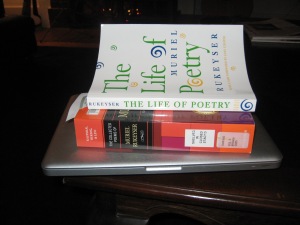
 Muriel Rukeyser’s “The Life Of Poetry” covers the poetic experience, its many uses and resistances, during the 1940’s. Her view of poetry comes from the experience of war, by her participation in freedom efforts prior to the war, and by disappointment the war did not bring peace, and also by science, which suggests a new age for poetry, and by the growing use of popular arts (radio, movies, songs, dance). Muriel argued that US culture feared poetry, where poetry is emotion. Emotion is feared because it calls up and recognizes harm, and asks for reparation for harms done. But who wants to do that? So poetry isn’t a popular art form. It’s not an art form at all. Once poetry becomes an art form, it freezes on the surface: No myth but movement, no still lives, no basket of fruit and the hovering fly that never dies. And the poem is not a “place” (154, 174), the mind not a hunk of meat. Both are energy. The emotion of poetry creates empathy and argues for change. She was writing about silicosis as early as 1938, advocating for victims, explaining the disease. Empathy is recognition, which is also emotion, of the audience, which she prefers to call the witness. What is witnessed? Relationships: between images, sounds, symbols, people, things. And relationships are constantly on the move. Nothing is fixed, not in time, not in space, not in mind.
We probably do dislike poetry, at the least ignore poems, or even scorn poetry, treat poets like vaudeville clowns, but it would seem a bit overwrought today to say we fear poetry. But when Muriel says we fear poetry, she means we are separated from emotion, and the thought of reconnecting to our emotion scares us. Human nature probably does not improve over time, in spite of technological progress, and we may be further removed from emotion today than we were in 1949. The culture Muriel’s talking about does not value emotion, the emotional. The sections of “The Life of Poetry” devoted to the popular arts and the uses of poetry in the sentimental suggest lost opportunities. The popular arts fail to go deep enough. Sentiment is unlike emotion. Emotion is a weakness because, once it is unleashed, it is uncontrollable. Control is a value. One attempts self-control, and when that doesn’t work, control over others. Allowing the working class, the miners and laborers and factory workers and garment sewers and waitresses, weekend release over a couple of beers and a country western song playing on a jukebox, evoking tears, or the equivalent sentiment found in church prayer, is acceptable. But no emotion. Control yourself. Get sentimental if you must. It’s ok to vent. You can wear it on your sleeve, your troubles, but don’t freak out. And self-pity also is sentimental.
“There is difficulty in breathing.
Yes.
And a painful cough?
Yes.
Does silicosis cause death?
Yes, sir.” (Rukeyser, Collected Poems, “The Disease,” 86:87)
Emotion is the weary heart wearing and tearing on the poet’s sleeve. This doesn’t play well in boardrooms, where emotion is kept submerged through charitable donations and the branding of giving, or in churches where the sacrifice is symbolic, or in marriages of competition. Emotion is not anger. Anger is the sediment of sentiment, frustrated or undefined or ill-defined desire. Poetic emotion sublimates repressed desire. Poetic emotion is the sublimation of antithetical cultural values. For example, the auto has ruined the country, the countryside, the culture suffering in detrimental reliance. Without definition, this ruin devolves into road rage, the driver’s psyche full of potholes. Sentiment is nostalgia for a 1957 Chevrolet, road trips, surf safaris. The car is a catastrophe, the planet hit by an asteroid, impossible now to see the earth beneath the asphalt. But the smell of the new car still intoxicates, Whitman’s rooms full of perfumes. What to do about it? Robert Creeley, “I Know a Man”:
“drive, he sd, for
christ’s sake, look
out where yr going.”
The novel as middle class entertainment contains emotion; that is, the novel packages emotion, places limits on emotion, surrounds emotion with form. As for the dime store novel, mysteries, detective stories, noir: the term “hard boiled” is born of sentiment. The so-called seedy section of the city boils with sentiment. The sentimental love to visit, but they don’t want to live there. It’s good to have someone to look down on, to criticize, to arrest. Likewise, poetry as craft is sentimental where it deliberately obscures to imitate emotion. The merely personal or found fabrications or wordplay that does not touch the human condition is entertainment. Not that entertainment isn’t useful; it is, but it’s not poetry. Poetry is the marriage of play and work, where play pays dividends and work pays nothing but a release of emotion, which spells trouble. Muriel describes a workshop exercise (179) that might be called “where’s the poem”? The poem exists in the imagination of the witness, and that’s not craft. A poem is not words.
There is a war between play and work, between worker and exploiter, between the divided selves. Poetry acknowledges the war and becomes a tool to make people whole again. Emotion is the stain of war that poetry seeks to clean. There’s another reason emotion is devalued, suggests Muriel. Emotion connects to nature, to trees, to roots, to the land and to animals. That’s seen as cutting into profits, though it need not. To reach down into the emotion that connects the human to the planet requires a reevaluation of the relationship. Today’s eMotion is backlit. That’s not the emotion Muriel is talking about. Muriel’s emotion sews together symmetrically a sensorium distorted by technology as in a funny mirror. Muriel’s emotion deals with alienations and depravations, goods and evils.
Important poets for Muriel included Whitman and Melville. Whitman is the poet who discovered good, and good is his breathy line, the form of the discovered self, the freed self. To Melville passed the work of dealing with evil. Muriel foreshadows the current crisis in the Humanities by juxtaposing poetry with science, comparing methods, making good use of science. Imagine your kid comes home and tells you he’s decided to study to be a cave wall painter, and he’s going to work in caves, painting on walls by the light of a torch. Fear of poetry is about resistance to emotion, but more, about the resistance to the imagination, about inability to even recognize the imagination.
“The Life of Poetry” is not an academic book (a good thing), but it’s not an easy book. For one thing, the references to popular culture are antiquated, and some of the references are obscure. For another, there’s evidence on every page the writing is the work of a poet. But by the last two chapters (the penultimate “Out of Childhood,” and the last, beginning “The Meaning of Peace”), the prose becomes familiar, the writing a little less fearful.






 The Coming of the Toads